ALL FOR
SPEED
AND SIDECARS
Speed 1
Chapter 1: Pre-ramble
- John
My interest in all things mechanical began at a very early age, in fact during my preschool years when the world was still enjoying the last knockings of the age of steam and electricity was quite new. This was long before the invention of plastic and electronics, when most things from a mangle to a crane digger were mechanical.
At home I would derive added value from my tin plate, clockwork or friction drive motor toys by dismantling them to fathom out how they worked. Unfortunately I did not possess the manual dexterity, tools or the patience to reassemble them. The distorted tin plate tabs would no longer line up or go through the slots from whence they came. By the time I was at high school I had progressed to dismantling mechanical clock movements. Much later, around the age of 14 to small internal combustion engines, or as I preferred to call them Infernal Contraption engines.
My schoolmate Ron, also afflicted with “motorcycle mania” often visited AE Piggott & Sons' scrapyard, next door to Frank Berry’s in Western Boulevard, Leicester, where we scrambled across piles of scrap motorcycles to retrieve trophies, usually timing case covers plus other interesting items, from marques and models which we had never seen on the road, such as a Panther (Phelan and Moore) 350 OHV.
On one return trip on foot from the scrapyard we were walking down Walnut Street when a girl who was walking in the opposite direction smiled at me.I was flattered at attracting the attention of a pretty female, but my pride soon evaporated when I got home and saw in the bathroom mirror that I had a huge stripe of scrapyard grease on the side of my face. I chastised Ron for not telling me. He thought it was a big joke, which it was, — on me. The girl was only smiling at my scruffy, unclean appearance.
We were lucky to have been at that age at a time when many married men were exchanging their motorcycles, with or without sidecars, scooters and mopeds for small family cars. At that particular time old but still serviceable British motorcycles could be bought for more or less scrap prices, which is just as well as I was always short of readies.
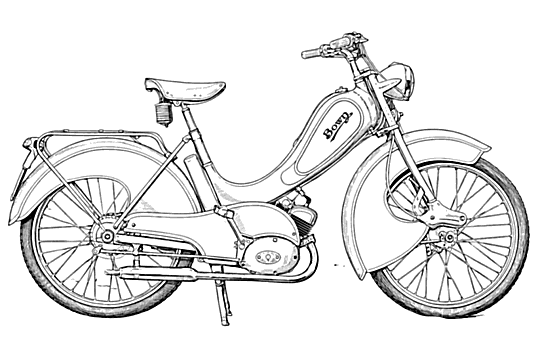
My first acquisition was a 50cc Bown moped with a German single cylinder, piston ported 2-stoke Sachs engine. It didn’t run, in fact the frame was broken, but I learnt a lot by dismantling the engine.
At the scrapyard I also found a complete 1950’s 50cc Trojan Mini-Motor engine which was designed to fit above the rear wheel of a normal bicycle to convert it into a moped. The drive shaft of the motor was fitted with a serrated roller which provided friction drive to the crown of the rear cycle tyre when the motor was lowered onto the wheel. The cooling fins on the cast iron cylinder barrel were vertical so the engine was designed to operate in the horizontal position. The cylinder head was aluminium and electrics were provided by a Wipac combined flywheel magneto and dynamo.
I bought a new set of piston rings from Wellworthy of Lymington and Ringwood, Hants who had a retail outlet on Belgrave Road. From 1959 The Trojan Works in Purley Way, Croydon, Surrey, became the main UK concessionaires for Lambretta Scooters.
For a short time before they closed in the 1970’s, Petty’s stocked a few French mopeds as complete machines, which were essentially heavy duty pushbikes with a small 2-Stroke motor, similar to the Trojan, suspended or the front wheel. (This may have coincided with the closure of the Velocette works in Hall Green, Birmingham, for which Petty’s had been a main dealer.) Drive was again via a serrated roller, this time bearing on the front tyre. One of the few front wheel drive motorcycles perhaps?
Whilst in my fifth and final year at high school my uncle Colin gave me an Austrian Puch SRA 150 “Alpine” scooter which was a tidy looking machine with 2-tone blue paintwork. It had a German 2-Stroke Sachs engine of 150cc displacement. The exhaust system utilized part of the tubular frame of the machine which made decarbonisation impossible.
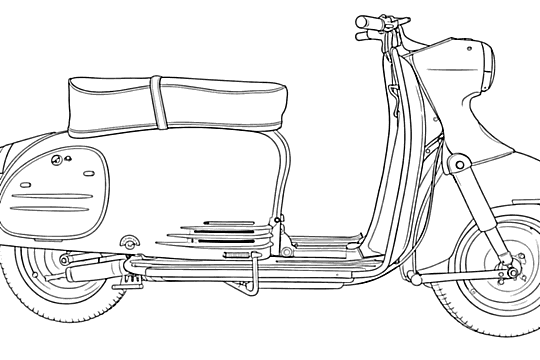
I rode it many times up our back garden path, dripping droplets of thick black goo onto the slabs, much to the annoyance of my long suffering mother who, time and time again, insisted on removing the goo on her hands and knees with a scrubbing brush loaded with Ajax scouring powder and water. The scooter was eventually taken by my father to Dobbo’s scrapyard off Hastings Road Leicester where my father worked in an engineering factory.
Next came our Cyclemaster period. The Cyclemaster was a complete motorized rear wheel with a back pedalling brake and included the small petroil tank with an integral oil measuring cylinder in the filler cap. Engine capacity was originally 28cc though later models were bored out to 32cc. Ignition and direct electric lighting were again provided by a Wipac combined flywheel magneto and 6 volt dynamo. Engine cooling was provided by vanes around the periphery of the rotating hub which formed the motor housing. Fuel consumption was claimed to be 230 miles per gallon, though who would want to ride so far on a pushbike?
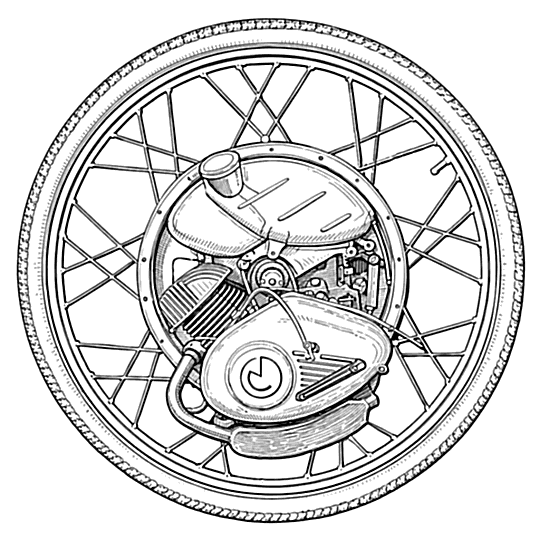
With some modification the Cyclemaster unit could be fitted to any standard adult bicycle frame. Usually the rear forks of the standard bike frame had to be forcibly widened at its extremities to accommodate the wider Cyclemaster rear wheel. The fatter tyre on the Cyclemaster might also create problems with chafing if incorrectly aligned. BSA made their own version which they named “The Winged Wheel”. All in all the Cyclemaster was an uncomplicated, compact, and well thought through design which provided off-the-peg get-to-work motorized transport for a relatively small outlay.
Ron was the first to acquire a pushbike with a Cyclemaster engine in. We were 14 or 15 at the time so had to ride it around a field at the bottom of Park Drive LFE where Ron lived. The field was also at the back of the M1 Fosse Services. To start the Cyclemaster the petrol tap had to be turned on and then choke closed manually at the engine. The clutch lever replaced the left hand rear brake lever on the handlebars, hence the back pedalling brake. The starting procedure involved pedalling the heavy bike along as fast as one’s legs and energy would allow and then drop the clutch to start the engine spinning. With luck the engine would fire up and the rider would have to dismount immediately to fully open the choke device which was attached to the air cleaner of the carburettor.
According to the handbook ascents required “light pedal assistance”. The performance of Ron’s Cyclemaster was disappointing to say the least, so we decided to give it a “de-coke” which was a manual de-carbonization process necessitating the dismantling of the exhaust system, cylinder head and barrel. The exhaust port of Ron’s engine was almost closed by oily carbon deposits. After we had scraped away all of the offending carbon and reassembled the machine its performance was transformed immeasurably, but it still wouldn’t blow one away.
Whilst still on the subject of Cyclemasters; after I left school my uncle John passed on 2 Cyclemasters to me which had formerly been the property of my father; one of them still registered and fitted to my Dad’s “Golden Rudge” pushbike. I got it insured third party only for a pound or two, but on a maiden trip it developed a flat rear tyre and I couldn’t be bothered to remove the wheel, brake anchor plate and connecting cables to fix it. I had other things to do, other places to go and quicker ways of getting there.
My mother’s youngest brother Mike was slightly less than 7 years older than me and was into rock and roll and motorbikes, so I naturally followed suit. He seemed more of my generation than were his older siblings so I looked up to him like he was a big brother, when technically he was my uncle. Otherwise, in hindsight, there wasn’t much else to look up to. Doesn’t every mixed up youth need a hero and a role model? I did but the choice was limited and not that great.
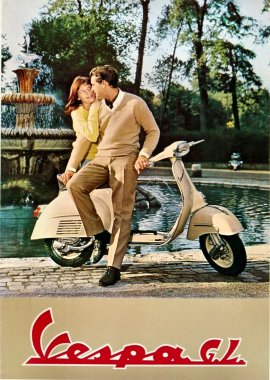
Mike’s first machine was an old Vespa scooter, which I had pillion rides on. (He may not have had a full licence at that point). It was a very strange sensation for me when Mike leaned into corners and I tried to remain upright. That was until he told me that I had to lean with the bike also. As soon as I learned that trick I enjoyed the experience more and more and soon became “hooked” on motorcycles and on speed.
For one of his late teenage birthdays, Mike’s dad (my grandad) bought him a fairly new 200cc Triumph Tiger Cub from Gray’s motorcycle showroom on Melton Road. The Tiger Cub gave him nothing but trouble; nevertheless he passed his test on it at the Keeble Road driving test centre off of Welford Road, Knighton. I rode pillion on the Tiger Cub a time or two also. Not long afterwards and to my grandad’s annoyance Mike took the Tiger Cub back to Gray’s and exchanged it for a 1962 Triumph 21 model 350cc parallel twin with the upturned bathtub bodywork over the rear wheel, a heavily valenced mudguard over the front wheel and the headlamp set in a pressed steel nacelle which also contained the speedometer and lighting switch.
Roll your mousewheel to zoom into the brochure
For the American market: 350cc is 21 cubic inches.
- Ed
Norton did a similar thing at the time with their 600cc Dominator, possibly designed more for the American market. What the significance of the “21” was I couldn’t tell you.
As with all Triumph models there was also a crude ignition isolation switch operated by a removable spade key. This was supposedly as an anti-theft device, but in practice any ordinary screwdriver would suffice to get the bike started. Mike’s Triumph 21 was painted in metallic light blue and the registration number was SFK 516. As with all Triumph gearboxes, unless the bike had rearset footrests and a reversed gear lever, there were 4 gears; one down, three up from neutral, which was the exact opposite to every other make of British bike I ever rode.
Performance was of course much more impressive than the Tiger Cub. Acceleration was rapid and top speed of 80 plus could be reached in no time at all. The bike was reliable as Mike rode it from Leicester to Perranporth Cornwall and back in 1965 with no problems apart from rider fatigue and a numb bum. The bike’s main let down was its handling, with the legendary Triumph instability at the rear end. Why Triumph never rectified this known fault is baffling. It is a fact that the otherwise excellent Triumph parallel twin engines were fitted to many Norton Featherbed and BSA frames to create “Triton” and “Tribsa” specials, but nobody ever fitted any other manufacturer’s engines into a Triumph frame. Triumph had experimented briefly with a frame with twin front down tubes, similar if not the same as the BSA twins. BSA was in the same commercial group as Triumph and had also absorbed Sunbeam and Ariel. An example of this frame can be seen in the 1963 film “The Great Escape” where a 1961 Triumph Trophy 650cc twin, disguised as a German Army bike, was ridden by Steve McQueen. The actual machine is on display at the Triumph factory visitor centre at Hinckley Leicestershire, though it would have been produced at Triumph’s production facility at the Meriden Works in Coventry.
Mike had at least a couple of spills on the 21. Once on the way home from work at Ford and Slater’s on Narborough Road South as he sped through the Middleton Lane, Aylestone Road, Wigston Lane staggered road junction which was effectively a blind S-bend, only to run into a car which had stopped on the same side of the road just inside Wigston Lane. The second known spill ended his motorcycling days, broke his leg, damaged the side of the Morris Minor car which caused the accident and wrote Mike’s bike off completely. After the collision Mike had been propelled across the road and had cracked his head on the chassis of a baker’s lorry, puncturing the crown of his crash helmet. Mike’s accident could so easily have been fatal had he not been wearing a crash helmet, which was not a legal necessity in those days. Knowing Mike as I did I would imagine that excessive speed on his part was also a major contributory factor to the accident, but the woman driver accepted full responsibility for having caused it. How sad for Mike to be subsequently demoted to a Ford 100E Prefect.
However, my motorcycling days were only just about to begin and I wasn’t put off at all by Mike’s accident. My experiences of motorcycles up until then had already infected me with motorcycle mania and I was hooked on SPEED. Velocity that is, not the narcotic drug.
During my final months at school I had, all too briefly, had a girlfriend who’s Dad had a Velocette MSS 500cc hitched to a double adult sidecar. That was the start of my admiration for Velocette’s. After the girls 15 birthday party her Dad offered to drive me and another lad home. As the boyfriend I was given the option of travelling in the sidecar or on the pillion seat. There was no contest and without hesitation I opted for riding pillion, with no crash helmet, the wind in my hair, (I had hair back then) the cement mixer like thud of the exhaust and the fastest rate of acceleration I had experienced up to that point.
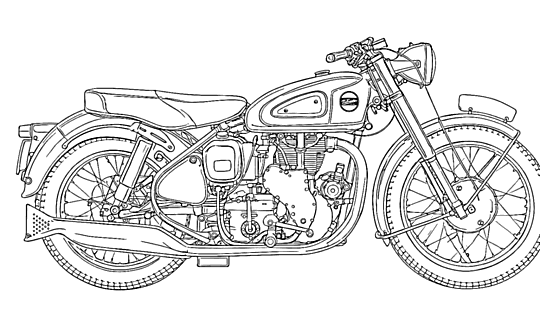
Just before my 16th birthday I bought my first motorcycle from a private seller on “the Saff” which had been advertised in the Leicester Mercury. The bike was a 1958 Triumph Tiger Cub for £25 (may have been more) which turned out to be a naiI; but I was not yet 16 and still soaking wet behind both ears. I should have taken notice of the “sold as seen” tag before I signed a declaration to that affect, but I was won over by the sellers spiel (lies) about a tuned engine, skimmed head and a claimed top speed of 80mph, when a brand new Tiger Cub was rated at 65mph tops. It had a megaphone exhaust and a cable driven rev counter so I was easily convinced, or should I say misled.
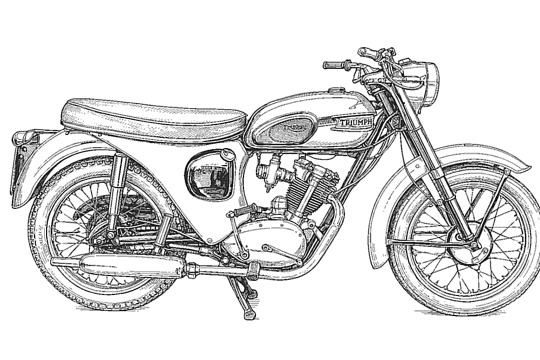
My 16th birthday was on a Thursday and as I had already started work the following Saturday was my first excited day out on the road in precarious so called control of my own so called motorcycle. As Saturday dawned, which for a 16 year old would have been around 10am, I headed out into the countryside and the open road from South Wigston to Countesthorpe. In top gear I opened the throttle wide and waited for the speedo needle to shoot up to 80mph which by the Cosby road turn failed to happen. Having turned into Cosby Road I sat back on the pillion seat and laid low on the petrol tank in an effort to reduce frontal wind resistance to a minimum and wound the throttle open wide, but without any appreciable increase in speed and a touch over 60mph was all I could manage. Bah. Bitter disappointment flooded over me. I had been sold what my Dad would term “a pig in a poke”. A left and a right along the Welford Road I rode fairly sedately through Kilby village. Exiting Kilby village I turned left at the tee junction I again accelerated as fast as I could towards Wistow Park. It was then that I experience firsthand the Triumph wandering rear-end phenomenon. To be fair to Triumph, a later MOT did identify worn rear swinging arm bushes. Attempting to negotiate a long right hand bend at speed, the wandering rear end cancelled out the direction the front wheel was pointing, taking me closer to the grass verge and a heavy wooden field fence beyond, which I sought to avoid. Then I hit a lot of loose gravel which had accumulated on the outside of the curve. I braked in an attempt to avoid hitting the fence at speed and wallop, the bike slid sideways from under me, which was something of a blessing in disguise. The bike alone hit the fence and damaged the front forks, but not the fence, whilst I slid face down in the long grass between the road and the fence which I fortunately avoided colliding with. The visor of my crash helmet split and the jagged edge pierced my skin beneath my eye and the coarse grass caused friction burns to the lower, exposed facial area which persisted for a week. The driver of a van that had been following kindly offered to transport me and the damaged bike back to Wigston and I accepted. The driver would have delivered me at our house but I had him drop me off at the end of our road so that I could at least ride the bike home, which I did, just. The handlebars were pointing in a different direction to the front wheel, my helmet was lodged in my lap and my face was a mess.
At the front of our house I was greeted by my father who at the time was washing his car. “What the blazes have you been up to?” enquired my father. The answer was obvious and apparent. My mother was out shopping in Leicester so my Dad ran me over to Arbour Motors in Dorset Street, Belgrave where we bought a replacement pair of front forks for a fiver. The forks were fitted in record time before mother returned. Refitting the headlamp into its nacelle was a problem as the connecting wire was ridiculously short and the sharp edge of the nacelle aperture cut into my fingers. The glass of the headlamp had also been broken but that was replaced with a clear polythene bag. Ingenuity, resourcefulness and improvisation: That’s what has always set Englishmen apart.
- John Ellis