ALL FOR
SPEED
AND SIDECARS
Speed 3
Chapter 3: Royal Enfield 350cc “Bullet”
- John
Royal Enfield 350cc “Bullet” OCH 748, which I think was a Nottingham registration. This was the very first real motorcycle I had ever ridden whilst I was still at school. I first rode it down the long back garden of the Kirby Muxloe contact who owned it at that time. After I left high school the same contact eventually bought my Tiger Cub and sold me the Bullet and later other bikes. He had stayed on at high school for one more year into the 6th form.
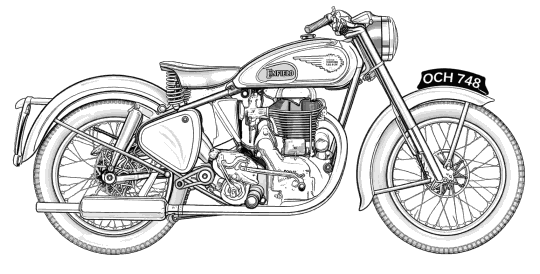
The marriage of the 1959 Bullet engine to its gearbox was a halfway house between pre-unit and unit construction with the gearbox bolted directly on to the rear of the crankcase casting. The engine gearbox unit was hung across the vacant gap between the front downtube of the tubular frame and twin curved frame extensions below the swinging arm pivot, making the engine/gearbox unit part of the frame. The engine was tall as it incorporated an integral oil tank beneath the crankcase. There was a short head steady bar between the cylinder head and the main frame. The engine had a cast iron cylinder barrel and an aluminium cylinder head. It didn’t have a valve lifter but in its stead a small separate Bowden cable operated poppet valve decompression valve, which it did not need as the engine kicked over easily.
Again there was an inoperative Lucas alternator, but at least the magneto ignition was reliable. The cast aluminium headlamp nacelle had two integral pilot bulbs one either side of the main headlamp, which could not be relied upon. The gear change was on the right hand side of the gearbox in the British tradition and was of the usual 1 up 3 down configuration with a separate heel operated lever to select neutral from any gear except first. On the road the single cylinder overhead valve “Bullet” was no speed machine and did not live up to its title, performing more like a lame pellet from a fairground air rifle.
As I was still 16 and on a provisional licence at that time I needed to attach a sidecar chassis to the Bullet in order to ride the bike legally on public roads. Fitting a sidecar chassis legally enabled any rider of 16 years or above to ride a bike of any engine capacity on L plates, with the additional benefit of reducing the insurance premium by a massive 50%. I put the word out that I needed a sidecar chassis and got to hear that a former schoolmate named Dave, who lived with his parents in a large house with a large garden, had such an item going cheap. Dave took me into the garden and pulled out a Watsonian Wobble Wheel chassis which had been hidden beneath a huge Rhododendron bush. The £5 asking price was reasonable so I handed it over without hesitation. My house was less than a mile away so I left Dave’s garden pulling the sidecar chassis alongside me on the left, by hand. Passing the Carlton Drive recreation ground some cheeky kid shouted “What’s up mate, can’t you afford a motorbike?” The world is full of comedians! I know. I’m one of them.
The next step was to visit Bob Pike’s sidecar accessory shop on Humberstone Road to purchase the necessary sidecar attachment fittings. This was in 1967 when Bob was about to close down to retire. At that time the shop was not well stocked and was more than a bit untidy. However, Bob had all of the fittings I needed except for the front lower attachment arm for a 4 point fixing, so I had to make do with only 3 mountings with only the main one at the upper front, so the whole assemblage flexed quite a bit.
Before I fitted the sidecar chassis the bike needed a new MOT. As the outfit would be minus a usually essential lower front mounting on which it might have failed the MOT I decided to have it MOTed as a solo and attach the sidecar afterwards. There was no Law saying that sidecars could not be fitted post MOT. My Dad, who had kept up his full motorcycle licence, insured the Enfield for one day and road it to Petty’s for MOT, returning with a pass certificate. My Dad was so impressed with the bike he offered to buy it from me as a get to work steed. Sorry Dad. I need it myself.
The Wobble Wheel chassis had a wire spoked wheel with a central winged retaining nut. The wheel was not sprung but was instead mounted on a stub axle attached to a vertical arm which also supported the frame carrying the sidecar mudguard and sidelight. The vertical arm could move backward or forward slightly to accommodate irregularities in the road surface but was made in such a way as to return to the perpendicular in between wobbles. The vertical arm would move backwards by a small degree under acceleration and deflect more violently whenever the wheel struck an obstacle such as a kerbstone, pothole, etc. Underway the vertical arm carrying the sidecar wheel wobbled back and forth constantly, hence its nickname “Wobble Wheel”.
The sidecar chassis was duly attached to the Bullet and the tracking was set slightly “toe out” with the aid of my mother’s washing line prop and one borrowed from a neighbour, with the bike leaning out slightly.
Without a sidecar body the unbraked sidecar wheel tended to lift on left hand bends and the twin front drum brakes, of a smaller than useful diameter and operated by a single brake lever, were for ornament only.
On my first trial of riding a motorcycle and sidecar “outfit” I rode out into the countryside one evening when it started to rain. On a left hand bend I lost confidence and control, braked, veered off to the right as the weight and inertia of the unbraked chassis continued to push the bike over onto the opposite side of the road and I ended up on stranded on top of a grassy hillock opposite. Unable to pull the outfit off of the hump and back onto the road on my own I was rescued by a couple of motorists who stopped to help me; one of which opined that I was a “young idiot” and that I “shouldn’t be on the road”, which in hindsight was a fair assessment, but in my own defence I had never ridden a motorcycle and sidecar before and had received no instruction or advice on how to do so. Again on a left hander at a road junction in North Evington Leicester I went through the same wrong procedure and ended up being tram-lined against the kerb on the wrong side of the road, just managing to pull up before my right hand hit a lamppost. This is no good I thought. I shall have to get something put on the sidecar chassis to weigh it down a bit and make the chassis a bit more useful in the process.
One morning I was supposed to attend Charles Keene College on “day release” from the factory. Well Charles may have been Keene, but I never was. Entering the Painter Street car park on the Bullet outfit I had to squeeze through the gateway as a car was exiting in the opposite direction. The spinner of the wobble wheel struck the iron gate making it ring like a bell. Venturing further into the car park looking for a vacant parking place, I was suddenly overcome by the nauseating pong from the stagnant canal basin. Continuing around the perimeter of the car park until I reached the gate once more, I made a swift escape and spent the day riding out in the Styx. By late afternoon I decided to head for home before it got to dusk. By the time I reached Anstey at around 6pm it was getting dark and as Sod’s Law would have it the moment I switched on the headlight the headlamp bulb blew, leaving just the two pilot lights, one either side of the headlamp nacelle. A local garage on Cropston Road, which had been a cinema, later a restaurant and is now Broughton’s Ironmongers, only had 12&mbsp;volt bulbs so with the permission of a lady resident of Cropston Road I left the outfit on the grass verge in front of her semi detached house and went home on the bus. The next day I had to get up at the crack of dawn to take two connecting buses from Wigston to Anstey to collect the bike and limp back to Leicester, arriving at work on time for once.
- John Ellis