ALL FOR
SPEED
AND SIDECARS
Speed 4
Chapter 4: Riding a Motorcycle and Sidecar
- John
Over a period of time I taught myself how to ride firstly a motorbike and then a motorbike and sidecar, both fairly competently in the end, by a process of trial and error; (mostly error to begin with). It was all a bit of a science with a steep learning curve; “teach yourself” and “learning by doing”. Of course mistakes were made but where else was there for novice bikers to learn but on the road? There were no driving schools for motorcyclists and if there was ever a textbook on the subject nobody I knew was aware of its existence. We couldn’t afford textbooks and we couldn’t read and write in any case.
If anyone imagines that riding a motorcycle and sidecar outfit is the same or easier than riding a solo think again. It is almost totally different and requires skills and knowledge which have to be acquired by trial and accident. For a start a solo can be leaned over into bends, whereas a motorcycle and sidecar is compelled to remain upright. (It’s best that way). The solo has only two wheels in line with each other; one at the back and one at the front, whereas and the outfit has the same plus an extra wheel at the side, which it is best not to ignore or forget about, especially when overtaking another moving vehicle or stationary obstruction, riding next to a wall or bridge parapet and generally to maintain the outfit at a safe distance away from such obstacles as well as from the nearside kerb.
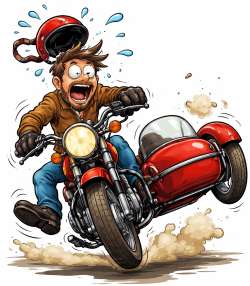
Left hand bends, and particularly left hand street corners, can be problematic with chassis-only or lightly loaded sidecars, as the sidecar wheel has a tendency to lift off the road as G-force shifts the centre of gravity and weight distribution over to the right. The bike also leans slightly over to the right, which can initially be disconcerting for the uninitiated. The natural reaction when the sidecar wheel lifts on a left hander is for the rider to apply the brakes, which is actually the worse possible thing to do as the weight of the outfit is then thrown onto the front wheel of the bike causing the bike to decelerate whilst the sidecar and its unbraked wheel, which is possibly rotating freely in fresh air, continues at a greater speed than the bike creating massive understeer and pushes the outfit straight ahead or to the right, where the outfit could scrape alongside the opposite kerb or collide with the first obstruction on the wrong side of the road.
In such a situation the outfit could mount the opposite pavement, end up in a hedge, or for the outfit to roll completely over on its right hand side and possibly onto the riders right leg. Sounds horrendous? It can be. Conversely braking too hard in a straight line could cause the bike and sidecar to topple over forward, but this assumes powerful brakes on the sidecar and the front wheel of the bike. I preferred to use engine compression and down shifting to decelerate. Brakes were a last resort which, on a lot of British bikes that I rode, could not always be relied upon.
A local newspaper reported on a real life (death) case of a middle aged male who was a qualified and experienced solo motorcyclist who decided to have a sidecar fitted to his powerful large capacity Japanese multi cylindered bike. Having refused the offer of instruction and advice on how to ride an outfit the man rode off and killed himself within the hour on his maiden trip. Along the main road through Old Woodhouse the rider lost control at speed on a left hand bend; braked hard and ended up on the opposite of the road where he hit a tree and died instantly.
Bearing in mind that on a left hander the bike has to travel a greater distance around the bend than the sidecar wheel, the trick I discovered on approaching a left hand bend is to decelerate the completer outfit before the bend and then accelerate the powered bike around the unpowered sidecar. The bike thereby travels the greater distance at a greater speed than the sidecar and both exit the left hand bend with all wheels in contact with the road surface, or at least that is the theory. A small amount of sidecar wheel lifting, whilst remaining in control of the situation, is permissible.
Right hand bends are not a problem as the sideways G-forces and weight distribution are thrown from the bike onto the sidecar wheel, initially giving it more grip. The bike can be driven confidently at higher speeds into a right hander, even to the point where all three tyres lose their grip and the whole outfit can be made to slide sideways around a right hand street corner in a controlled manner via a deft combination of throttle control and opposite lock, as with speedway and grass track outfits. Acquired confidence based on an understanding of what is going on, and why, is maybe the most important key when at the helm of a motorcycle and sidecar.
Using the basis of the controlled drift I became adept at performing two useful manoeuvres:
1: As a 3-point turn is not possible due to the outfit having no reverse gear (unless it is a Russian “Ural” outfit which also had a super low gear for ploughing)
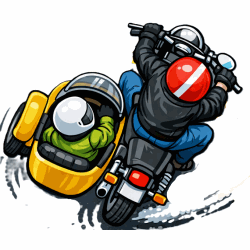 Turning the outfit around 180° in the width of any residential road which is clear of parked vehicles and other obstructions is possible by travelling along the street at 30mph, swinging the handlebars hard over to the extreme right to induce the three-wheel slide and first half of the rotation, then at the half way point swinging the handlebars over to the extreme left to control and end the rotation and speed, bringing the outfit to a halt with the outfit facing the opposite direction at the desired spot with the sidecar wheel close to but not touching the kerb. Do not attempt this manoeuvre during a driving test.
2: Arriving at the Evington Lane/Wakerley Road crossroads at 30mph from the direction of town aboard my Ariel Huntmaster outfit, the traffic lights suddenly changed from green, but it was too late to pull up safely (or at all) so I induced a 90 degree powered slide to the right and continued at speed downhill towards Stoughton Drive and home. (We had moved to Evington by then). I should add that this manoeuvre is only possible with a sufficiently powerful machine and a sufficiently mad rider.
Of all the sidecar outfits I possessed during my 4 year motorcycling career from 1967 to 1971 I never had one with a sidecar brake. If a sidecar wheel is fitted with a brake then by law it had to work like the rest of the brakes on the bike, but if there was no sidecar brake then there was no brake to work, the outfit was still deemed to be legal. With a heavily loaded double adult sidecar, a sidecar brake would be useful on left handers when the sidecar brake alone could be applied causing the sidecar to decelerate, allowing the bike, whose brakes had not been applied, to continue at a higher speed and to be pulled around to the left, in effect overtaking the sidecar. However the sidecar brake could only function on left handers whilst the sidecar tyre was in firm contact with the road surface and not be inches above it as is often the case with a lightly loaded sidecar. Applying all three brakes together in a straight line would retard any outfit quicker than would applying the bike brakes only, where the momentum of the unbraked sidecar would tend to push the bike around to the right, which could be compensated for with the steering but is still not ideal, unless right is where you wanted to go. Riding a sidecar outfit is a bit like sailing a dinghy; all about compensating applied forces and shifting weight distribution and the centre of gravity.
In my case, the open sidecar chassis and the absence of a sidecar body initially compounded my handling problems. Later I found that any kind of body on the sidecar chassis helped to reduce sidecar wheel lifting, especially when loaded. My paternal grandmother donated a heavy wooden blanket box, finished in dark blue matt milk paint, which was roughly 4 foot long and 18 inches square in cross sectional area.
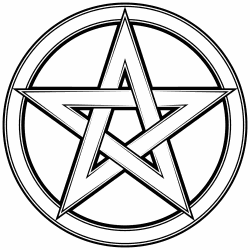 I bolted the blanket box onto the sidecar chassis and painted a large white pentangle on the front panel as I was a fan of “Tales of Mystery and Imagination” on our black and white 19” Murphy TV. Later, on the left hand side near to the front I attached a self adhesive advertizing label which said “As seen on TV” which amused one lady in Kirby Muxloe who remarked “Well I’ve never seen anything like it on TV” . I suggested that she must be watching the wrong channel. As a ballast weight I placed a large solid steel multi-vee pulley block which was surplus from my Dad’s factory.
On an early run riding the Royal Enfield Bullet outfit down Blood’s Hill into Kirby Muxloe I turned left into Main Street at speed, only to find a single decker Midland Red bus parked up on the left, just inside Main Street. As the braking system on the outfit was so pathetically inadequate I was forced to overtake on the wrong side of the road with a white Hillman Imp approaching from the opposite direction. There was just enough room for us to pass each other as the Imp had mounted the footpath. I kept as close as I could to the side of the parked bus but was still worried that my right hand might strike the windscreen pillar of the Imp. After the Imp had passed without incident, all seemed to go well until the outfit reached the front of the bus. The centre of the bus’s front wheel was dished outwards and was retained by a ring of several protruding wheel nuts. Before I knew it the winged “spinner” of my sidecar wheel had climbed up the said wheel nuts causing the sidecar to climb up the cab side of the bus until the sidecar tyre made contact with the bus bodywork causing the sidecar wheel to climb even higher. The bus driver emerged around the front of the bus to find me still sat stationary on my outfit, inclined sideways at a crazy angle of around 45 degrees, with the sidecar wheel halfway up the side of his bus. He offered his instant judgement as to my youthful ineptitude and how I shouldn’t be on the road. (Heard it all before mate). The driver helped me to detach my outfit from the side of his bus, whilst warning me that if I marked his paintwork I would be in deep trouble.
The Bullet, which was still geared for solo work, now had a lump of sidecar to drag along on its left hand side making the bike underpowered, over geared and generally unfit as a sidecar tractor. The top speed in that condition was around 60mph, give or take. Out on the A50 I attempted to overtake a loaded quarry truck, but as soon as I drew alongside the lorry cab the driver put his right foot to the boards and speeded up to the maximum he could muster and I did likewise. The ensuing race ended in stalemate as both of us ended up flat out with nothing in reserve, even with me sliding back on the dual seat and laying flat on the tank. After a mile or so I gave up and turned down a side road.
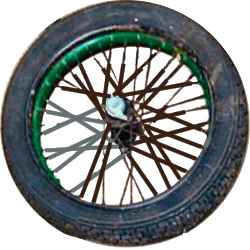
On the return trip I was cruising along merrily without a care in the world when, on a long right hander, the sidecar wheel, complete with its stub axle, came adrift from the chassis which fell onto the road. The bike suddenly leaned over to the left with the wobble wheel arm creating a spectacular display of sparks as it scraped along the road surface. I decelerated and attempted to maintain some directional control over what remained of the outfit. Meanwhile the sidecar wheel continued along the road upright, all on its own and finally came to rest 100 yards down road, leaning against a farm fence. I retrieved the wheel on foot and was able to replace the stub axle, minus its retaining nut which had fallen off and was lost, into its proper place. From there on I managed to continue but had to stop now and then to kick the stub axle back into the vertical arm as it was still attempting to escape on now slow right handers. My father took the stub axle to his factory and had a new retaining nut made. The stub axle and wheel were refitted to the chassis and the exposed thread peined over to prevent further escapes.
- John Ellis