ALL FOR
SPEED
AND SIDECARS
Speed 8
Chapter 8: More bikes - More Speed
- John
In Motorcycle Mechanics magazine I read that someone had fitted a Triumph Tigress 250cc 4-stroke twin scooter engine into a BSA C15 motorcycle frame. By sheer coincidence a man who lived opposite to Peter had a Triumph Tigress scooter which he wanted to get rid of because it would only fire on one cylinder. I spoke to the man and gave him £5 for the Tigress, but it was buried at the back of the garage behind a load of miscellaneous junk (for the want of a better term). The man said that that was no problem as we could pull it through the back door of the garage and wheel it through the house.
It felt strange pushing the dead scooter through the family’s living room between the TV and the family who were sat on the sofa watching Coronation Street.
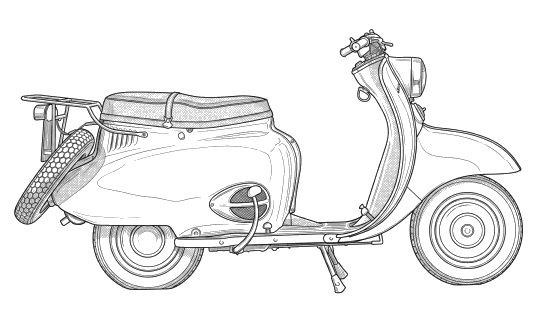
The ignition fault turned out to be a duff condenser which was easily replaced. The scooter had 3 gears operated via a kick pedal protruding through the floor of the running boards. On a later spin on the open road the scooter accelerated well up to around 60mph when I tried to kick it into 4th gear only to remember that it only had three gears and I was already in top gear. Never mind, I thought, as the under gearing will be resolved when the engine is fitted in the C15 frame which has 19 inch diameter wheels compared with the 10 inch wheels of the Tigress.
Next up I had to source a BSA C15 and who should come along but the Kirby Muxloe contact who drove me to a field full of permanent caravans on the flood plain of the River Soar between Quorn and Barrow upon Soar. There was a metallic green BSA C15, identical to the one owned and ridden by Delroy, except this one didn’t run. I paid £12 for the C15, loaded it into a van and me and it were driven back to Wigston.
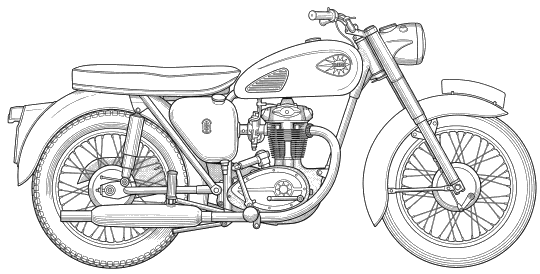
I spent hours removing both the C15 and Tigress engines from their respective machines and then attempted to fit the Tigress engine into the vacant C15 frame, which presented immediate problems with engine mountings. Having somehow solved the mounting and alignment problems the next problem was insurmountable: I transpired that the final drive chain of the Tigress was not of the same pitch as the C15 rear wheel sprocket. Did it mention that in Motorcycle Mechanics? If so I hadn’t read it.
An engineer might have been able to make a new front final drive sprocket to match the rear sprocket, but I was not an engineer and had no access to such facilities. The Tigress went to Dobbo who must have thought that I was one of his best customers and the C15 was sold to the work colleague with the Ariel Colt for 1/6d and a sausage sandwich from the Cedar Transport Café at Kilby Bridge.
Matchless G3 350c 1948
This machine had been offered to me previously by the Kirby Muxloe contact who was selling it on behalf of his older brother. It was in immaculate original condition with black paintwork and white coach lining, but it had a rigid rear end which was for old men and did not fit the image of would-be racers like me and my motorcycling peers. It was sold for next to nothing to a couple of brothers who lived on a farm. They stripped off various cycle parts and used it as a field scrambler.
I eventually acquired what was left of the bike in a very sad condition and wanted to salvage the unusual engine at least as its timing/magneto drive case sloped to the rear when on more modern Matchless and AJS singles it sloped forward.
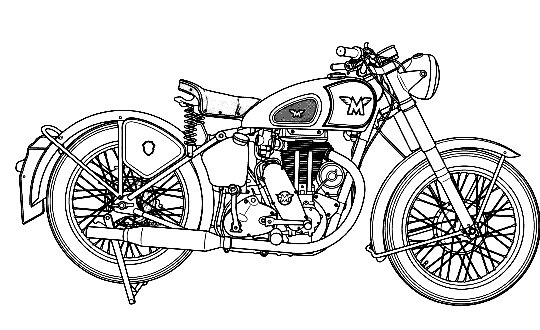
Quite how the Matchless found its way from Kirby Muxloe (or the farm) to Len’s house I cannot recall, only that it did. Len and I drained what little petrol there was in the tank, removed the spark plug, the Amal standard carburettor and the final drive chain to make the machine inoperable and by our reckoning no longer a “mechanically propelled vehicle”. We then took it in turns to push the dead Matchless all the way from LFE to Wigston whilst the other of us paddled Len’s Suzuki 80 along like a hobby horse, without starting the engine. All went well until we reached the traffic lights at the bottom of Braunstone Lane at the Narborough Road South junction.
As soon as the lights changed in our favour I ran across Narborough Road South pushing the dead Matchless in an effort to reach the relative safety of Braunstone Lane East before the lights changed against us. Len meanwhile bump started his Suzuki 80 and rode rapidly across the main road side-saddle. Then things took a turn for the worse as a uniformed police constable appeared out of the Post House Hotel car park and ordered us to stop so that he could investigate what we were up to. Taking out his notebook and pencil the policeman began to scrutinize the Matchless.
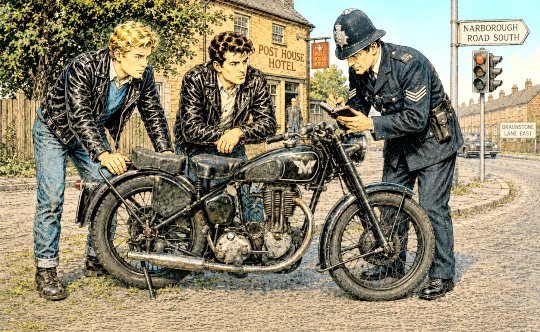
Taking out his notebook and pencil the policeman began to scrutinize the Matchless
Is this machine insured? No! Is it taxed? No!
Why are you pushing it?
Because it won’t go. Why won’t it go?
No petrol, no carburettor, no spark plug and no final drive chain, so it can’t be classed as a mechanically propelled vehicle, only as a person propelled pile of junk.
The policeman disagreed and informed us that according to the law pushing is the same as riding. (Ever tried pushing a horse?) He must have known that he had no case against us as he sent us on our way with the advice that if we were stopped again by the police that we were to tell them that PC Clever Sod had already stopped us and had taken all the details. At least two patrol cars passed us on the final leg of our journey and neither stopped to question us. Len riding his Suzuki 80 side-saddle must have been illegal as he was “not in full and proper control of the vehicle”, but that was forgotten about by the policeman in his zeal to nobble us for a traffic offence relating to the Matchless.
At my parents house the Matchless engine was installed in the Red Hunter frame as a “sloper” in substitution for the NH engine. The Matchless engine still ran but the farm boys had neglected to top up the oil tank causing the engine to run dry which in turn caused irreparable damage to the integral oil pump. Counting my losses, everything was scrapped, but too soon as shortly afterwards I acquired the 1951 Ariel VH Red Hunter, the engine of which would have slotted straight into the 350cc Ariel NH cycle parts. Too late.
Velocette 1934 MOV 250cc and
Velocette 1940 MAC 350cc
This was an amalgam of two machines acquired from a lad in Countesthorpe whose father may have been in the British Navy as the bike had been originally registered in Plymouth.
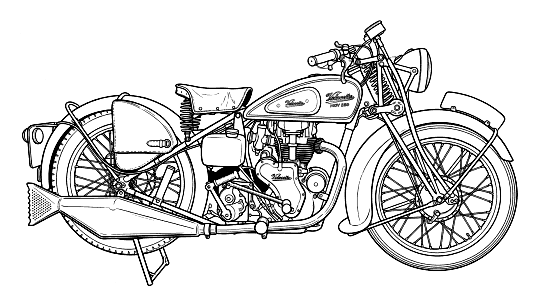
The bike as I acquired it turned out to be a mish-mash of MOV and MAC parts as some of the original MOV parts had been damaged over time. The frame turned out to be from the MAC but was fitted with the MOV rear wheel which had a smaller diameter axle fitting loosely into the rear fork ends of the MAC frame. The front girder forks and front wheel may have been from either machine. As with all pre-war Velocette’s the wheel rims were painted gloss black and were not chromed.
The piston crown of the MOV engine had been punctured by someone fitting a long reach spark plug into a cylinder head designed to accept only short reach spark plugs.
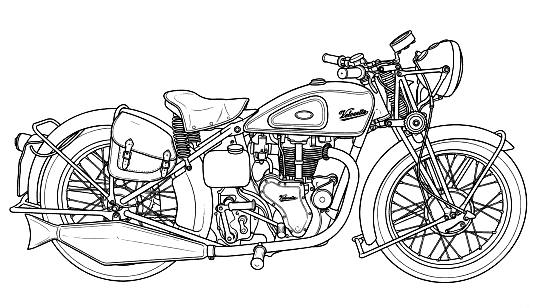
The 350cc MAC engine was substituted but the 250cc MOV registration number was retained, passing the 350cc bike off as a 250cc and was driven on L-plates. Even the driving test examiner was fooled by the deception when the Countesthorpe Kid passed his test on the 350cc MOV/MAC at the second attempt. Most British motorcycle manufactures who offered various standard engine sizes employed the same stroke with different sized bores. Velocette was different in using the same bore on their MOV and MAC models but altering the length of stroke, so that the MAC had a longer stroke than the MOV.
This meant that many of the main engine parts were the same and interchangeable. I decided to repair the 250 MOV engine and reunite it with the mixed bag of what was left of its original and the not so original cycle parts. I could have bought a brand new slipper type piston complete with piston rings from Wellworthy for £5, which may not seem a lot now but it amounted to one week’s wages for me back then, so my father took the original damaged piston to his works where the welder closed the hole with aluminium welding. A fault with the earlier MOV engines was inadequate oil supply to the camshaft and cam followers, causing the cams to wear excessively over time.
I exchanged the complete right hand half of the MAC engine, with its improved camshaft lubrication system and married it to the original left hand crankcase half of the MOV. Eros motors sold me a camshaft and followers from a 350cc Velocette Viper which fitted instantly. The gear type oil pump was the same for all models. Foolishly I wasn’t into preserving original vintage stuff so I had scrapped the original silencer, petrol tank, single seat and mudguards to give the machine a modern face lift with a racing seat from Peter’s modified BSA B31, a larger petrol tank which I resprayed in Vauxhall “Meteor Blue” with black side panels separated by a broad gold line and I applied genuine “Velocette” varnish applied tank transfers.
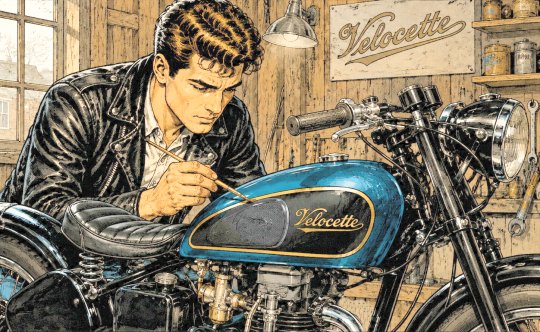
...I resprayed in Vauxhall 'Meteor Blue' with black sidepanels separated by a broad gold line...
The facelift also included aluminium mudguards, megaphone, chrome headlight etc. What a travesty. Before I could take it on the road the MOV became the subject of three consecutive swaps, firstly to Len in exchange for his BSA A7 Outfit, plus an air rifle, a box of motorcycle magazines and a transistor radio, then shortly afterwards from Len back to me in return for the air rifle only. Throughout all of this confusion the MOV had never left my Dad’s garage.
Royal Enfield 700cc Constellation
Having swapped my Velocette MOV for a Swallow Jet 80 single seater sidecar from a man in Willoughby Waterleys who restored old motorcycles and had a Scott Squirrel with its freshly painted frame drying over the bath, I was on the lookout for my next sidecar tractor. A workmate had informed me that the son of the owner of the Cedar Transport Café at Kilby Bridge had a Royal Enfield 700cc Constellation which he wanted to get rid of for cash. Negotiations took place between me and the Café owner resulting me paying £15 for a frame and forks, 2 wheels, various other cycles parts and a cardboard box full of engine in kit form. Everything was transported in the firm’s van to my Dad’s garage where I began to assemble the Constellation piece by piece and attach it to the Swallow Jet 80 sidecar on the front lawn.
All seemed to go quite well until I discovered that there were no cylinder heads, (separate on the 700cc Enfield). The father of the seller and I searched around his garage but no cylinder heads could be found.
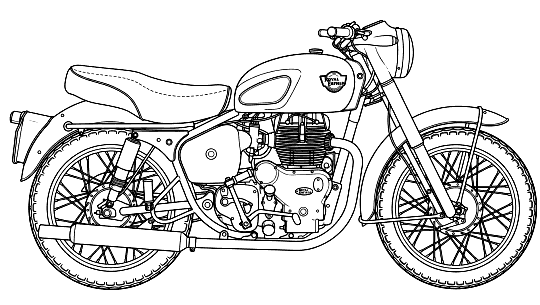
Eros Motors sold me a pair for £5 but on returning home I next found that the threads in the top of the aluminium crankcase meant to hold the studs for holding down the cylinder barrel and head had been stripped. At which point I threw the towel in, sold the sidecar and disposed of the bike; how? I can’t recall.
The Countesthorpe Kid came round to my house on his pre unit-construction Triumph Thunderbird 650cc which he wanted to sell and I thought I might like to buy and attach a chair (sidecar) to. I rode the thunderbird around the block solo, grappling with the 1 down 3 up gears which were the wrong way round to the 1 up 3 down I was used to. Turning into our road intending to open it up along the straight; instead of changing from 2nd to 3rd gear I changed from 2nd to 1st and nearly flew over the handlebars as the bike decelerated rapidly but my body kept going. Ta but no Ta.
Royal Enfield 150cc single cylinder 2-stroke
My workmate Bill had this bike leaning against a fence in his back garden and agreed to sell it to me for not very much. The engine was of Royal Enfield’s own manufacture and was not the usual Villiers unit found in most lightweight motorcycles of the day.
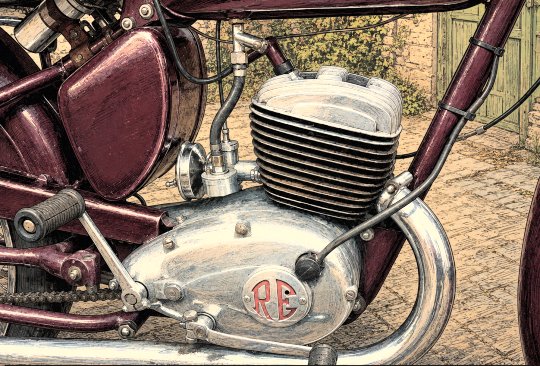
...the engine was of Royal Enfield's own manufacture and was not the usual Villiers unit...
I left the firm and never paid for or collected the bike.
BSA A7 500cc 1956
This 500cc parallel twin with plunger type rear suspension was a true sidecar machine, built and geared for the job. It had 4 gears, a wide power band and even with its double adult sidecar could accelerate rapidly to reach a top speed slightly in excess of the 70mph speed limit which had been introduced in 1966.
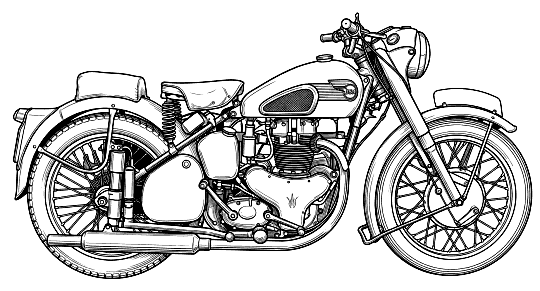
Len owned the A7 before me and had bought the outfit for £12 from our contact in Kirby Muxloe who only ever seemed to turn up to sell us something at a profit, or to show off his latest car. Len and a friend went on holiday with the outfit and at one point Len let his friend drive it with the result that they had to pay a farmer £10 to drag it out of a ditch with his tractor. I acquired the A7 outfit via the first MOV swap. Like the Ariel Huntmaster already described the A7 had two Gold Star silencers one of which was genuine and “straight through” and the other a fake copy with internal; baffles, so the exhaust note was odd.
I remedied that by moving the baffles from the pattern silencer to one side by ramming it through with a broom handle. It was on the A7 that I first learnt the trick of turning a motorcycle and sidecar to face the opposite direction in one continuous movement in the width of the road without clipping either kerb.
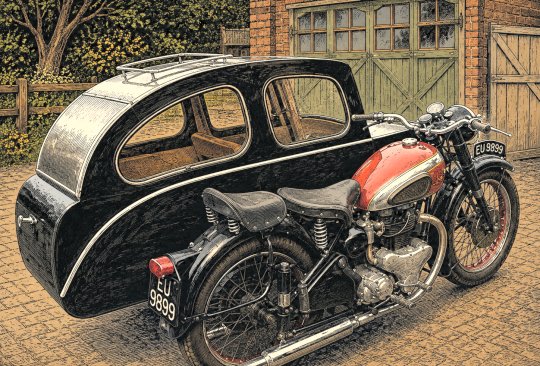
...the double adult sidecar did not fit the image of a sub 200 year old...
The double adult sidecar did not fit the image of a sub 200 year old so I pondered about removing the top half completely, apart from the front screen, but in the end decided to remove the plywood and aluminium sidecar body completely and replace it with a single seater I had seen in the car park of the Daniel Lambert pub on the Goodwood Estate in Leicester. The sidecar was attached to a 600cc Norton Dominator.
I hadn’t enough money to purchase the entire Norton outfit so I informed our Kirby Muxloe contact of the existence of the bike which he bought and sold at a profit to a member of the KMR (“Kirby Muxloe Rockers”) whilst I paid him a fiver for the sidecar. Having no store of suitable coach bolts I held the Norton single seater sidecar body down on the Sprung Watsonian sidecar chassis of the A7 with leather luggage straps. I rode over to LFE to show the modified A7 outfit to Len and we went for a spin to Bradgate Park via Kirby Lane, Ratby and Groby. Just as we came to the railway bridge in Kirby Lane there were two blonde young ladies thumbing a lift but we could not accommodate them both in the single seater sidecar which was not in any case properly secured to the chassis. Sod moves in mysterious ways our blunders to expose.
Len had brought along his brand new Velocette “M series” handbook to show me but at Bradgate we lost it in the Old John car park. Back at Len’s house his Dad, who had also been to Bradgate separately on his Lambretta scooter, said “look what I found in the Old John car park”. It was Len’s Velocette handbook.
There never was a windscreen on the single seater sidecar body but it had a large boot which was accessed by folding the PVC upholstered seat back forwards to rest on top of the seat itself. Normally the back of the seat was secured in the upright position by a single short fabric strap with a press stud, but the sidecar was old and the press stud was worn and the back of the seat was apt to fall forward whilst the outfit was in motion and especially under braking. This was not a problem at lower speeds in town but on the open road it proved to be so when one day I headed out Northwards along the A6 Loughborough Road, out of Leicester. Keeping to the 30 mph speed limit through Birstall I changed down into third gear at the end of the speed restriction and opened the throttle wide, changing into fourth gear at around 50 mph.
The exhaust note through the Gold Star silencers was like the roar of a World War 2 fighter plane. Nearing the top of the hill approaching the Wanlip turn there was a loud bang. Pulling over onto the grass verge I found that vibration had caused the back of the sidecar seat to fall forward exposing the boot cavity which acted like a parachute, the entrapped air pressure blowing out the aluminium back panel of the sidecar body. What had been a curved sheet of aluminium, secured to the plywood sides of the sidecar body with nails was now an almost straight sheet of aluminium secured only at the top edge by the few remaining nails.
I ripped the semi-detached sheet of aluminium completely off, posted it in the footwell and nailed it back on when I got home. I also made the top attachment of the seat back more secure. Finally I sold the outfit one Saturday to a lad off of Braunstone Lane East for £17. He took the outfit out for a spin on the Sunday but hadn’t travelled half a mile before he was stopped by the police in a queue of traffic in Braunstone Lane East just before the railway bridge with no possibility of escape.
He was found to be without insurance, was not displaying L-Plates (he was a learner) and he hadn’t yet registered the bike in his own name, for which he was heavily fined and banned from driving for one year.
Backtracking somewhat Len and I rode out from Wigston to Thurnby one evening on our separate bikes as Len had heard of someone who was breaking a crashed BSA A10 650cc twin for spares. I was on my Francis Barnett 197 and Len was riding his 175cc BSA Bantam on which he had just passed his test.
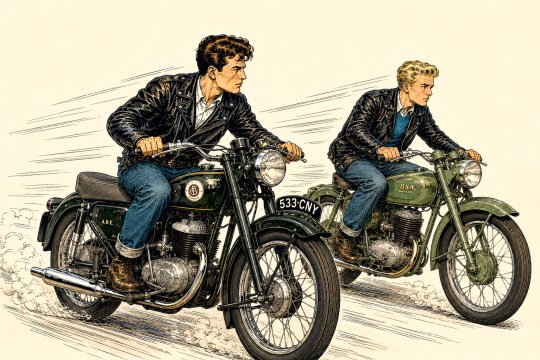
...I was on my Francis Barnett 197 and Len was riding his 175cc BSA Bantam...
Len had secretly bought a 650cc BSA Gold Flash and sidecar (which his Dad wouldn’t have been happy about) but for which needed a few spare parts, hence the trip. Again we swapped bikes before we reached Stoughton village.
In Stoughton village there is a difficult junction just beyond the churchyard with no road markings whatsoever which made it difficult to judge the right line to take to negotiate the bend into the Thurnby Road cleanly. I rode ahead and was half way around the bend when I realized that I would have to lean over even further and alter my trajectory in order to avoid ending up in the hedge of a cottage directly ahead.. Ascending the hill into Thurnby village I looked back expecting to see the headlight of my Francis Barnett with Len on board but all was darkness with no sign of Len or my bike. Returning to Stoughton and the junction I found Len and my FB buried in the garden hedge of the said cottage between the Thurnby and Evington turns.
Len had to be physically extracted from the prickly Berberis hedge. We eventually continued on to Thurnby where there was nothing left of the A10 worth buying.
To conclude Len’s story: Len had removed the sidecar from his Gold Flash and rode it solo, as did I. Len took me from Wigston to St Margaret’s swimming baths one evening on the back of his Gold Flash, topping 90mph along Welford Road in Knighton. We overtook a car on the wrong side of the road with another car approaching in the opposite direction. Instead of braking Len kept the throttle open and cut in front of the overtaken car just in time to narrowly miss the oncoming vehicle.
“Missed!” shouted Len and continued at a reckless speed. Len had a worrying lack of fear, no appreciation of danger, or sense of caution. A near neighbour and older acquaintance of Len’s who raced BSA Bantams saw Len’s riding style and told him that he would make a good racer as he had no fear. Len was proud of that comment and took it as a compliment.
After swimming Len offered to run me home but I elected to return home in one piece in the relative comfort and safety of the L8 Midland Red bus to Wigston.
The next and the last time I saw of Len alive was him exiting the Leicester Speedway Stadium car park riding a BSA Rocket Gold Star in racing trim with rearset footrests; clip on handlebars, fibreglass tank, racing seat etc.
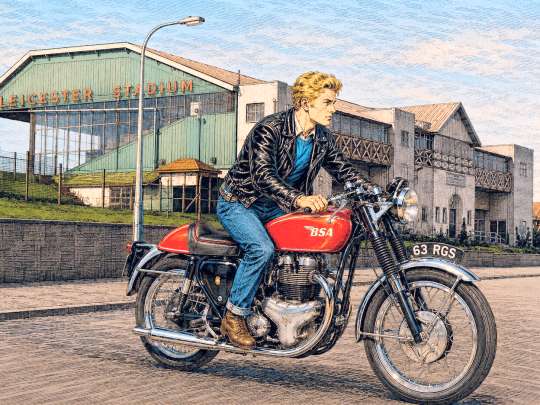
...last time I saw of Len alive was him exiting the Leicester Speedway Stadium...
We were all 18 but Len didn’t get any older as he collided with the side of a car at a junction where the car had the right of way. Ride fast; die young. Bikers are so vulnerable in accidents. Len’s demise was both shocking and sobering.
He did not grow old as we who are left grow old e.t.c. The complete South aisle of church was full of bikers at Len’s funeral. Len’s Dad requested via the vicar that none of us should attend the graveside, so we all dispersed quietly. It was strange to see so many solemn young bikers filing orderly, quietly and respectfully out of the church in borrowed suits.
I often wondered if Len’s Dad blamed us in some way for Len’s obsession with bikes and with speed and in some way for his accident, but we were all stricken with the same obsession and Len’s fate could have been any one of us. R.I.P. Len.
- John Ellis
Additional illustrations by Jean-Francois Helias