ALL FOR
SPEED
AND SIDECARS
Speed 9
Chapter 9: The Bitter End
- John
After leading the world in motorcycle production and innovation since the turn of the 20th century, by the mid to late 1960’s the British motorcycle industry was suffering its death throes having taken their eye off the ball and failing to read the Japanese writing on the wall until it was too late.
As soon as they finally received their wake up call UK firms like BSA and Triumph hastily invented new models which looked similar to the first wave of Japanese bikes arriving on British shores, but the new British products were neither competitive nor reliable. The badge engineered 350cc Triumph “Bandit” and BSA “Fury” (or was it the other way around?) with an untried and un-British180 degree crankshaft was invented in haste and failed in an equal hurry.
Unit construction versions of the traditional large capacity BSA and Triumph parallel twins were produced of which only the Triumph retained anything of its familiar looks whilst the boring right hand lower end of the BSA A50 500cc and A65 650cc “Power Egg” design, with no separately identifiable timing case cover, resembled an overblown Bantam.
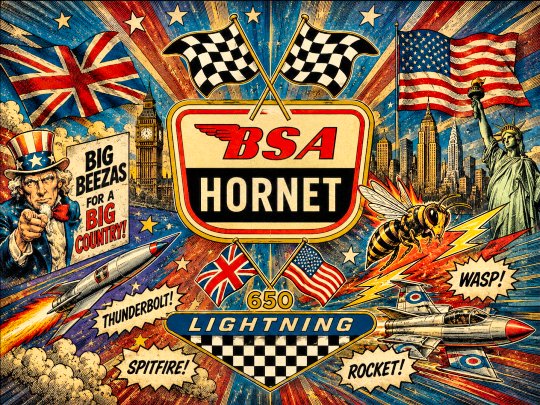
To appeal to the American market the big Beeza’s were given American he-man names such as Thunderbolt, Lightning, and Spitfire. BSA reused the Rocket label and added Hornet and Wasp.
British motorcycle manufacturers were experts at inventing daft names for their products: At the lower end of the 1960’s market the BSA “Beagle” (woof-woof) was offered as an alternative to the 90cc Honda C200 and the Ariel “Pixie” (lucky for some; unlucky for others) as an alternative to the step-through Honda 50cc. Neither British product proved to be popular.
Then there was the Francis Barnett Fulmar named after a seagull and nicknamed “The Flying Banana”. Before WW2 there had been the Scott Squirrel and the Coventry Eagle “Silent Superb Deluxe” which was none of those things.
In 1951 uncle Derek had a 1934 Coventry Eagle 147cc “Silent Superb” which had a rigid pressed steel frame and girder front forks. The engine was a Villiers twin port single cylinder 2-stroke.
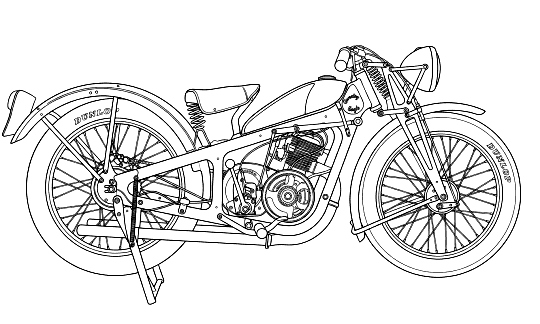
Derek told me that if it didn’t start by the 10th kick he’d have to go indoors and sit down for a while to regain his strength and composure and then try again. Derek took his bike test on the Coventry Eagle and when he had completed the practical part he had to take off his crash helmet to hear what the examiner was shouting at him, which was to “Turn the bloody thing off!” The bike was making such a din.
After passing his test on his Coventry Eagle Derek traded it in for a 1936 350cc “Cammy” Velocette with a rigid rear end and girder forks as by then he had a new job 20 odd miles away at Coventry Gauge and Tool Co Ltd. Coventry paid higher wages than Leicester did.
The bike trader told Derek that he couldn’t offer him much in the way of part exchange for his Coventry Eagle as it was “only fit for scrap”. Weeks later Derek saw a postman riding his Coventry Eagle around Leicester.
The rear axle of the Cammy Velo broke due to an unreasonable load being applied when Derek took his weighty father in law, plus boxes full of fishing tackle on the pillion for a day’s fishing trip. A replacement axle was machined from an old milling machine arbour at Derek’s factory.
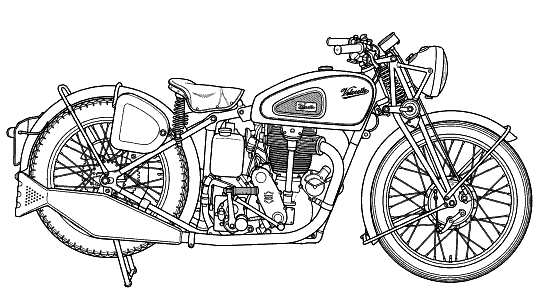
The Velocette gave Derek good service and was finally sold when he passed his car test and was allowed to drive the firm’s van in his own time as well as for the firm.
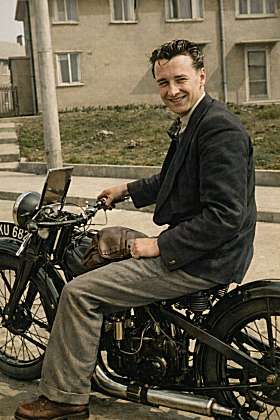
Another tale from Derek was that just after WW2 he came home on leave from National Service in the Army and rode pillion on his friend Howard’s 1937 Triumph Tiger 90 500cc single.
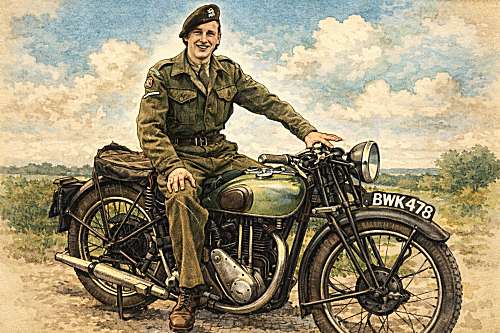
Derek on Howards Triumph Tiger 90
Petrol was still rationed so Howard started the engine on Ronson lighter fuel and then switched over to the tank containing kerosene as soon as the engine had warmed up. A hot engine will run as a semi diesel on kerosene but it creates a lot of smoke (steam) and will “run on” even after the ignition is switched off.
The story goes that the pair rode around the clock tower, enveloping the policemen who habitually stood there looking up all five radiating roads, in a cloud of white smoke.
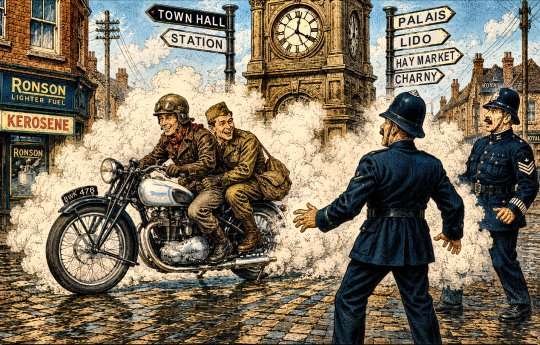
...the pair rode around the clock tower, enveloping the policement in a cloud of white smoke...
Who knows what the BSA bosses were thinking about when they designed the 50cc ”Ariel-3” (3 wheels that is, not 3 cylinders) which had no Japanese equivalent. The Ariel-3 was a joke which everybody laughed at, nobody took seriously and few were sold. Only 3-year olds and Noddy (in Toyland) rode trikes.
Velocette meanwhile plodded on regardless up to 1971 turning out their 350cc Viper and 500cc Venom high camshaft singles which were oddly named after a snake and snake poison.
As excellent as they were in their class the Vipers and Venoms continued to carry the torch for the fast fading British old-time tradition through to the bitter end. The provenance of the highly developed 1971 500cc Venom Thruxton, which with its top speed of 124mph was the fastest production 500cc single ever, could be traced back to the original 250cc MOV design of 1933.
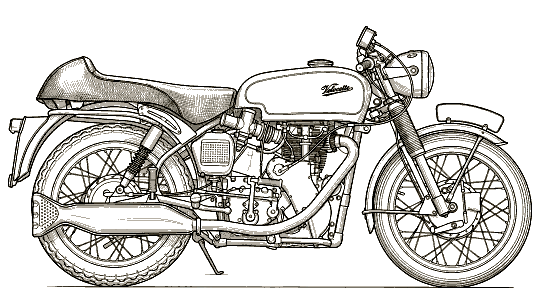
Velocette’s were something special but the firm was so blinkered, out of date and out of touch that on any brand new Velocette Viper or Venom, right up to the end of production; dualseats were fitted as standard, but rear footrests were an “optional extra”.
Compared with British iron I found Japanese bikes to be characterless and without a long standing pedigree. Why did we need electric start when we had legs, or indicators when we had arms to indicate via semaphore?
The timing case covers of British bikes were unique to a brand which was often cast into the surface and the whole was highly polished aluminium lovingly kept so with elbow grease and “Solvol Autosol” metal polish. Japanese bikes had no recognizable timing case cover and were either painted or anodized silver; how boring. British bikes were generally built to last, which accelerated their downfall.
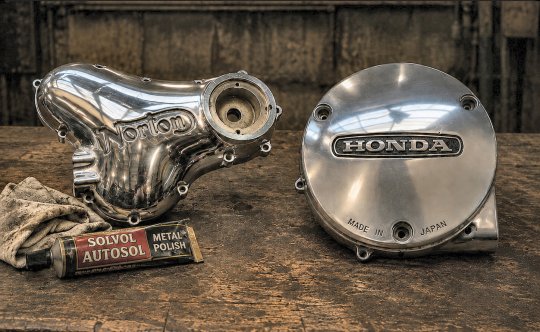
...highly polished aluminium lovingly kept so with elbow grease and 'Solvol Autosol' metal polish...
Times, rules and laws relating to motorcycles and motorcycling have changed a lot over the past half a century and more: Before 1961, which was before our time, a 16 year old could ride a motorcycle of any capacity without a sidecar.
From 1961 the limit for a learner was set at 250cc for a solo but remained unlimited for a motorcycle and sidecar. The compulsory wearing of crash helmets did not become Law until 1973.
Most of us passed our bike test on a lightweight solo machine of 250cc or less, which was the limit at the time, but bike performances could vary greatly eg a BSA 123cc D3 Bantam could reach 45mph in a fortnight whereas a Ducati 5-speed DOHC 250cc, for those few who were rich enough and lucky enough to own and ride one, could reach 105mph in no time at all.
In the late 1960s a full bike licence permitted the licence holder to ride a motorcycle of any capacity, with or without a sidecar, also a scooter or moped, but curiously also a 3-wheeled car, the driving of which is nothing like riding a motorcycle. However, passing the driving test in a 3-wheeled car did not permit the licence holder to ride a motorcycle other than a moped of 50cc or less.
The bike test taken to obtain a full licence was a bit of a lottery depending on the mood of the examiner. There was no theory test and no prior instruction, only the recollections of previous victims as what to expect.
The practical aspect of the test included riding alongside the examiner at walking pace whilst remaining in control of the bike, performing an emergency stop without stalling the engine (or worse) when an anticipated test centre employee leapt out into the road from behind a tree along Victoria Park Road, plus performing a right turn across oncoming traffic, etc.
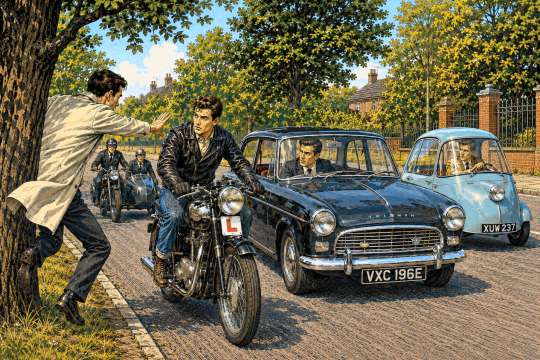
There are apocryphal tales of examiners leaping in front of the wrong motorcycle
Passing on a solo was, I guess, easier than with a motorcycle and sidecar, and I only ever heard of one acquaintance who took his test on an outfit where the examiner insisted upon riding in the sidecar for the entire circuit with the resulting difficulty of audible and visual communication between examiner and rider.
I was happy to have been a learner on a solo (initially) but later decided to stick with motorbike and sidecar outfits for their relative stability, load carrying capacity, cheaper insurance and generally because for me they were much more fun.
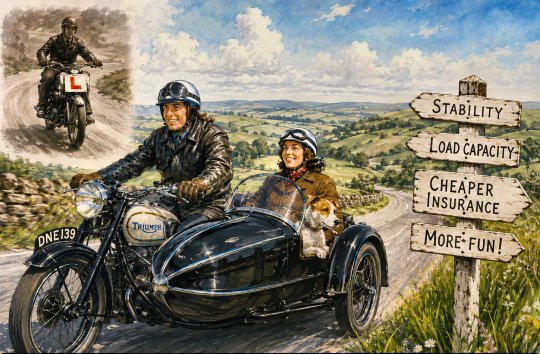
...happy to have been a learner on a solo but later decided to stick with motorbike and sidecar...
The theory aspect of the driving test involved answering random questions from The Highway Code booklet. The most baffling question being on “stopping distances” for which there was a table in the Highway Code which had to be memorized. Giving the wrong answer could lead to instant failure.
The “stopping distances” were invented statistics which did not relate to reality of changing weather, road and driving conditions, type of road surface; tarmacadam, concrete, granite setts, the type of vehicle and its braking system etc. There are just so many variables it was not a fair question.
I never once applied the brakes and then went back to measure the skid mark.
- John Ellis
Additional illustrations by Jean-Francois Helias