The air still comes out. Don't ask where it goes in!
Unlike every other weblog you ever saw, this one is in correct chronological order so you can read it the right way round. But it always shows you the latest entry first so scroll up for earlier stuff.
The 2026 index will appear here
The index contains links to some of my Let's Get Moving Champions blogs on the
Active Together
website. They are denoted by the icons.
Resolutions
I'm still optimistic [read "DAFT"] enough to make New Year resolutions, consisting of the usual half‑baked ideas to eat less rubbish, take more exercise, stop beating the missus...
There are challenges to take up regarding LPMCC.net. Often it involves working less hours, but making them more productive. [NO CHANCE]
This book was where I discovered Jitsi, now adopted for our Virtual Club Nights
Late last year I read This is for Everyone by Tim Berners-Lee, inventor of the World Wide Web.
It isn't often that I read a real book [apart from Rupert Annuals], but on those occasions they can have a profound impact.
So one LPMCC.net resolution is to follow Sir Tim's principles.
In the process of organising some outside events, I stumbled upon .ICS files. If you use an on‑line calendar, this iCalendar Standard file can enter details into it, saving you a lot of time. They are begging to be incorporated into Hans Veenendaal's
Rally Listing,
for the benefit of the many riders who make good use of available technology.
Every new or updated page on LPMCC.net is announced in our left‑side menu, in our
Mobile News, and through an RSS feed. RSS stands for Really Simple Syndication or maybe Rich Site Summary. If the latter, then I've been doing it a disservice with short measure. I'm resolved to correcting that this year.
Watch this space...
Don't hold your breath
⦁
Whenever we announce our plans to add something to the website (such as the features proposed in our New Year Resolutions, above) we add the proviso "Don't hold your breath". To make sure you keep on breathing, living, and reduce your blood pressure and stress levels, here is a guide to a regular, relaxed six-breaths-per-minute rhythm. Sit comfortably and keep time.
According to Caroline Williams in 3rd January New Scientist, the benefits of deep, slow breathing are supported by research. Simply breathing slowly in through the nose and out through the mouth for 10-20 minutes a day can make a real difference. It's free, safe and can be done anywhere. If you're looking for a gentle, natural way to feel calmer and more rested, your breath is a very good place to start.
I can breathe easy over one of my resolutions: Our RSS feed now contains more information and illustrations.
Patience
Wrong again
I try to think ahead. Fresh out of my engineering apprenticeship, I was already thinking of retirement. So I took out a "With-Profits Endowment Policy" for half of my wages, but projected to pay me happy returns on my 65th birthday.
Soon after taking on the policy, I began to worry about increasingly automated production. Would it result in a reduction in retirement age, leaving me to pay instalments from my state pension?
Now AI is bringing the same problem to professions.
As it turned out, in this (and every other) case of "improvements", the impact has been the very opposite. Rather than benefitting the workers, it put some out of work, while those still employed need to work longer years to fund unemployment benefits. But profits are up.
Whoever coined the phrase "Win some, lose some" doesn't live in the same world as me.
What I never anticipated was my insurance company demutualising and the "With-Profits" going to shareholders, leaving me to just about break even.
A few years back, I moved into retirement apartments where we are not trusted to use gas appliances. My heating was provided by storage heaters, devices designed to be an expensive way to provide the wrong heat, in the wrong place, at the wrong time. I decided to seek a better method.
The buzz-word these days is "Heat-Pump". It is a cunning way to move heat from somewhere cold to somewhere warmer, using a relatively small power input to trick the Second Law of Thermodynamics. (not break it, just trick it) It is much favoured by Those-In-Power, who support varying subsidies for air source and ground source heat pumps. They need to, because installing those systems is very expensive.
Not wanting to forgo the opportunity to black the eye of the Second Law, I chose to install an air-to-air heat pump. These are not subsidised because they are also known as "air-conditioners" that will cool during hot periods. Those-In-Power do not want the hoi polloi to install these devices that they enjoy in their ivory towers, because that could strain power supplies during hot weather.
Nevertheless, I went ahead with air-con. It has been very successful, providing warmth at the right time and place, at an acceptable cost. A bonus is cooling during the couple of days when we have hot weather.
Ruining AMOC
AMOC stands for Atlantic Meridional Overturning Circulation — Google it. What you need to know is that it includes the Gulf Stream that brings warm seawater to Blighty, blessing us with a mild, maritime climate. And it is weakening.
The result of continued weakening will be to change our climate from mild winters and cool summers into arctic conditions. So I ain't feeling so smug about having a cool air-con!
Are we there yet
Veni, vidi, revocavi
Every Saturday morning I cycle into the city to buy fruit and eggs from the market, then join the free Tai Chi sessions. This week we were celebrating World Tai Chi Day, with displays by Chinese students and lion dancers.
When I returned to the Town Hall Bike Park, I met fellow Embers, Carol and Tim. They were there for the Old Town Festival and heading for Jewry Wall Museum, so I joined them. We took advantage of the festival special offer of concessionary entry price at the museum.
Leicester contains one of Britain's largest surviving Roman walls and many original artefacts. The foundations of the Roman baths were discovered in the 1930s by pioneering archaeologist Dame Kathleen Kenyon, and more recent items were found during the construction of Vaughan Way underpass. Further archaeological discoveries have been made in this millennium, including evidence of the town's western wall and brilliant mosaics. These came to light during recent developments, including High Cross shopping centre, Stibbes factory and Leicester market.
What was my top attraction? Sausage rolls in the museum café!
For me, the second most impressive items were preserved painted plaster wall and ceiling sections. Remarkable for surviving almost 2000 years of neglect and burial.
After a quick lunch we wandered back through town to see the many displays that traced Leicester's history through Saxon and Viking dark ages following the withdrawal of the Roman Empire.
Jubilee Square was just one of the locations for activities and displays. The beer garden looked especially inviting in perfect spring weather.
As a bonus concession, Tim and Carol secured free cycle hub membership at the Town Hall Bike Park — after considerable negotiations.
Watching paint dry
Weblog analysis takes a long time in computer terms; the program I run takes about an hour. During that time I need to know...
that it started
that it is working
that it hasn't crashed
when it has finished
The first and last items are easy to achieve. Gauging progress is not so simple. How many times have you watched a progress indicator creep up to the full mark for it to either...
dwell on 100% interminably
start again from zero
announce that the process has failed
My indicator is more accurate but, due to the program's cavalier attitude to memory use, the indicator that begins with quick movement to 10%, then slows to crawl for the final few per c e n t .
To indicate progress the screen needs to update, but if the program is running flat out, there is no opportunity to do that until the program has finished and released some processing power. To update the screen requires the program to be interrupted and more time is added to the whole process. Interrupts are minimised to one every thousand lines processed, but with over a million lines in the file, that still adds up.
Now that I'm confident the program will not go into an infinite loop, I forgo the luxury of a progress bar. The message that says the program has started also makes a stab at estimating what time I should return from raiding the fridge. Because the uninterrupted program runs ten times faster, I may not put on as much wait weight.
Wringing the changes
Sensible Signs
There you are, riding along in the summer countyside, minding your own business, when you see the two warning roadsigns shown here, both on the same pole to save clutter. Which hazard will you reach first?
Junction on right
Junction on left
Bend (right)
It's logical innit. You read from the top. Or maybe the bottom. Or perhaps a bit of both?
Bit of both.
The rules are, you read the signs from the top, and within each sign from the bottom.
You managed to cope with that piece of logic quite safely. But is it any wonder that the definition of "road accidents" includes the phrase "failed to cope"?
Don't miss it
Motorcycing was a big part of my life, so I'm often asked if I miss riding.
I had the experience of working at the
Triumph Meriden
cooperative.
I motorcycled all over England, Scotland and Wales, to associate with the finest riders who generously volunteered their time to share their skills with new riders.
No, I don't miss it, because I did it.
The road goes ever up and on
And long ago my childhood passed.
To try to retrace steps is wrong,
Slow days of youth, in truth, flew fast.
So, stride ahead and don't look back,
Each day another hill behind.
The strength and hope of youth I lack;
Old friends and memories I find.
From the Hobbit Walking Song by JRR Tolkien
Not for you
Photobomb
Francois sent an ancient newspaper cutting of club members at an early
Big End rally
that was recently added to a suitable report page.
Newspaper photographs use a printing technique called halftone — regularly spaced dots of varying sizes to simulate shades of grey and colour. That's because traditional printing can only be full black - or nothing. The pattern can play havoc with digital screens that have their own pixel scale. See the effect at different scales and tilts on part of the photo.
Blurring the photo removes moiré patterns, but also reduces clarity that is poor in the first place.
I asked Gemini AI to bring the photo back to life, which it did enthusiastically, even adding colour to the old B&W cutting. There is always a catch to these performances because Gemini has an imagination that isn't reined in by reality.
Faces were subtly changed so we couldn't recognise old friends; sunglasses added and specs removed.
Hover over the photo for Gemini's hallucination of the group.
The biggest surprise was inclusion of a photobomber absent from the original photograph! His name is Gemini Creptin.
Help and save me
Any dog
Three factor verification!
Our own standards
It has settled a bit by now, but last month the news media was alight with accusations derived from a book by the brother of a deceased princess. No names, no pack-drill.
I've read neither book nor its newspaper serialisation, but guess it probably tells more about the writer than the subjects whose thoughts and motives are conjectured.
We judge others by our own standards.
It isn't only people that we inflict our prejudices and biases upon. It is called anthropomorphism — it's a word, not a company.
People also apply animation to objects, especially vehicles. Own up if you gave your motorcycle a name, and attributed personality to its behaviour.
Few things are as strongly endowed with human traits as Large Language Models (LLM), or Artificial Intelligence (AI). They become judged, as people are, by the standards of the observer.
Portents of doom and evil reflect the inner minds of those making the predictions, not the mechanism itself, which is as opaque as the mind of a tree. It is fear of the unknown.
Doomsaying is seized upon by those who share the fear, amplified by journalists concerned for their livelihoods. Expounded by those classes whose lavish lifestyles are put at risk.
As mentioned in my 2023 blog, this is disruptive. Like the Enclosures Acts that displaced people from agriculture into craft and artisan work. Like the industrial revolution that again displaced them into wage-slave machine operators.
Those disruptions that enriched the wealthy were gleefully accepted by the middle classes who sneered at manual labour. With the loss of active labour we now need sport and (expensive) gyms to compensate. There is money to be made there as well.
With AI disruption we will sneer at intellectual claims. Whatever the professionals do, AI can do better, quicker, cheaper — while the wealthy are enriched.
Where manual workers turned to guilds, trade unions and socialism, the professions turn to their own tools of trade (influence, education, legislation) and organised Societies and Institutes. Or they can get on their bikes and retrain as plumbers!
There's opportunity here for whoever monetises social clubs for the displaced and impoverished middle-class.
Light on the subject
Back in the 80s I read an interesting report that revealed that riders who used daytime headlights were more likely to be involved in an accident.
Putting it that way was guaranteed to be misleading; riders recognise hazardous conditions and that's when they put their headlights on.
It's the hazardous conditions that are the root cause of the accidents, not the headlights.
Despite any correlation, cleaning your bike is not what causes rain.
I suspect that solar panels are absorbing all the sunshine. It's why I keep my solar-powered calculator shut in a drawer.
Making connections
Into the sunset
The trope of a lone, heroic cowboy riding off into the sunset is the final scene of many a western yarn. Doing that puts the low sun straight into the rider's (or driver's) eyes. This must contribute to many road accidents, but because reports are written some time after the crash, the sun has moved on and is no longer an obvious factor.
At least two deaths in the county were attributed to vision being impaired by low sunshine, both with additional factors.
Driving into shadow while facing a low sun, when eyes are unable to adapt to the strong contrast.
A wet road that reflects the sun from ground level as well.
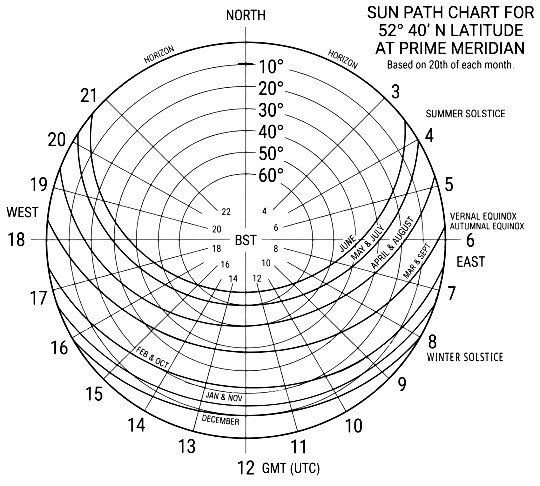
Sunny winter days extend the risk throughout daylight hours. When the sun makes an appearance it doesn't rise much above 20°, even at midday. In December, 10° is its highest.
Below is a simplified version of a diagram I referred to after checking date, time, weather reports, and vehicle directions, to see if low sunshine could have contributed to an accident. It isn't something that road signs and markings can address, but being able to eliminate it as a factor was informative.
It is impractical to expect drivers to have the above diagram in mind when planning a route or driving; they rarely even know the speed limit and their stopping distance.
There is little or nothing in road safety education about the risks involved. Early mornings and late evenings in summer will have increased shadows from trees in full leaf. Older eyes do not adapt to those conditions.
Bright winter days pose increased danger, so keeping this additional risk in mind is useful. Look for your shadow. If it stretches out behind you, show a rear light as you enter deep shade.
If you are riding into your own long shadow, be prepared for vehicles pulling into your path from driveways and side roads. Reduced visibility in your direction will result in a classic SMIDSY.
Don't ride off into the sunset too soon.
Ears need boxing
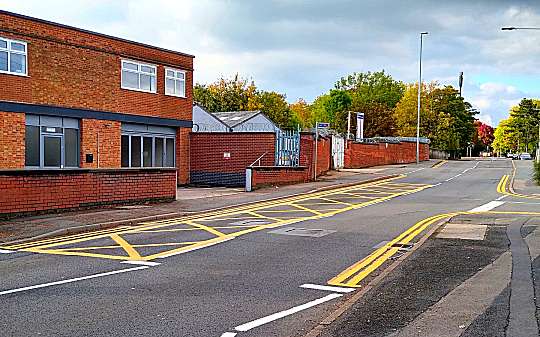
What is wrong with this photo? Yes, there should be traffic, and yes, it should be raining. But beside those things.
In case you need to revise, box junctions are covered by Rule 174 of the latest Highway Code. Unless you meet specific exceptions, you MUST NOT enter the marked box. [their colours]
Little about waiting, but do not enter. Penalty for transgression is a £70 fine.
Box junctions are necessary because the average driver doesn't have the nouse to work our when they are causing a traffic jam, or don't give a tinker's cuss if they do.
What is the purpose of the box junction in this photo? There is rarely a queue on the left of the road going away. Exceptions are frequent road repairs and utility work, but nothing permanent. Someone needs to get a grip of the thick yellow paint and drag it to the other side of the road, where there is often a traffic queue for the pelican or the traffic signals further along — the box should protect access into the junction.
But it's a waste of time waiting for the local authority to get a grip.
Bonus question: Does it qualify as oncoming traffic if it is pointing in the correct direction but stationary?