Chamois 1966
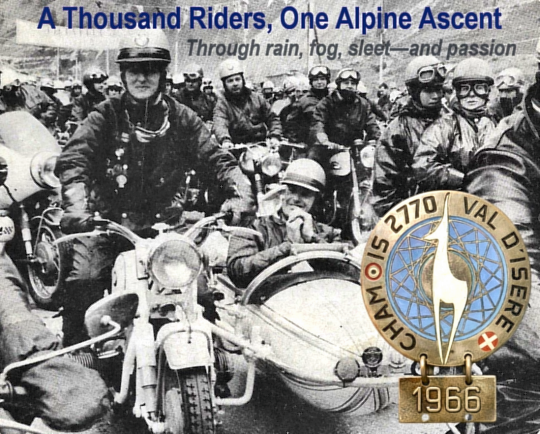
In July 1966, Val d’Isère was not yet the bustling tourist destination we know today. Summer there was calm, almost silent. Then, in a matter of hours, everything changed.
The village filled up. Engines began to roar. The streets grew dense with machines and riders.
What struck witnesses at the time — and still resonates through the archives today — was that overwhelming sense of arrival. Not a chaotic crowd, but a tide of enthusiasts from across Europe, drawn by a shared calling.
In Val d’Isère, the quiet of summer is suddenly shattered as the streets fill with riders from across Europe, united by the same passion.
700 participants by Saturday evening
Throughout the day, arrivals follow one another in a steady stream.
By around 8pm, the organizing committee of the BMW Club can be satisfied: more than 700 participants are already on site, with some yet to be registered.
The international attendance recorded by the organizers breaks down as follows:

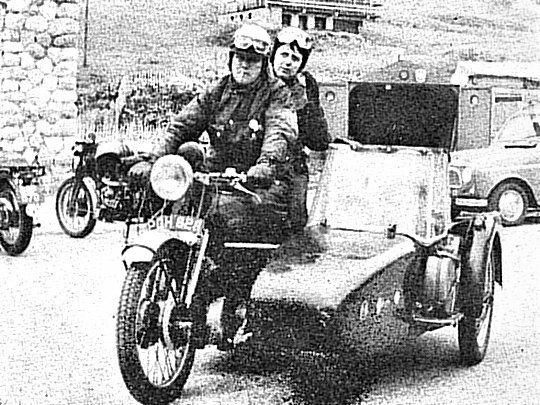
Among them was this daring Brit who made the journey all the way to Val d’Isère on his vintage 1929 Raleigh 350 — a feat that deserves a hat tip.
380 French
69 Germans
65 British
40 Swiss
30 Belgians
18 Italians
4 Spaniards
3 Swedes
2 Austrians
2 Americans
1 New Zealander
To this must be added the motorcyclists from nearby regions who arrived on Sunday morning, as well as Italian riders coming over from just across the border.
In the end, despite difficult weather conditions, around 1,000 motorcyclists answered the call.
At the end of this first day, a campfire — followed by a fireworks display — drew participants together.
When the parking lot becomes an exhibition
Nearly 750 machines were recorded, the vast majority being large-displacement bikes: around 80% exceed 500cc.
Among them, BMWs clearly dominated with around 375 machines. They were followed by the British marques — Norton, BSA and Triumph — as well as Japanese brands, notably Honda, with roughly 50 to 60 bikes each. There were also six Harley-Davidsons, along with Vincents and various other makes.
The Chamois parking area thus turned into a true open-air motorcycle show: plenty of production bikes, of course, but also many custom builds and personalized equipment.

The rally parking area was practically an open-air motorcycle show.
A striking array of equipment could be seen: Jakeman fairings, Atlas handlebar-mounted fairings, twin GT-style headlights with iodine lamps, Münch brakes, twin megaphone exhausts, large-capacity racing tanks and plastic fenders.
Among the most beautiful or rare machines — drawing particular attention — are notably:
A superb 650 BSA in full café racer mode: racing carburetors, a lightweight Gold Star alloy tank, a dual seat with backrest, upgraded front brake hub, Domiracer-style exhausts, rear-set footpegs, and more.
Zündapp KS601 models — now rare machines, almost only seen in the hands of dedicated enthusiasts — some ridden solo, others with sidecars. The KS601 is an older model: some examples clearly showed their age, while others appeared as if they had just left the factory, in immaculate condition.
Dad, mum and the kids — all squeezed onto this Vincent outfit for the trip from England to Val d’Isère. Vincent owners turned out in large numbers that year.
Several Vincents were present, including a rare Black Prince — an exceptionally uncommon sight in France — showcasing remarkable innovation for its time (not least its unique stand system).
Another Vincent featured an Earles fork borrowed from a Horex, a particularly successful and striking modification.

One more stunning Vincent outfit from across the Channel — apparently the family car of choice.
An Ariel Square Four in remarkable condition. Though not especially fast for its time (155–160 km/h), it was renowned in France for its smoothness, flexibility and quiet running.
Several Harley-Davidsons, including the 65HP Model, complete with a far-west saddle, studded saddlebags, and exhausts, handlebars and headlights in pure American style.
A Harley family reunion in Val d’Isère — every generation showed up.
Also spotted was an R75 outfit in Russian style, its rider in full uniform — only the machine gun was missing — as well as a Scott featuring the new chassis introduced in 1964, while retaining the liquid-cooled two-stroke engine that had defined a whole generation.

A water-cooled two-stroke — nothing new in itself — but this Scott featured a modern chassis, all lovingly maintained by its owner.
A Brough Superior with sidecar, seemingly straight out of a museum, and finally a 1929 Raleigh.
Importers join the Chamois
Three importers also took advantage of the event to showcase their machines.
A Yamaha van was parked on the main square, with a technician on hand to provide information, brochures and pricing. Demonstration bikes — including the new 100cc twin — were made available to visitors.

In the background of this British Vincent, notable for its oversized custom fuel tank, the Yamaha support van mentioned earlier can be seen.
The lesser-known Bridgestone marque was also represented, notably with a 90cc model prominently on display.
As for the third exhibitor — and not the least — it was Jean Murit himself.
Then president of the BMW Club of France and organizer of the Chamois, Murit was also the French importer for Münch. On this occasion, he unveiled to the public — exclusively in France — a machine specially built for him by Friedel Münch.
For Murit, Münch used a 996cc air-cooled NSU Motorenwerke engine, featuring a chain-driven overhead camshaft, mounted in a specially fabricated brazed steel tube frame inspired by Norton Featherbed principles.

At the handlebars of his Münch, Murit lead the procession from Val d’Isère to the summit of the Col de l’Iseran, Europe’s second-highest paved mountain pass.
Customers could choose between one, two, or four carburetors, with outputs of 43 or 52bhp.
The machine was equipped with a four-speed gearbox, connected to a gear-driven primary drive and an enclosed-chain final drive.

Murit’s Münch Mammut — basically a car engine with handlebars — roars into action at the 1966 Chamois, politely ignoring the concept of ‘reasonable’.
The front brake was one of Münch’s famous 250mm units.
More and more women at the handlebars
This July 1966 gathering also highlighted a growing number of female riders. Some were no longer just passengers, but now firmly in control of the handlebars.
Among them were three representatives of WIMA: Helen Pfeiffer (Continental Europe), Mary Dudgon (England) and Yvette Gadras (France).
A climb to the Iseran in extreme conditions
At 11:30am, the priest of Val d’Isère blessed the participants, after which the long procession set off toward the Col de l’Iseran.
Perched in a sidecar, the priest of Val d’Isère welcomed and blessed the riders before they set off to tackle the mountain pass.
The rain never let up. Halfway up the pass, fog and sleet added to the challenge.
In freezing conditions, the determined Chamois riders reached the summit, where a raffle took place, with a brand-new BMW 500 as the grand prize.
The return to Val d’Isère marked the time for a countryside lunch to close the event.
The rain briefly eased during the meal, only to return with renewed force as farewells began.
With the support of the BMW Club and the Val d’Isère Tourist Office, this second gathering signaled a bright future.
The Chamois was clearly here to stay — and all eyes were already on 1967.
Text: Jean-Francois Helias
Images: G.Gaudechoux & J.F Helias