Chamois 1967
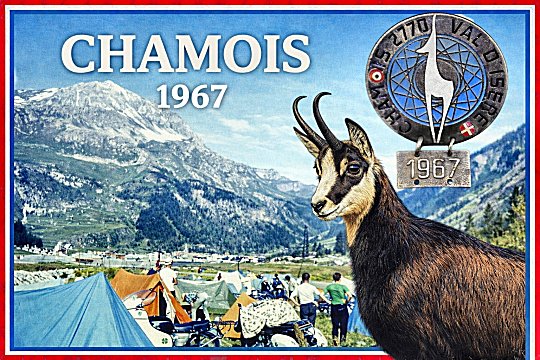
Heading for Val d’Isère on this Friday, July 14th — France’s national day. After long hours devouring hundreds of kilometres of sun-scorched asphalt, the road slowly began to change its character as the Alps drew near.
It narrowed, twisted, and coiled, linking sharp bends like a succession of challenges. Towering rock faces rose on either side, austere and commanding, while dense pine forests gathered strength and depth. Below, torrents and waterfalls caught the light, shimmering as they wove through the rugged terrain.
The air, still warm, occasionally carried the scent of wild herbs and resin. Then came the tunnels — dark, damp passages that felt like thresholds, ushering you closer to arrival.
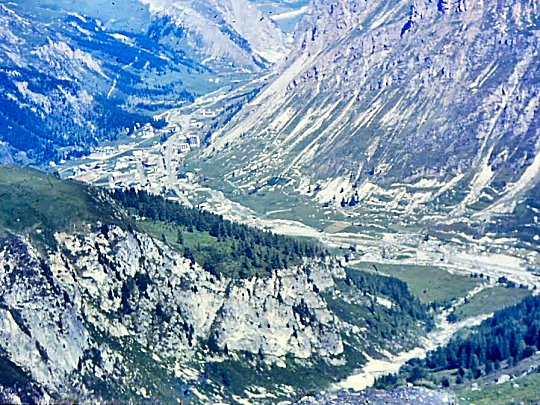
Down in the valley, bottom left: Val d’Isère in 1967 — a quiet village of 1,400 inhabitants… until the Chamois weekend doubled the headcount.
And suddenly, the landscape opened wide: Val d’Isère revealed itself, broad and radiant, watched over by Solaise and Bellevarde. Beyond, snow-capped peaks sealed the horizon, while the Isère River rushed down the mountainside with a deep, resounding roar.
Friday, 14 July — The arrival
As the site came into view, the unmistakable growl of engines filled the air. Lanes buzzed with constant motion, a restless flow of small-displacement bikes weaving among towering machines.
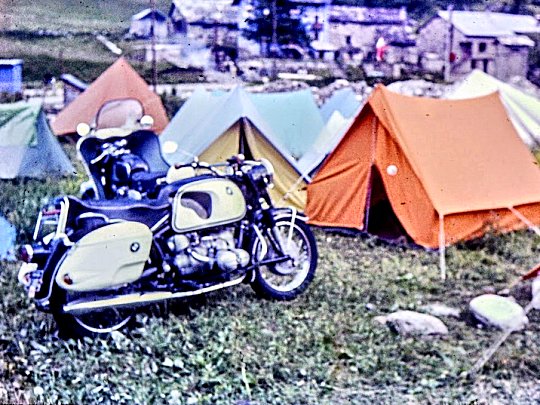
Order, of sorts
Tents went up as best they could on stony ground, forming an improvised camp. An unspoken order seemed to emerge: the French on one side, the English and Germans on the other. The gathering was already dense, alive — almost loud with mechanical camaraderie.
But the sky was quick to shift its mood. Clouds piled up along the ridge lines, heavy and threatening. Pitching tents suddenly became a race against time.
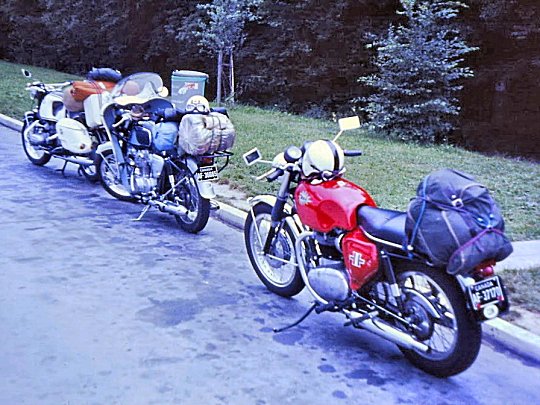
The 1967 Chamois welcomed Canadian motorcyclists… proof that word had travelled far.
A nearby meadow, greener and more inviting, lured a few campers in search of softer ground. Yet scarcely were their belongings sheltered when the storm broke with sudden violence. Driving rain, flashes of lightning, and rolling thunder engulfed the valley.
Those arriving late on Friday were plunged, without warning, into the raw initiation of the mountains.
The evening carried on beneath the downpour — clothes soaked through, but spirits revived by a welcome meal. Gradually, calm settled in, replacing the storm with the steady rhythm of sleep breathing through the tents.
Saturday, 15 July — A world of machines
At first light on Saturday morning, a soft glow filtered through the canvas. The silence that followed the night’s turmoil felt almost unreal. The clouds had vanished, giving way to a clear sky and a brilliant sun that breathed life back into the valley.
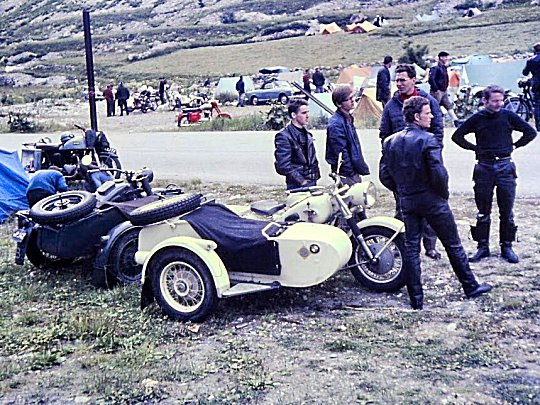
They pitched their tents wherever they could… and sometimes where they probably shouldn’t.
The wake-up was bracing. The cold waters of the Isère demanded a swift, invigorating wash. Yet for some campers — those settled just beyond the official grounds — a different reality intruded. A man appeared, claiming ownership of the meadow and demanding payment for each tent. Refusal brought immediate eviction, sometimes abrupt, even forceful. A simple rule reasserted itself: even in the heart of the mountains, no land is ever truly free, and improvisation comes at a cost.
Meanwhile, the Chamois rolled on — in truth, it was only just beginning. All day long, Val d’Isère echoed with the roar of exhausts as new arrivals streamed into the resort.
Val d’Isère, 1967 — loud, slow, gloriously unorganized.
No sooner did they check into hotels or pitch their tents than they shed their belongings and returned to the essential: the motorcycle.
Many lined their machines along the main avenue, on either side, transforming the street into a vast open-air exhibition. Others set off again without delay, heading for the legendary Col de l’Iseran. Some remained behind, bent over their bikes, absorbed in fine adjustments or makeshift repairs.
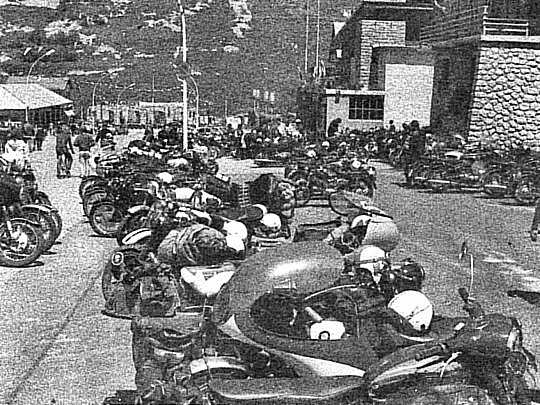
Rows of machines of every make and engine size lined both sides of the avenue, stretching for over five hundred metres.
On sunlit terraces, a few took the time to pause — seated before the mountains, cold drinks in hand. Nearby, small crowds gathered instinctively around the most striking machines. The sheer variety and richness of what was on display defied any attempt at a simple inventory.
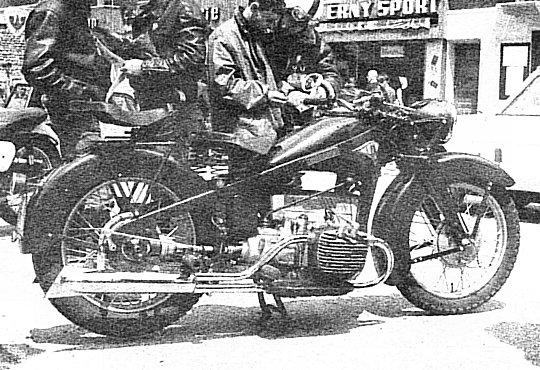
The oldest machine at the rally: a 1931 800cc Zündapp flat-four, featuring an imposing car-style gear lever with a central neutral.
Among them, vintage motorcycles bore witness to another age. A 1931 Zündapp 800cc flat-twin drew particular attention with its two exhausts at the front, two at the rear, a single carburetor housed in a casing above the engine block, 26 DIN horsepower, and a soft, muffled purr that was very pleasant to the ear.
There was also a 1937 Brough Superior V-twin with a sidecar — impeccably preserved, having journeyed all the way from Great Britain. Its owner, Alexander Winstanley, a young Englishman from Chester, readily posed for photographs, crowned with a top hat from another era.
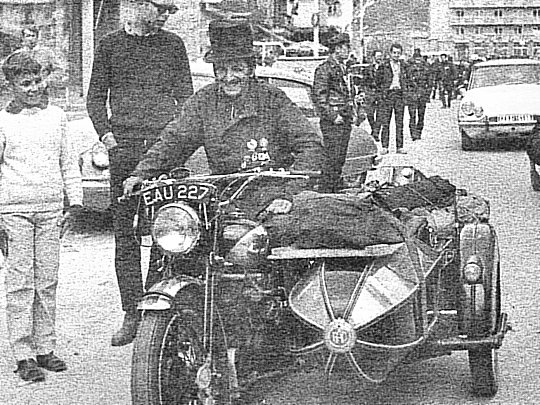
Chester’s Alexander Winstanley, turned more heads than the bike.
We rode this old bike down from Chester to Dover to catch the boat across to Calais. In those days you could not get International Insurance for motorbikes, you had to buy insurance for that country at the Customs post of the country. Frontier Insurance, it was called.
Across France to Switzerland. We stopped to camp, in France alongside a river.
Anyway, out of France into Italy. Aosta rings a bell. Then back into France for the run to Val d'Isere. On the way we crossed the Petit St Bernard pass, almost ending up in a 20ft snowdrift, but managed to get round it.
On arrival at the Rally, we booked in, by then frozen stiff and soaking wet; it had rained heavily for the last few miles. Happily a bunch of French riders decided they were to look after us as 'visitors to France' (very hospitable) and produced a Primus, a saucepan, a bottle of wine and a bag of sugar. The resulting brew soon warmed us up. There was a 'cheese and wine party' that night.
One of the days there was a ride up to the top of the Col d'Iseran, above the snowline. An absolutely glorious Rally.
Unfortunately that was the only long-distance we did on my Brough Superior as the top came off the back piston near Dijon on the way home. The other lad I was with, Lennie Griffiths and I, hitch-hiked back home, 600 miles in under 24 hours. That was quite an epic trip on its own. I did recover the bike to England eventually.
I remember Heather MacGregor well and her woolly hats. A nice lass. We had some good times Rallying. Digging our way out of the tent on one Elephant Rally — what fun.
Thanks again for the pix and memories.
 We rode this old bike down from Chester to Dover to catch the boat across to Calais. In those days you could not get International Insurance for motorbikes, you had to buy insurance for that country at the Customs post of the country. Frontier Insurance, it was called.

- Sandy Winstanley
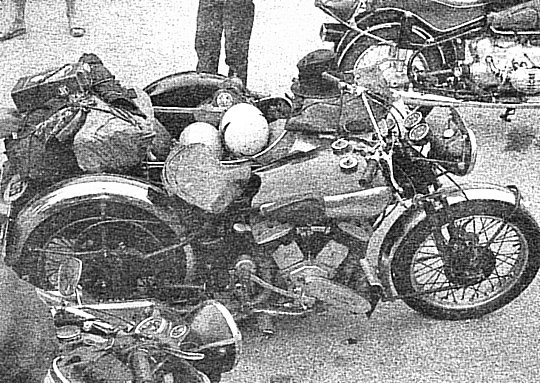
From above: the 1937 Brough Superior V-twin outfit—clearly a man of foresight, with a hefty five-litre can of Castrol perched atop the luggage.
Not far away, a more recent Münch Mammut — ridden all the way in by its German owner, whose enthusiasm matched that of his machine — drew a steady crowd of curious onlookers.
Yet the most striking motorcycle was undoubtedly a Vincent Egli, presented in immaculate condition. Its pristine state suggested it may not have arrived under its own power. Constantly surrounded, it revealed itself only briefly before disappearing again, leaving behind a lingering — and slightly frustrating — impression for those who had hoped to admire it longer.
Alongside these vintage and high-performance machines, more recent motorcycles were also well represented: an elegant Honda CB450 from Paris, carefully prepared in racing style with a sculpted tank, fairing, and seat; and two British machines — a Triumph Bonneville and a BSA Spitfire — ridden by Italian participants.
From this broad panorama, one conclusion naturally emerged. While the earliest editions of the Chamois had been largely dominated by BMW, the balance now appeared far more evenly distributed among different marques. This evolution challenged earlier criticism from some observers, who had seen the gathering as an excessive showcase for a single manufacturer.
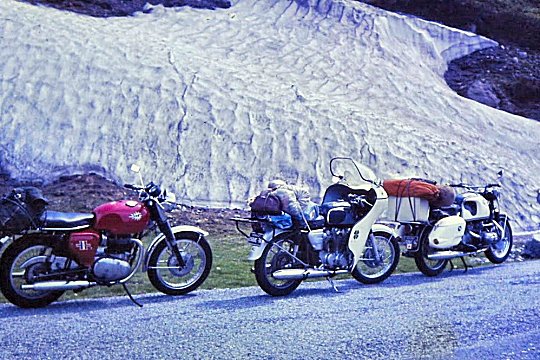
Not just a BMW party anymore…
The Chamois thus confirmed its transformation: it was becoming an open and convivial meeting point, bringing together motorcyclists of every background and nationality.
Let us pause for a moment and consider the numbers. Among the machines recorded were 342 BMW motorcycles. Alongside them, 86 Hondas — with a remarkable proportion of 450s — as well as 28 Yamahas and 12 Suzukis, bringing the total of Japanese bikes to 126. Their presence was unmistakable, not least for their constant, energetic activity.
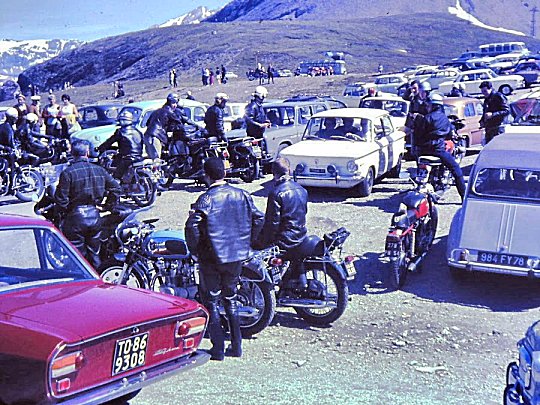
Up at the Iseran summit parking, no longer just bratwurst — British, Japanese, and Italian machines joined the feast. The Chamois was delightfully international.
A group of seven or eight young riders, mounted on 250cc Yamahas and Suzukis, stood out in particular. Their departure in tight formation created a striking sonic display, effortlessly evoking the atmosphere of a Grand Prix start.
British marques were also strongly represented, with a total of 200 machines: 73 BSAs, 66 Triumphs, 44 Nortons, 10 Royal Enfields, and 7 Vincent motorcycles.
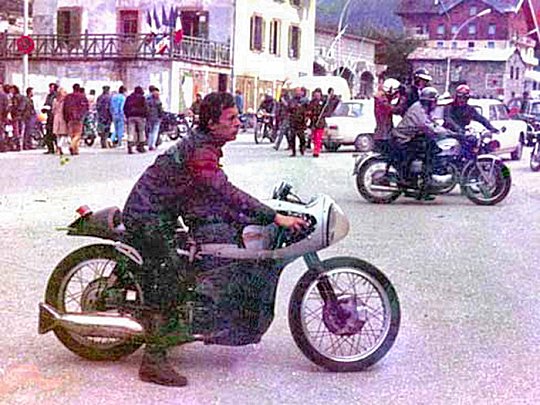
Either the organizers forgot to register this Velocette… or its rider simply decided to skip the paperwork.
The Italian contingent completed the panorama: 16 Ducatis, 7 Aermacchis, 5 Moto Morinis, along with a Gilera and a Moto Guzzi motorcycle. To these were added 19 French machines — 11 Motobécane and 8 Terrot motorcycles.
Among the latter, a curious Terrot “Rallye,” patched together from all sides, drew particular attention; a veteran of major gatherings, it became something of a living collector’s piece. Elsewhere, two Harley-Davidson motorcycles rounded out the field.
The Münch Mammut continued to draw attention. Its owner offered test rides to a few fellow Germans, who returned wearing expressions that blended admiration with astonishment. Their reactions spoke volumes — slow, emphatic nods that left no doubt about the machine’s formidable power.
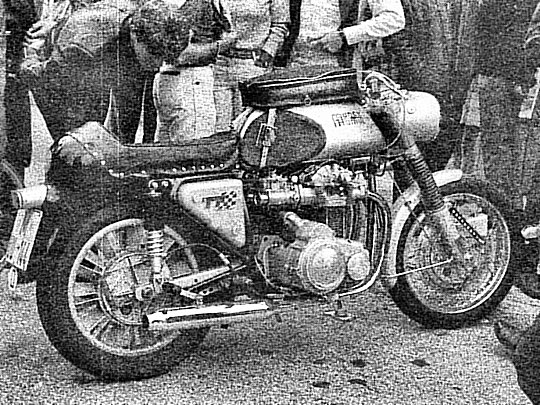
Power you don’t argue with… you just nod.
Saturday unfolded under a generous sun, in the best possible spirit, to the delight of all. The day found its own rhythm — a blend of leisurely rides, wandering conversations, animated exchanges, and short bursts on the road.
The atmosphere stood in deep contrast to the taut pace of urban life, offering a pause that felt almost restorative.
As evening fell, a large crowd gathered around the barrels from which Savoie wine was served, in a warm and convivial atmosphere.
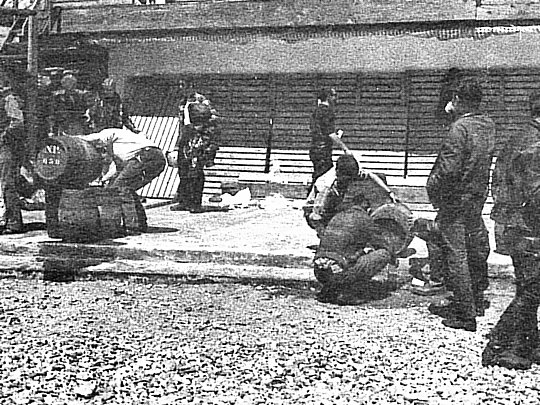
Savoie wine flows faster than the queue moves — all roads lead to the barrels.
The distribution proved rather slow, yet this did little to dampen the general good spirits. A light snack accompanied the refreshment, adding to the simple pleasures of the moment.
The festivities continued with the “motorcyclists ball,” brought to life by a high-quality orchestra.
One slight drawback remained: the noticeable shortage of female dancing partners. Many men hovered at the edges, watching the couples already on the floor, while others — dressed in leather or Barbour jackets — ended up dancing together in good humour. If elegance suffered somewhat, the scene more than made up for it in character and lively charm.
Sunday, 16 July — The final day
From the very first light of day, the road to the Col de l’Iseran came alive with a constant flow of motorcycles. Departures happened in small groups of two or three, climbing partway before turning back toward the station — only to set off again. The motion never truly stopped.
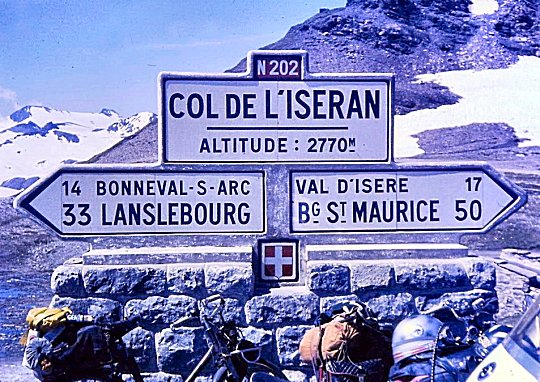
Proof you made it — in case anyone back home doubts it.
Meanwhile, participants in the ski-moto gymkhana scheduled at the summit collected their numbered bibs. Gradually, the crowd converged on the avenue of the cable cars, the designated meeting point for the 9:30am departure toward the Iseran.
From campsites and hotels alike, motorcycles streamed in without pause, emerging from narrow streets as if conjured from nowhere, feeding an unbroken current.
The roar became all-encompassing — a deep, rolling murmur born of thousands of exhausts blending together, at times dominated by the heavy pulse of a large twin or the sharper, urgent crackle of two-stroke engines.
Little by little, the apparent disorder gave way to structure. The flow organized itself into a long, dense column stretching toward the pass. The departure unfolded calmly, almost solemnly — like an inevitable procession moving steadily upward.
It starts as a roar… and somehow becomes a procession.
For several kilometres, the winding switchbacks of the road were lined with tightly packed motorcycles, forming dense, unbroken ranks.
The seemingly endless column called to mind another image — that of a slow, determined procession, like those tireless lines of insects advancing with unwavering persistence.
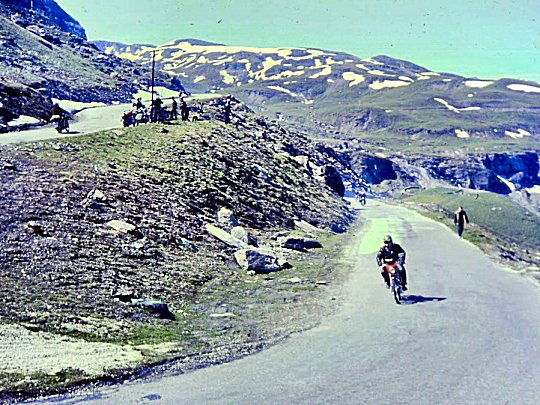
Climbing toward the pass, one curve at a time.
The vast and majestic Alpine setting felt perfectly suited to host such a gathering.
The scale of the landscape matched that of the event itself.
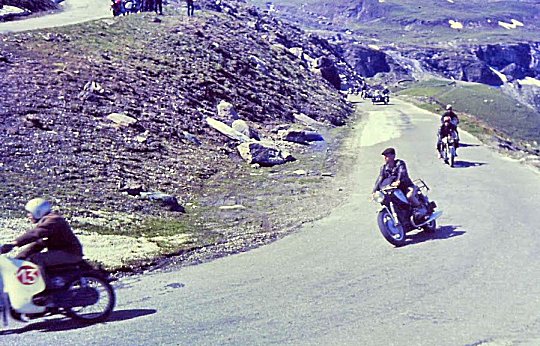
Each curve, a step closer to the sky.
At the summit, everyone eventually found a place to witness the gymkhana — the high point of this collective ascent.
A race of two disciplines
For this gymkhana, fifteen teams ultimately took the start in what remained a friendly competition. Originally, twenty-four had been expected, but numerous withdrawals thinned the field before the event began.
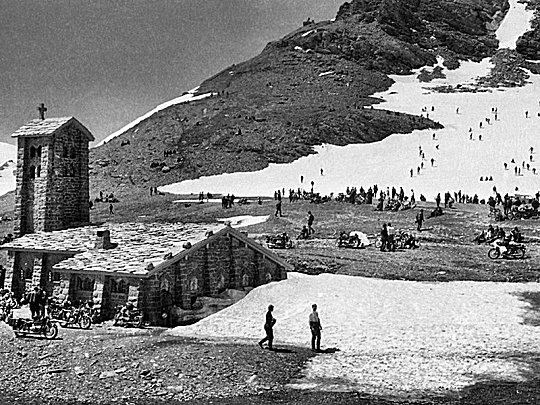
The Chamois ’67 gymkhana took place at the summit of the Col de l’Iseran (2,770m), under the watchful presence of the chapel of Notre-Dame de Toute Prudence.
Each team was built around an unusual pairing, bringing together two worlds: a skier and a motorcyclist. The former — dressed for the occasion in motorcycling gear — set off down a short slalom on snow. At the end of the descent, the baton was passed without delay to his teammate on a motorcycle. The rider then tackled a slalom laid out over uneven ground, where control and balance mattered far more than outright speed.
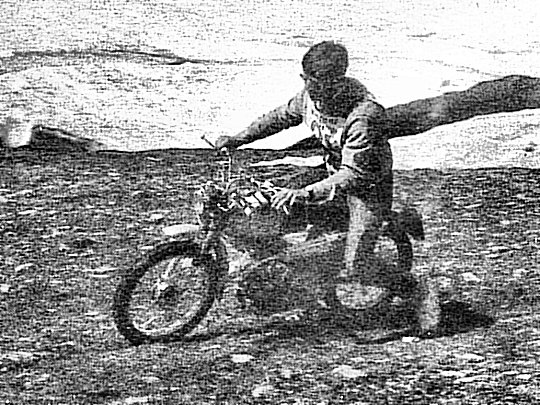
The final gymkhana competitor in action, at the handlebars of his ‘T.T. Special’.
The final standings were determined by the combined times of both teammates — a format that rewarded coordination just as much as individual performance.
At the end of the contest, victory went to the team of Poccard and Peugeot, who delivered a brilliant performance in this event, as unusual as it was spectacular.
The man who climbs mountains
No sooner had the gymkhana concluded — under the lenses and applause of a large crowd — than the show continued.
Claude Peugeot (one of the pioneers of trial riding in France during the 1950s alongside Claude Coutard and Claude Gapin, and a key figure in the discipline’s rise) took on the snowy slopes with companions. Riding a Bultaco Sherpa and a Husqvarna Cross, they set themselves a simple challenge: to climb as high as possible.
Claude Peugeot, Claude Coutard, and their crew, ready to climb ever higher toward the summit.
This daring ascent both astonished and captivated spectators unfamiliar with such feats.
Already the day before, Claude Peugeot had left a lasting impression. Beneath the upturned gaze of hundreds in Val-d’Isère, a motorcycle climbed a steep, invisible trail. Leaping forward, poised in a fragile balance, it eventually reached a small plateau nearly 150 metres above the village. At the handlebars, Claude Peugeot was simply taking his “evening ride” — in his own unmistakable way.
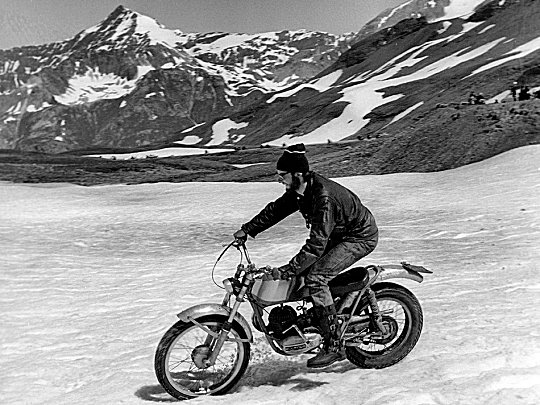
Riding the snowline at the 1967 Chamois
The Chamois drew to a close on Sunday in the early afternoon with the traditional picnic on the grass, bathed this year in generous sunshine after the descent from the Col de l’Iseran.
The atmosphere was especially warm and convivial: rows of Savoie wine barrels were set out for all to enjoy, and participants needed little encouragement to indulge. Meanwhile, the raffle prizes were drawn by innocent hands, under the attentive eyes and spontaneous commentary of the crowd.
The riches of the Chamois raffle
As in previous years, the 1967 Chamois raffle stood out for the richness of its prizes. Among them were Altus and Bell fairings, a Bell fuel tank, a Cromwell helmet, and various pieces of equipment — tank bags, gloves, and leather chin guards — not to mention several model motorcycles.
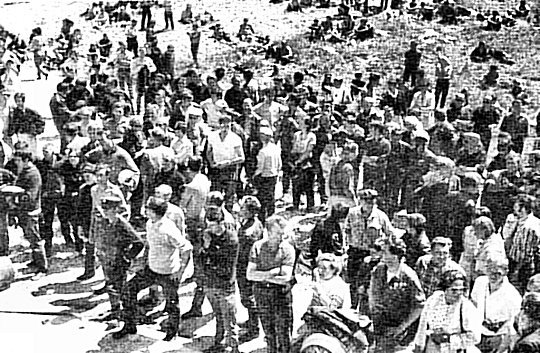
The crowd pressed in, eager to catch the raffle results.
The two luckiest winners received, for one, a full reimbursement of their stay at the Chamois, and for the other, an eight-day holiday in Val d’Isère.
But the most coveted prize remained, as always, the BMW R50, offered by Jean Murit and the BMW Club de France. This time, fortune smiled upon a certain Mr. Goddat, holder of ticket number 325.
The gathering in numbers — and beyond
At the close of this 1967 gathering, the official registration figures record 815 machines and 1,124 motorcyclists, representing fourteen different nationalities.
Even on holiday, old habits die hard — as shown by the salute of this Canadian serviceman at the Chamois ’67.
The breakdown was as follows: 910 French, 59 British, 53 German, 29 Italian, 21 Swiss, 17 Belgian, 10 Swedish, 6 Spanish, 4 Polish, 2 Danish, 3 Austrian, 2 Luxembourgers, 7 American, and 2 Canadian participants — the latter likely servicemen stationed in Germany.
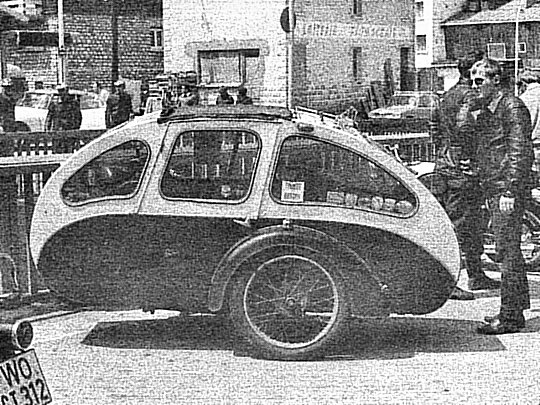
Of the 59 Brits officially registered at the 1967 gathering, those who showed up on this classic Made-in-England outfit were surely among them.
When non-registered attendees and the many passing motorcyclists — stopping only briefly to take in the event —are taken into account, the true scale of participation can be estimated at around 1,500 people and nearly 1,000 machines.
Those figures, however, call for some nuance. At first glance, the official total may seem lower than expected, yet this impression does not hold up under closer scrutiny. Registration numbers only imperfectly reflect the true extent of attendance.
One gendarme tries to keep order… the motorcycles have other plans.
The entry fee, set at 20 francs — including a light meal and participation in the raffle — likely discouraged some riders from registering. Many chose instead to join the gathering informally, without completing the official process.
In the end, the turnout clearly exceeded the announced figures, despite competition from the 1967 FIM Rally held in Moscow that same year.
Thus came to a close the Chamois of 1967, true to its original spirit while already revealing its evolution. Beyond the machines, the numbers, and the performances, what emerged above all was a human adventure — shaped by miles travelled, chance encounters, and a passion shared across borders.
In this grand Alpine setting, between snow and asphalt, each came in search of something: a challenge, a fleeting escape, or simply the joy of riding. And all left with more — memories, images, and stories that endure long after the descent from the pass.
Text: Jean-Francois Helias
Images: G.Gaudechoux & J.F Helias