Chamois 1970
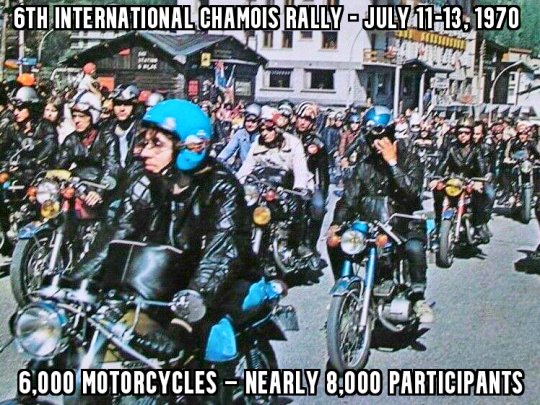
The organizers had expected around 4,000 participants. As a precaution, 4,500 registration forms had been printed. Yet by Sunday morning, everything was gone while motorcycles kept arriving without interruption.
In total, nearly 6,000 machines and an estimated crowd of around 8,000 people converged on Val d’Isère — an absolute record, more than double the previous year’s attendance.
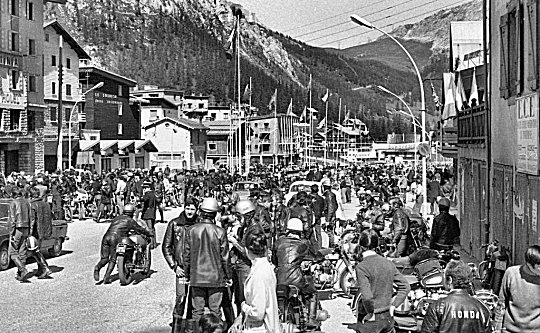
Nearly 6,000 machines and an estimated attendance of around 8,000 people.
What began in 1965 as a gathering organized by a handful of enthusiasts from the BMW Club de France around Jean Murit has, five years later, become one of Europe’s largest motorcycle rallies.
Inside Chamois 1970: the documentary that captured its soul
For three days — July 11, 12 and 13 — the small Alpine resort of Val d’Isère stopped being merely a paradise for skiers and hikers and became the capital of a people apart: motorcyclists.
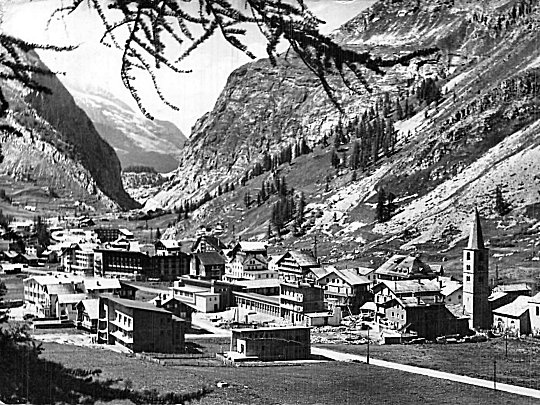
The small Alpine resort of Val d’Isère in the summer of 1970.
At 1,850 metres above sea level, at the foot of the Vanoise peaks and not far from the Italian border, the sixth edition of the Chamois 2770 attracted a crowd larger than ever before.
The documentary that captured its spirit
To mark this sixth gathering, a remarkable documentary was produced by the INA — then the French National Broadcasting Office — in collaboration with Pathé Cinéma. Narrated by Patrick Chapuis and featuring the participation of French ski champion Jean-Claude Killy, the film now stands as an exceptional historical record.
www.ina.fr/ina-eclaire-actu/video/cpf04006265/le-rallye-des-chamois
Lower quality version of the INA documentary.
Through its images, the film offers a vivid immersion into the atmosphere of the gathering, capturing with remarkable authenticity the spirit of freedom, camaraderie, and adventure that inspired the thousands of riders converging on Val d’Isère.
Riders without borders – United by the road
Had it been possible to observe Europe from the sky that weekend, one would have seen streams of motorcyclists crossing the continent’s roads toward the French Alps.
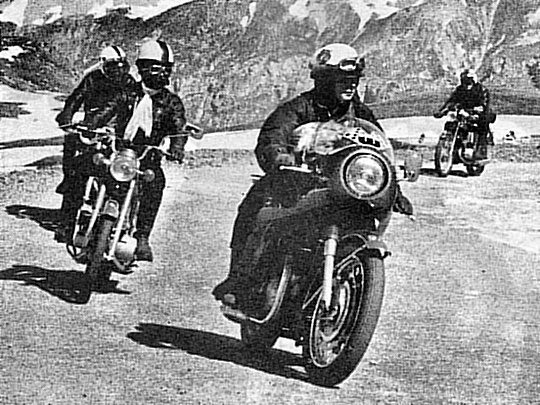
The great migration of riders toward the French Alps.
Swedes, Dutch, Belgians, Germans, English, Italians, Swiss — and even Americans — all set out to join what had become an unmissable gathering. They shared the same goal: reaching Val d’Isère and experiencing the unique adventure of the Chamois.
In the resort’s streets, the crowd was immense. Motorcycles filled the avenues, parking lots, and the areas around hotels and cafés. Everywhere echoed the roar of engines and excited conversations.
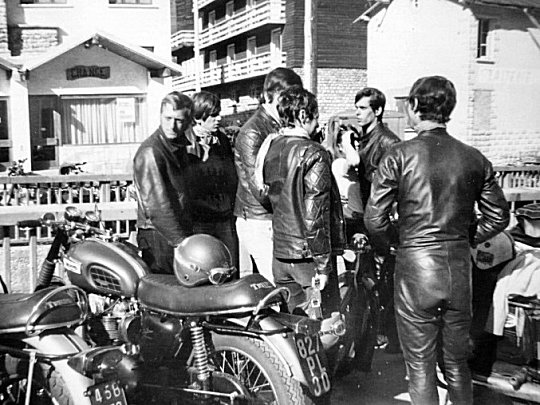
In every corner of the resort, engines roared and conversations buzzed with excitement.
Young and old alike, solitary travellers and groups of friends wandered through the village with smiles on their faces. Some recounted the hardships of their journey, others admired the bikes on display, while many were already preparing for evenings around campfires.
Tents, campfires and the badge
The meadows around the town filled with yellow and blue tents, while the Alpine night glowed with campfires, headlights, and laughter.
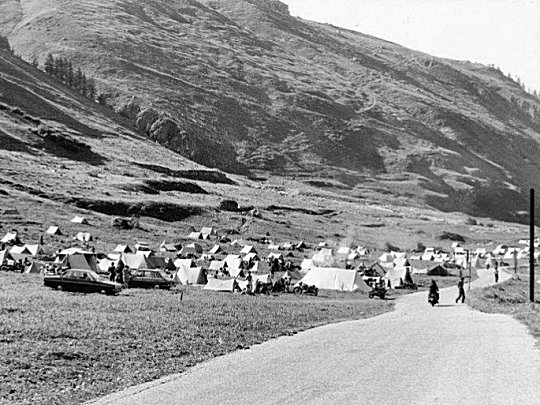
The meadows around the town filled with hundreds of colourful tents.
As every year, the raffle featured an impressive list of prizes, headed by three brand-new motorcycles. The coveted first prize was the traditional BMW R 50/5, followed by a Honda CB 350 for second place, and a Kawasaki GR 2-90 for third. BMW France also offered two additional major prizes: all-expenses-paid weekend trips to attend the London Motorcycle Show.
As the registration tickets shown below reveal, the 1970 Chamois raffle once again offered an enticing collection of rewards — provided luck was on your side during the draw.
Registration cost 10 francs and included the 1970 year bar for the badge, entry into the raffle, as well as access to the Solaise and La Daille cable cars.
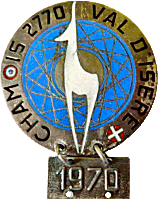
The commemorative medal, however, was not included in the price. It was sold separately for an additional 8 francs, while a few more francs would buy stickers.
Many considered the overall cost somewhat expensive, yet no one wanted to leave without the souvenir badge.
The pilgrimage to the high pass
Sunday morning remained the most eagerly awaited moment: the ascent to the Col de l’Iseran. From Val d’Isère, motorcycles set off in an endless line toward the 2,770-metre pass that gave the gathering its name.
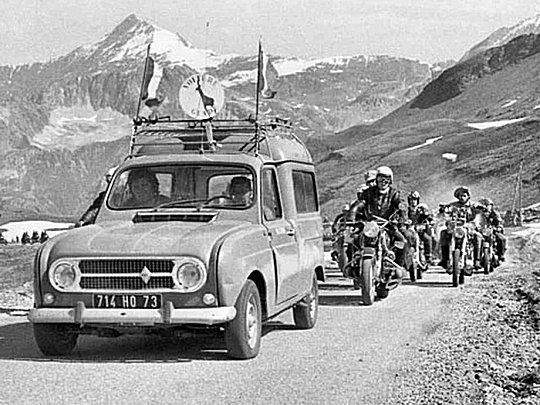
Through the Vanoise reserve, the road became a ribbon of endless bends.
The road climbed for nearly 17 kilometres through the Vanoise reserve, winding through more than a hundred bends.
Engines roared through the hairpin turns while the altitude sometimes disrupted carburettors; some motorcycles suddenly seemed to lose their voice in the thin mountain air.
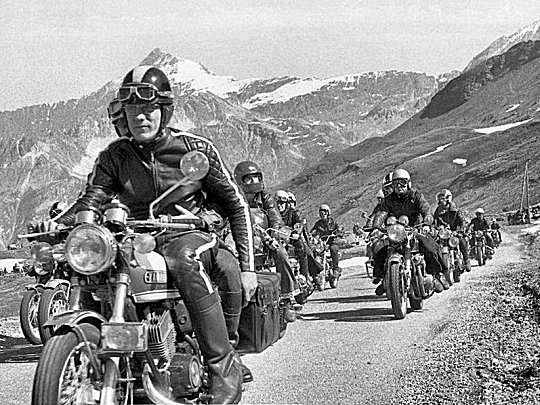
An endless caterpillar of motorcycles climbing toward the pass.
As participants approached the pass, the area around the small chapel turned into a true steel fortress. Thousands of motorcycles were parked wherever space could be found.
Despite all the precautions taken by the organizers, traffic jams became inevitable. Motorists trapped in the middle of this tide of two-wheelers were sometimes less enthusiastic than the riders themselves. Yet the atmosphere remained remarkably good-natured.
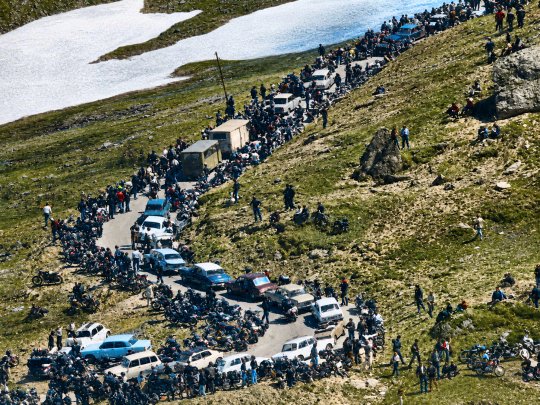
Cars found themselves swallowed by a tide of two-wheelers.
Amid the crowd dressed in leather jackets and Barbour coats, tourists and skiers in colourful Bermudas watched the scene in astonishment.
Motorcycles covered the mountain slopes while impromptu snowball fights broke out on the lingering summer snowfields.
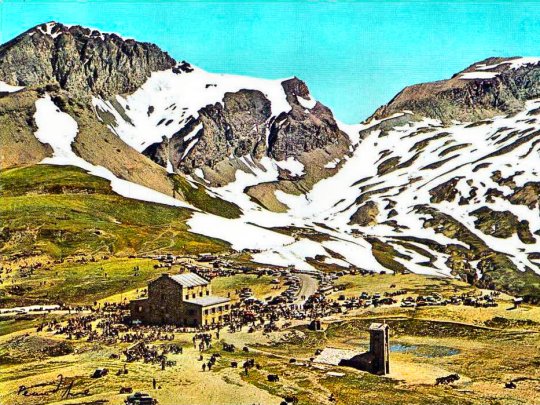
Around the tiny alpine chapel, the mountain became a fortress of steel and chrome.
Nearby, a few trial riders attempted impossible climbs across rocks and patches of snow, drawing applause and laughter from the spectators.
The ultimate motorcycle showcase
But the Chamois was far more than just a climb to a legendary mountain pass. It was also a vast living showcase of the motorcycles of its era. Every marque was represented, from humble Mobylettes to the awe-inspiring four-cylinder Hondas.
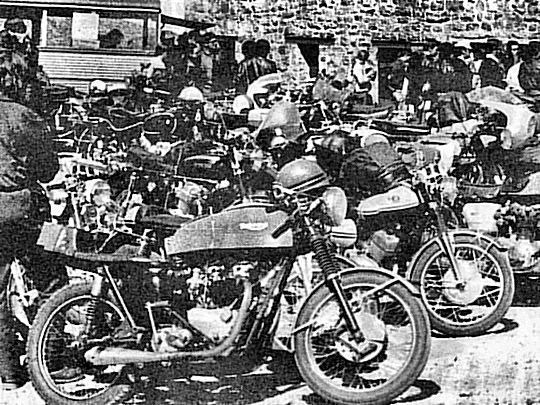
Small engines, big engines, famous marques and forgotten names — a living showcase of motorcycling in all its diversity.
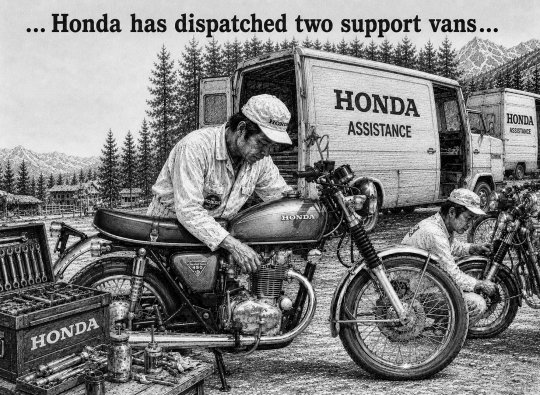
Honda, moreover, dispatched two support vans to provide roadside assistance and maintenance for the machines.
The Japanese mechanics worked tirelessly, and their efficiency left a lasting impression on all the participants.
The competition also seized the opportunity to shine. Kawasaki displayed everything from a modest 90cc model to the formidable Kawasaki H1R racer belonging to Michel Bétemps, then the French National Champion in the 350–500cc speed category.
Yamaha unveiled its eagerly awaited new 650cc machine, alongside a 250cc trials bike and a heavily modified 360cc model showcasing numerous technical innovations. The Chamois had truly become a showcase for modern motorcycling.
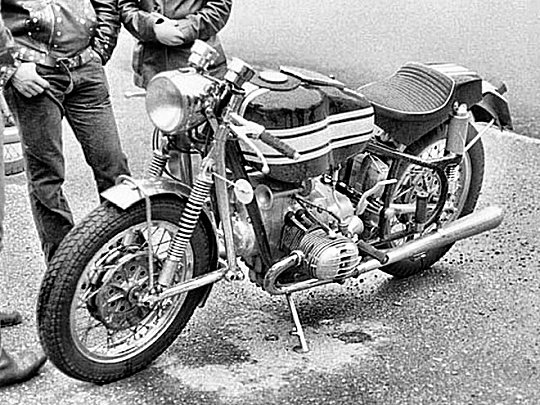
BMWs enhanced with Fath kits stood out with their unmistakable racing pedigree.
Amid this mechanical multitude, enthusiasts could admire machines of every imaginable kind. BMWs prepared with Fath performance kits, producing nearly 55 horsepower, stood beside extravagant Harley-Davidsons draped in chrome and elaborate decorations.
Some Harleys had ridden all the way there after hundreds of kilometres on the road; others, far more flamboyant, had discreetly arrived on trailers — a detail that never failed to amuse the purists.
Some Harleys, like these, had travelled hundreds of kilometres to reach the gathering.
Vintage motorcycles also held a place of honour. English Velocettes with parallelogram forks, 1946 BMW R73s, wartime Zündapp sidecars, Puchs, Motobécanes, Gileras, and Saroléas together evoked the entire history of motorcycling.
Three-wheelers were equally well represented, including an Englishwoman who had travelled specially to the event with her daughter.
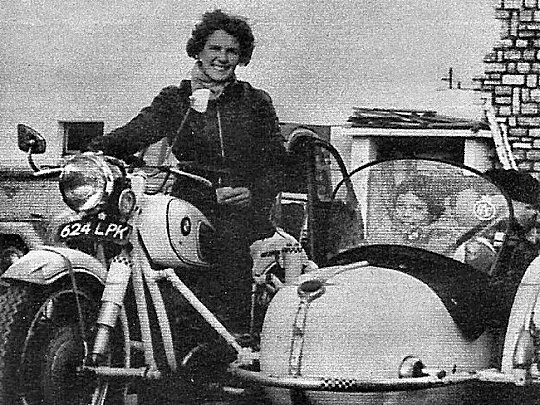
Will any reader recognize this fearless rally woman from Great Britain at the handlebars of her BMW outfit, registered 624 LPK?
Every machine told a story, and every rider carried with them a fragment of the road.
Farewell to the Chamois — until next Year…
For deep down, the Chamois 2770 was far more than just a motorcycle rally. Above all, it was a vast brotherhood. All these men — and a few women — shared the same passion and the same love of the open road. They modified their machines to travel farther and better: oversized fuel tanks, comfortable saddles, protective fairings, powerful headlights capable of piercing the long night roads on the journey home. Some rode fast, others took their time, yet all were living the very same adventure in their own way.
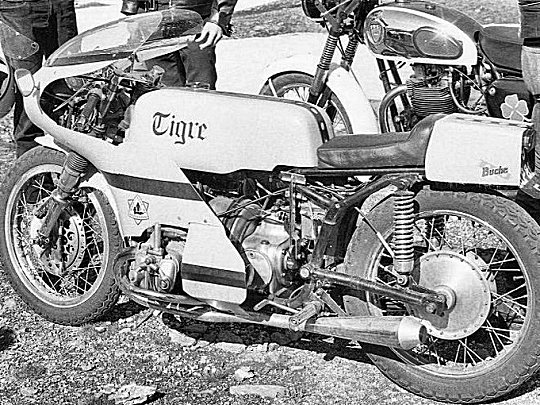
One of the event’s highlights was Jean-Paul Buche’s bitza, powered by an 860cc Panhard Tigre flat-twin with Ratier-Cemec shaft drive. Built on a modest budget, it reached an impressive 200 km/h.
Then, all too soon, came the time to leave. By Sunday evening, only a few hundred die-hards remained, still climbing and descending the road to the Iseran simply for the joy of the bends.
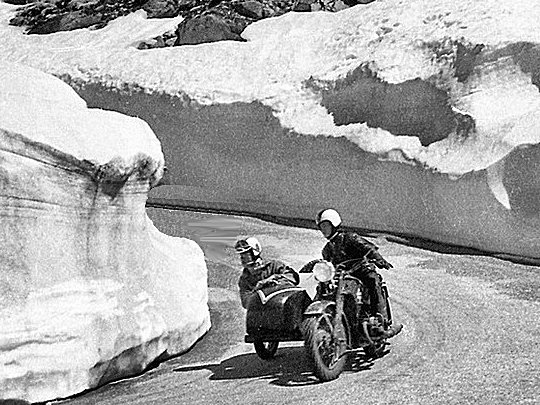
...still climbing and descending the road to the Iseran simply for the joy of the bends …
Gradually, the campfires died out. By Monday morning, the great majority of participants had left Val d’Isère, carrying away memories of mountains, camaraderie, and freedom.
But no one saw it as a farewell. In conversations over the last cups of coffee or while climbing onto their machines one final time, everyone was speaking about the next gathering. After such a success, only one thought filled their minds: returning in 1971.
Text: Jean-Francois Helias
Photos: Gilles Gaudechoux & Jean-Francois Helias