Rallye Neiges
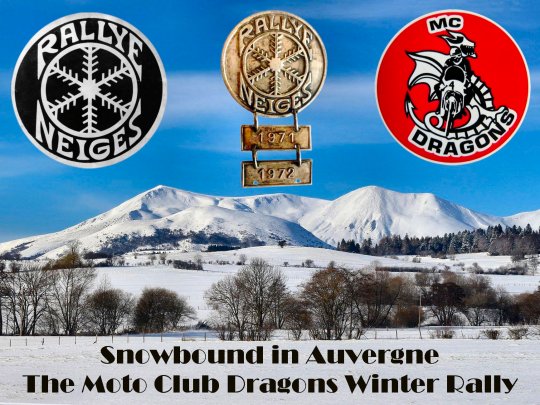
In July 1970, just one week after the Chamois Rally in Val d’Isère, the MC Dragons, under the leadership of its president and founder Christian “Kiki” Blanchot, organized its very first event: a summer rally named Vercingétorix.
Six months later, on 16–17 January 1971, riding that momentum, the energetic and rebellious Auvergne-based club staged its second event: this time a winter gathering known as the Rallye Neiges.
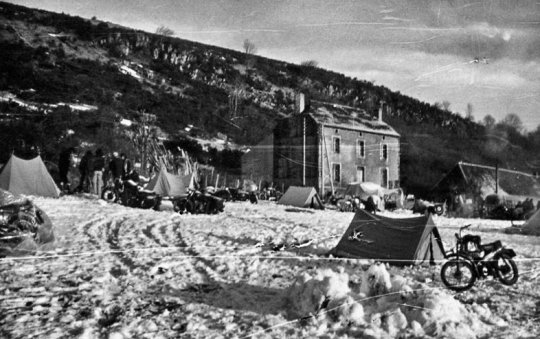
View of the bivouac of the die-hards at the 1971 Rallye Neiges.
This international gathering — with no rules and no rankings — was, according to a statement by Kiki published in the press at the time, “intended to allow riders of good will to start the year under the banner of motorcycling brotherhood.”
It took place in Saint-Alyre-ès-Montagne, on the border of the Puy-de-Dôme department, in the Cézallier massif, about 80 km south of Clermont-Ferrand.
Saint-Alyre-ès-Montagne
A village whose name was derived from Alyre of Clermont, recognized as a saint by both the Roman Catholic and the Orthodox Churches.
He died in 384, on his return from a journey to Trier. According to tradition, he was summoned by Emperor Maximus, who asked him to cure his daughter, said to be possessed by a demon. Alyre is indeed invoked in cases of exorcism.
The expected cold… but timid snowfall
Back in the day — and even as late as 1971 — winters in the Cézallier massif, at an altitude of nearly 1,200 metres, were far harsher than they are today. It was not uncommon for Saint-Alyre-ès-Montagne and the surrounding hamlets to be cut off for several days by heavy snowdrifts.
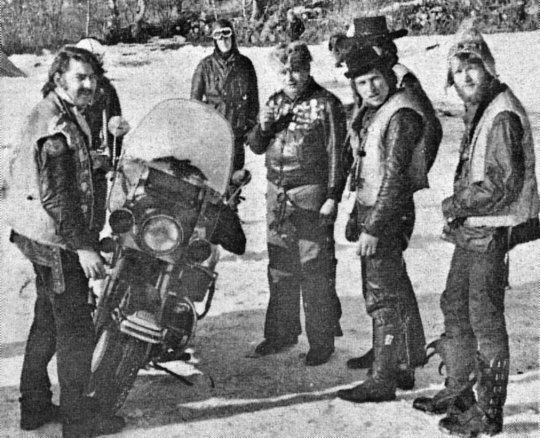
Kiki Blanchot (left), the notorious Jo Poterre (wearing the fur hat) from the HD Club de France. Behind him stand three prominent members of the MC Dragons: likely Jean-Claude “Grand Cowboy” Boyer (only his hat visible), and in front of him Jean “Le Plombier” Pozzo (black hat). I’m drawing a blank on the identity of the third.
Snowplows didn’t run as regularly as they do today; and even when they did, the snow they cleared quickly returned to the roads, driven back by the wind.
Kiki and his Dragons had found what seemed like the perfect location, dreaming of a weekend that would live up to their expectations: biting cold, plunging temperatures, frozen roads, and heavy snowfall without respite.
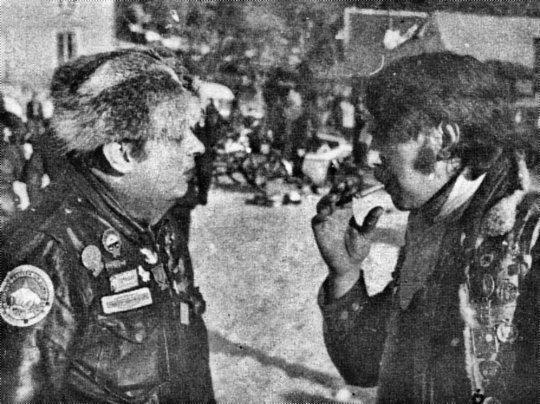
The inimitable late Jo Poterre, aka “Jojo Harley,” deep in conversation with Kiki. A real character! It took some serious grit — and a fair bit of madness — to rack up miles in the dead of winter on a Harley as heavy as a dead mule and about as comfortable on snow as a cow on ice… not to mention you had to be willing to forget about staying clean — or upright.
A scenario worthy of the legendary 1969 Millevaches Rally — long held as the ultimate benchmark. And yet, as so often with winter gatherings — be it certain editions of the Elefantentreffen or many lesser-known events — the gods chose to ignore the organizers’ prayers.
There was snow, of course — plenty of it — but mostly clinging to the higher reaches of the plateau. Not a single fresh fall came to spice things up. A small disappointment, perhaps, for the hard-core rallyists who had come precisely for that: hardship, challenge… and a proper winter to wrestle with.
The MC Dragons’ art of hospitality
Despite everything, this first Rallye Neiges — much like the Vercingétorix held six months earlier — proved to be a warm and convivial success. Not a single participant had cause for complaint. As usual, the MC Dragons had taken care of every detail, delivering an organization of the highest quality.
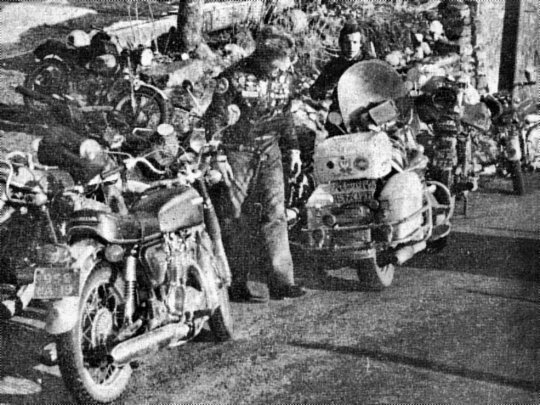
Why so many shots of Jojo’s Harley? In those days, these bikes were far rarer than they are now.
The route, starting from Saint-Germain-Lembron, about ten kilometres from Issoire, was flawlessly marked.
At the finish, the club ensured smooth check-in and registration, welcoming participants on Saturday the 16th from 2pm to 9pm, and again on Sunday morning from 8am to noon.
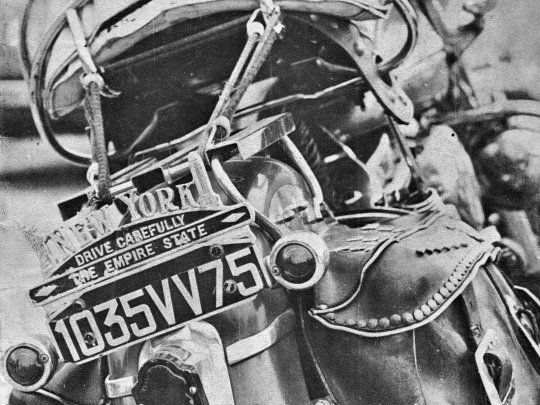
With such a fine rear view, the photographer simply couldn’t resist.
The deliberately modest entry fee entitled participants to the traditional commemorative badge, its logo once again designed by Kiki and featuring a stylized snowflake.
Also included: unlimited mulled wine — no less than 150 litres had been prepared by the late Jean Pozzo, known as “Le Plombier,” as well as access to the village dance, held on a wooden floor, and to the campsite.
On a large open esplanade, a tarpaulin-covered wooden platform had been set up, serving both as headquarters — largely run by the female members of the MC Dragons — and as a makeshift dormitory.
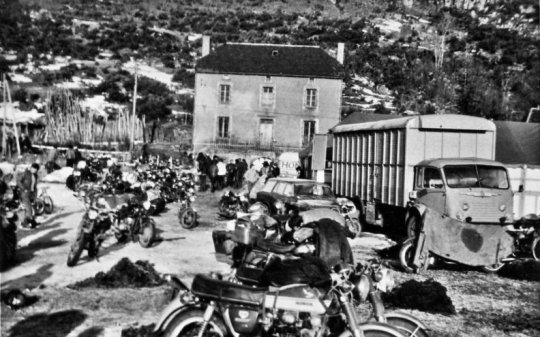
On the right-hand side of the image, you can see part of the covered wooden floor.
It was heated by an oil-fired blower, spreading a warmth that journalist François Vignes, founder of Europe Moto Magazine, humorously described as “ideal for incubation.” And despite the racket of the generator, one could still make out, in the background, the pop hits of the day drifting through the loudspeakers.
At the heart of the Saturday night atmosphere
Near the entrance, a narrow one-way corridor guided arrivals like an initiation rite toward a huge steaming cauldron. There stood a member of the organizing club, a true dragon-like figure — tall, imposing, and endlessly talkative — presiding like a guardian of ancient rituals.
Wielding a ladle like a sceptre and a fire poker like a staff, he dispensed generous servings of a mysterious potion to every newcomer. No one escaped the ritual.
Rumour had it — and it seemed well founded — that several bottles of rum had somehow found their way into the brew, giving it properties as warming as they were unforgettable.
Judging by the enthusiasm of the participants, it must have been quite something: a few crafty souls were seen sneaking back through the line, elbowing their way in for a second — or even third — helping.
Saturday night: the ‘flashy biker poser’ hanged and pelted with snowballs amid the jeers and shouts of the rallyists.
One of the standout moments of Saturday night was the ritual execution of a straw effigy — a so-called “flashy biker poser.”
Rope around its neck, it was hoisted above a bonfire and, right on cue around 10pm, swiftly “dealt with”.
To the cheers, boos, and gleeful mockery of a thoroughly fired-up crowd, the unfortunate figure was then mercilessly pelted with snowballs.
A scene hovering somewhere between folk ritual and outright madness. But then again… only the Dragons could turn something like this into entertainment.
A church and a bistrot
In those days, it was often said that any French village worth its salt, if it didn’t have a church for lack of importance, would at least have one or two bistrots to preserve the essentials.
Saint-Alyre-ès-Montagne, however, had the good fortune of having both: a church for the souls… and a bistrot for the living.
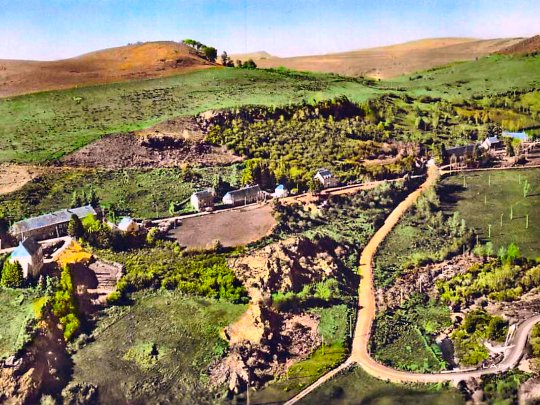
Aerial view of Saint-Alyre-ès-Montagne… the village bar lies somewhere below.
Here, the bistrot was far more than a place to grab a drink — it was the village’s beating heart. You came to buy your tobacco, lean on the counter for a quick glass — usually followed by another — settle the world’s problems with unshakable certainty, spread the latest local gossip (accurate or otherwise), or play a few hands of cards in the thick, smoky air of endless belote games.
Beyond the grocery and the bakery, there was nothing for miles around. Which meant this place — cheekily nicknamed “the Drugstore” — concentrated all the social life of the area within its walls.
During the January 1971 rally, it turned into a full-blown crossroads of humanity — a lively melting pot where the mayor, old-timers, bar regulars, and MC Dragons all mixed without ceremony. Elbows on the counter, voices rising, laughter echoing… and glasses somehow always empty just when you thought they’d been filled.
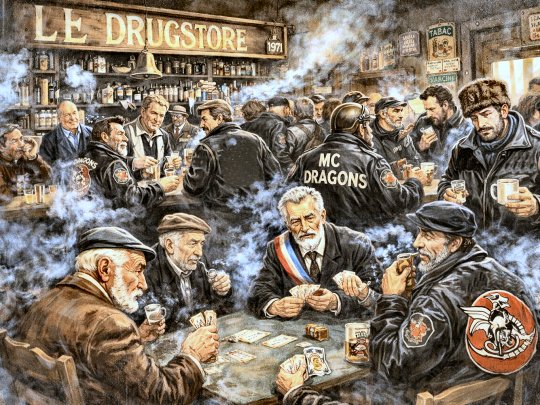
No photos of the bar’s interior atmosphere survived that weekend… likely lost in the haze above the counter. This AI-generated image, however, gives a fair idea of it.
And then there were the others… participants sometimes put to the test by the infamous rum-laced welcome potion, who came here in search of a second wind. You could see them regaining their colour over a solid “rince-cochon,” a local remedy of proven effectiveness.
The skeptics proven wrong
One of the most notable aspects of the gathering was undoubtedly the quality of its atmosphere: a genuine, unforced good mood that gave rise to no disruptions capable of interfering with the smooth running of the event.
As with their summer rally the year before, the MC Dragons' first winter event was eagerly anticipated. After catching many off guard with the unexpected success of July 1970, they were now under scrutiny, with all eyes on them for the January 1971 Rallye Neiges.
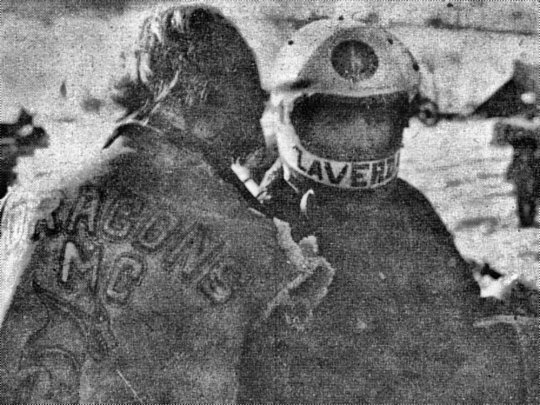
Kiki, seen from the back, is deep in conversation with a Laverda guy. On his shoulders, his sheepskin cut-off shows the colours — club name up top, logo center, nickname below. Back then, it was the Dragons’ signature — their identity, their uniform.
In certain circles, the usual naysayers — jealous minds, hardened skeptics, and a few aging FFM dinosaurs — were already predicting a spectacular flop.
Every good story needs its doom-mongers, after all. But, as so often, reality had other plans… even if pride would prevent most of them from ever admitting it.
François Vignes wasted no time setting the record straight in Europe Moto Magazine:
“And yet, I remember the warnings from certain narrow-minded individuals before the start: ‘The Dragons… it’s going to be a mess!’ Well, gentlemen, you were wrong once again: the Dragons rose to the occasion, and I take my hat off to their organization.”
In the end, the verdict was clear: despite the snow failing to truly show up, the event itself most certainly did — and proved, beyond doubt, to be a solid success.
900 rallyists, 500 machines
The MC Dragons pulled off a colossal effort to bring the event together, backed by the locals of Saint-Alyre-ès-Montagne, who pitched in without hesitation.
If anyone had judged it right, it was the riders. They showed up in force, from every corner of France, unfazed by the cold.
By the time registration closed, nearly 900 had checked in — more than 500 machines crowding the scene. A turnout that spoke louder than any prediction.
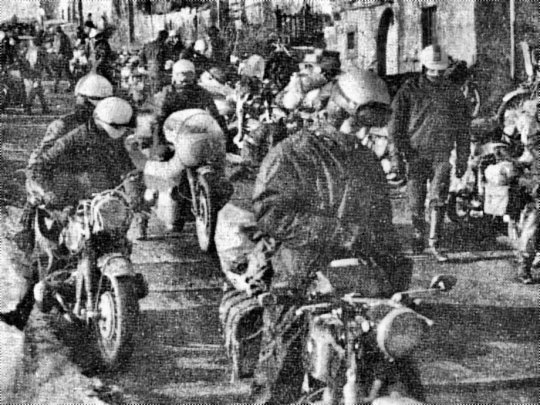
Cold? What cold? 900 guys clearly didn’t think it was worth staying home for.
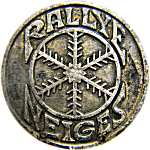
Such enthusiasm was something Kiki and his crew hadn’t quite anticipated for a winter rally. They had planned ahead, of course… but not to that extent: only 300 medals had initially been struck.
Faced with the turnout, an additional 600 had to be produced and later mailed out to their rightful recipients.
Proof that even the best-organized teams can be caught off guard… when success exceeds all expectations.
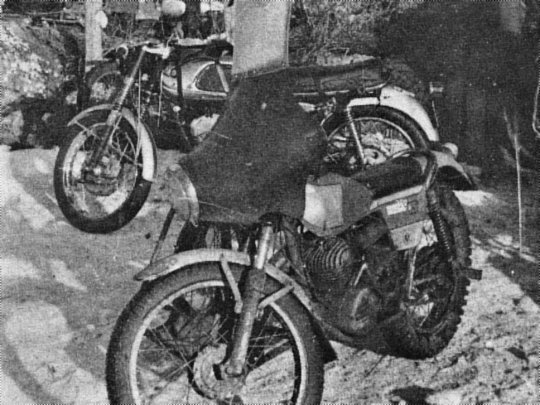
An unusual custom: an off-road bike equipped with an Altus “pig-nose” fairing, manufactured in Auvergne.
Five Editions, One Story
In 1972, the Rallye Neiges returned for its second edition in Saint-Ours-les-Roches, a modest village some twelve kilometres from Volvic and about twenty from Clermont-Ferrand. Though attendance dipped compared to the previous year, more than 400 rallyists still made the journey.
Then came a pause. As with the Vercingétorix, no editions were held in 1973 or 1974, leaving the future of the rally uncertain.
It resurfaced in 1975, this time in the Cantal, at Alberoche in the Mauriac district, over 100 kilometres from Clermont-Ferrand. But something had changed. Following the path of the Vercingétorix, the Rallye Neige became invitation-only, reserved for a tighter circle of seasoned riders — a shift toward a more exclusive, almost initiatory gathering.
In 1976, it returned to Saint-Ours-les-Roches, like a quiet homecoming.
Then, in 1977, what would become its fifth and final edition took place at the Domaine du Viginet in Saint-Nectaire, then owned by the de Rigny family.
A few months later, in September 1977, the tragic death of Kiki Blanchot brought far more than a life to an end. With him, the Rallye Neige — and its elder sibling, the Vercingétorix — faded away, closing the chapter on a singular era.
Text: Jean-Francois Helias
Images: G. Gaudechoux & J.F Helias