Rallye Neiges
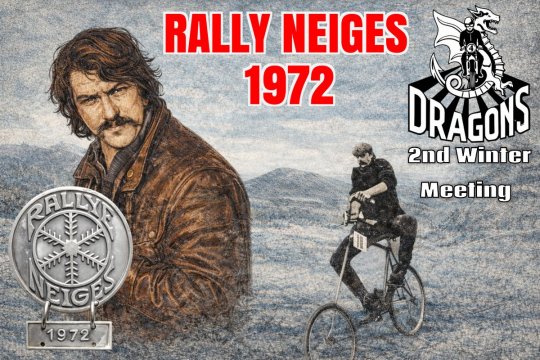
For the true purist passionate about winter motorcycle rallies, the 1971–1972 season offered an exceptionally rich calendar of gatherings.
Just imagine it for a moment. As an appetizer, on December 17th, 18th and 19th, 1971, came the legendary Millevaches Rally, organized by MC 95 in Meymac, high on the plateau that gave the event its name.
The following week — more precisely on December 25th and 26th — the late Jacques Hubert, better known to his friends as “Bébert de Chartres,” founder of the Vautours de Chartres club, organized at Saint-Léger-des-Aubées the very first edition of what would become their now-classic Christmas gathering.
Then, on January 8th and 9th, 1972, came the main course: the traditional Elefantentreffen, held on the Nürburgring circuit in Germany.
And finally, for dessert, the second edition of the Rallye Neiges, organized on January 15th and 16th, 1972 by the famed and notorious MC Dragons in Saint-Ours-les-Roches, barely twenty-one kilometers from Clermont-Ferrand.
A young rider’s winter rally memories
Boarding at the Catholic school of Notre-Dame de Guéret and the son of a factory worker, I had almost no pocket money to speak of. Yet that did nothing to diminish my growing passion for motorcycle rallies, in which I had already been taking part, more or less regularly, since 1970, despite my very limited financial means.
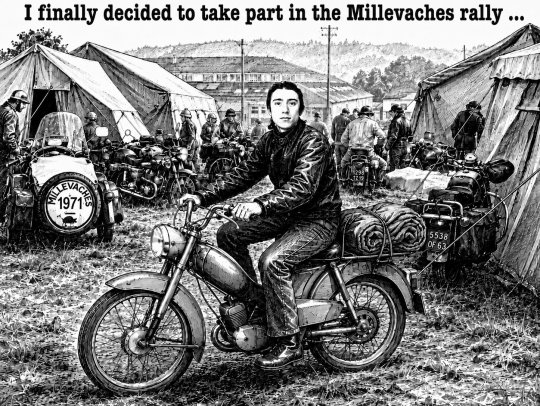
By the winter of 1971, I was forced to make a choice. Together with a bunch of friends, I finally decided to ride to the Millevaches gathering on a humble moped, reluctantly giving up the other three winter events. Looking back today, if I had to do it all over again, there is little doubt that I would choose the Rallye Neiges instead.
Around four hundred motorcyclists had made exactly that choice and gathered, on that second weekend of January, in the heart of Auvergne. The setting for the festivities in Saint-Ours-les-Roches was none other than a comfortable holiday camp perched at 800 meters above sea level, bearing the warm and inviting name of “Clair Matin” (“Bright Morning”).

The “Clair Matin” holiday camp as it appeared here in the early 1970s.
Under the banner of the MC Dragons, this very place would later become the venue for two other notable motorcycle gatherings.
When pirate clubs challenged the F.F.M.
Barely a month after this Rallye Neiges, on February 12th and 13th, 1972, and at the initiative of Kiki Blanchot, this same holiday camp welcomed no fewer than forty-eight motorcycle clubs from all across France for the second “Pirate Riders Meeting.”
The purpose of this gathering in Saint-Ours was to bring together the so-called “pirate” and non-affiliated motorcycle clubs in order to discuss the creation of an alternative structure to the French Motorcycling Federation (F.F.M.).
The organizers criticized the F.F.M. for its growing bureaucracy and its desire to control — or even suppress — free motorcycle gatherings. In their eyes, road motorcycling should instead remain rooted in freedom, brotherhood and spontaneity, far removed from administrative constraints.
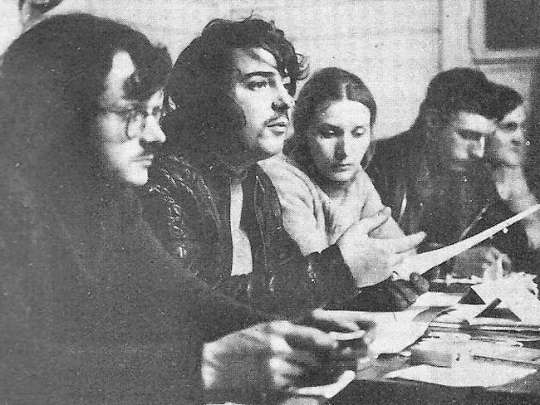
At the February ’72 Pirate Riders meeting, MC Dragons president Kiki Blanchot (second from the left) presiding over the debates.
This meeting was therefore intended to allow independent clubs to exchange ideas and possibly unite the pirate motorcycle clubs around a firmly anti-bureaucratic spirit. In their own words, the goal was above all to “save road motorcycling.”
The first of these Pirate riders meetings had been held in Saint-Quentin at the end of January 1971. The third took place in Amblie in April 1972, while the fourth, planned for Issoudun, ultimately never came to pass.
A few years later, in February 1976, Kiki Blanchot returned to “Clair Matin” to organize, on the very same site, the third Rallye Neiges, which had by then evolved into an invitation-only gathering.
Saint-Ours-les-Roches in brief
Historically, this village nestled in the heart of the Auvergne Volcanoes Regional Natural Park remains closely linked to the Château des Roches de Coffins, an ancient medieval fortress that shaped the local history of the region for centuries.
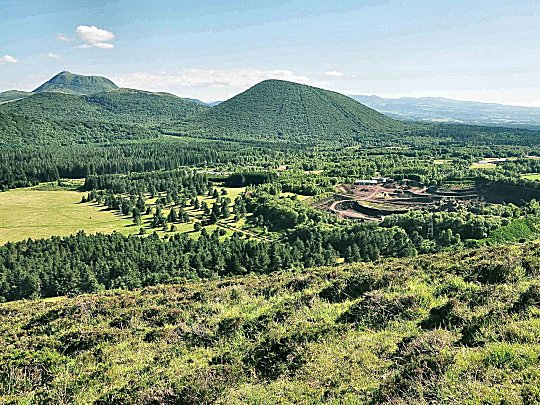
View over the Lemptégy volcano and the Saint-Ours-les-Roches region.
The rally that lived more in memory than on film
As for this second Rallye Neiges of January 1972, I unfortunately possess only a tiny handful of documents and memories relating to the event.
One must remember that, at the time, apart from two or three genuine photography enthusiasts, very few motorcyclists bothered to bring a camera along to rallies. Most of us preferred to live the moment to the fullest: riding, drinking, laughing, putting the world to rights deep into the winter nights, and enjoying the unique sense of brotherhood that surrounded those gatherings. The idea of preserving any of it on film came a distant second.
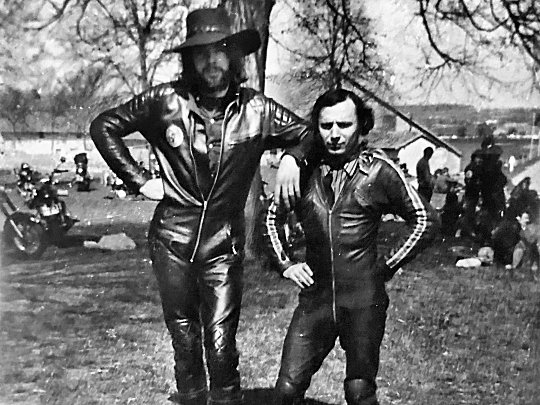
Two well-known MC Dragons members who helped organize the 1972 gathering: Jean-Claude “Grand Cowboy” Boyer (left, with hat) and Jean “The Plumber” Pozzo beside him. Kiki always described them — along with Alain Sallas — as his most loyal “lieutenants.”
Photography, it must be said, was far from being an inexpensive hobby in those days. Having a roll of film developed by a professional photographer represented a considerable expense — especially when half the pictures inevitably ended up in the trash: blurred shots, overexposed frames, badly composed images or simply complete failures. Back then, every photograph cost money long before it truly existed.
Although I have lived for more than forty years nearly 9,500 kilometres from France as the crow flies, I have fortunately remained in touch with many rally riders whom I still consider close friends today.
I always enjoy catching up with them by phone or over the Internet, and it was in that spirit that I recently spent an entire day trying to piece together the memories of this gathering by contacting everyone I believed had taken part in it.
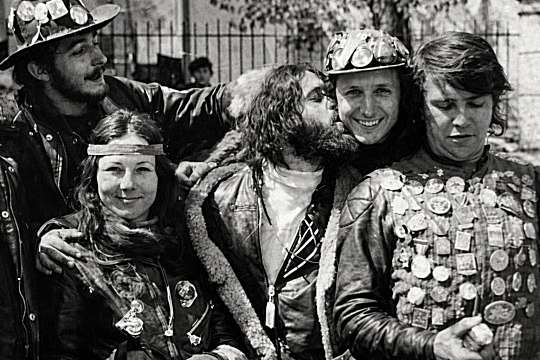
The MC Dragons of that era: young, carefree and devoted to the rally lifestyle.
Debonneville, despite being a close friend of Kiki Blanchot, had ultimately not attended the gathering. Jacques Gilbert — better known within the Trappus club as “Jacques the Anarchist” — had indeed been there, but having arrived in the middle of the night straight after finishing work, he remembered almost nothing about it… apart from an access road turned into a complete sea of mud.
As for Dragon member Michel Baubet, his memory recalled nothing especially remarkable either, except that he had been part of the organization and that, as was often the case, his role mainly consisted of feeding and watering the participants.
All the other contacts who might have helped me were, alas, permanently unreachable, having long since moved to a particularly quiet neighbourhood located… six feet underground.
ARVSCORDRA: the three-club rally
That same year, 1972, the MC Dragons had originally planned to organize the third summer edition of the Rallye Vercingétorix in July. However, due to insufficient funds, the club was ultimately forced to cancel the event for that year.
The Dragons did not remain inactive for long, however. They joined forces with two other regional clubs — the Scorpions and the Arvernes — to organize an entirely new gathering together, one that would ultimately see only a single edition. Its name was simply created by combining the opening syllables of the three clubs: thus was born the ARVSCORDRA.
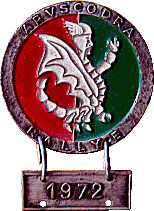
The design of the commemorative rally badge could only have been entrusted to Kiki Blanchot, who excelled at that sort of artistic work. His drawing merged the emblems of the three clubs into a single creature of almost medieval and mythical inspiration: the helmeted head of an Arverne warrior, the claws and tail of a scorpion, and the body and wings of a dragon. The finished result was absolutely magnificent.
According to Kiki, however, this collaboration between three different clubs did not leave particularly happy memories, as disagreements and conflicting views were frequent throughout the organization of the event.

The one-off ARVSCORDRA rally took place at the foot of this extinct volcanic lava dome.
Nevertheless, the gathering took place amid the magnificent scenery of the Auvergne volcanoes, more precisely at the foot of the Grand Sarcouy, a striking dormant volcano nicknamed “The Cauldron” because of its distinctive shape.
Participants were treated to the traditional Auvergne potée, along with an unusual Gaulish-style mead, while the entertainment program featured games and activities that were completely out of the ordinary.
Empelopsis - the Caïman Section’s one-off rally
Still during the year 1972, one of the three sections attached to the MC Dragons of Clermont-Ferrand — the Caïman Section of Riom — organized its own gathering in turn: the Empelopsis Rallye.
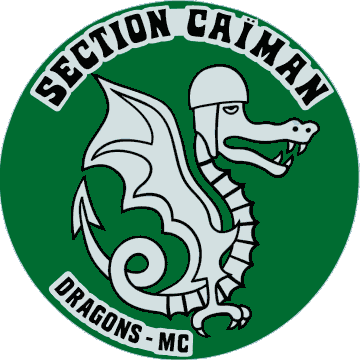
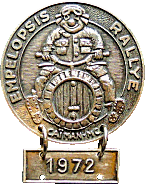
Like many small motorcycle gatherings of that era, the event saw only a single edition and was never organized again. Once more, the design of the commemorative badge was naturally entrusted to Kiki Blanchot, whose graphic talent had by then become inseparable from the visual identity of the Auvergne rally scene.
Founded by the ever-friendly Jean-Pierre Ventax, whom I had the pleasure of knowing in the mid-1970s, the Caïman Section mainly brought together a group of young riders from Riom, on the outskirts of Clermont-Ferrand. Most rode small-capacity motorcycles, more out of financial necessity than personal choice, yet this did nothing to diminish their enthusiasm or their passion for rallies and the motorcycle lifestyle.
From relentless activity to slow decline
The year 1972 ultimately stands out as one of the high points in the history of the MC Dragons.

From left to right: Philippe Herbin, vice-president of the MC Dragons, and Christian “Kiki” Blanchot, the club’s iconic president.
Within the space of just a few months, the club and its various sections multiplied their initiatives: the Rallye Neiges, the Pirate Riders Meeting, the ARVSCORDRA project alongside the Scorpions and the Arvernes, not to mention the Empelopsis Rallye organized by the Caïman Section of Riom.
Rarely had a regional motorcycle club displayed such energy, creativity and organizational vitality. Behind this remarkable burst of activity stood, of course, the tireless Kiki Blanchot, surrounded by a small but exceptionally dedicated core of loyal members.

The Legendary MC Dragons of Clermont-Ferrand: Kiki and his crew at Joe’s Bar during TT 1970 — at the height of their glory years, when the club was widely regarded as the most active motorcycle touring club in France.
But this golden period was unfortunately not destined to last. By 1973 and 1974, the club’s momentum had gradually begun to fade, and the MC Dragons no longer organized any gatherings at all.
Kiki, however, continued to travel to the major motorcycle events of the era, as well as to the first invitation-only rallies, accompanied by a very small core of former club members who had remained faithful to the spirit of the early days.

Kiki and Bernadette Blanchot — two unforgettable figures of the French rally scene. They may no longer be with us, but their memory still rides beside us. Few couples lived the motorcycle life with such passion and devotion.
It would ultimately take until 1975 for Kiki to revive two of the Dragons’ greatest creations — the Rallye Neiges and the Vercingétorix — now reborn under a new, strictly invitation-only format.
- Jean-Francois Helias