Troll Rally
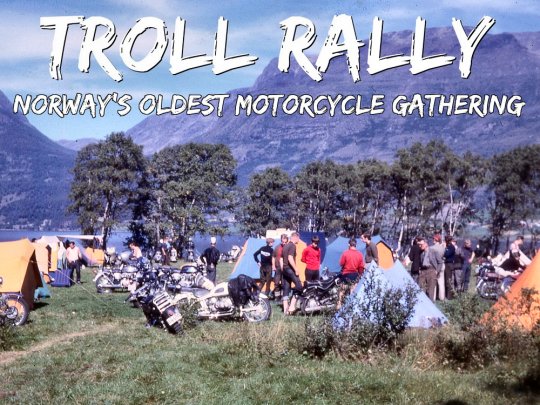
When motorcyclists speak of Europe's great touring rallies of the 1960s and 1970s, certain names immediately spring to mind: Germany's legendary Elefantentreffen, Wales' Dragon Rally, France's Chamois Rally and Millevaches, Italy's Stella Alpina, Belgium's Lions Rally, and several others that have become part of motorcycling folklore.
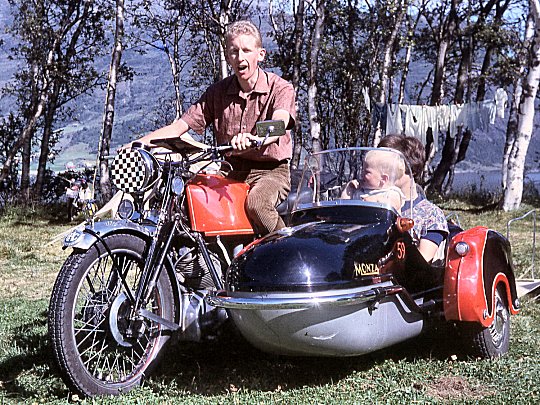
Troll Rally 1966 – At the heart of the campsite, a British rallyist poses with his Vincent sidecar outfit. The number 59 suggests he may have belonged to London's legendary 59 Club.
Yet one famous gathering has been conspicuously absent from these pages until now: the Troll Rally, the oldest and most influential motorcycle rally in Scandinavia.
That omission deserves to be corrected.
First organised during the summer of 1965, the Troll Rally occupies a unique place in European motorcycling history.
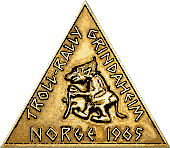

The commemorative badges from the first two Troll Rallies, held at Grindaheim in 1965 and 1966. Grindaheim remained the rally's home for the first eight editions, from 1965 to 1972.
More than simply Norway's oldest international motorcycle gathering, it became the event that inspired an entire generation of Norwegian touring rallies and helped establish the country as one of Europe's most rewarding destinations for motorcycle travellers.
The Trolls – Guardians of Norway's Mountains
The Troll Rally naturally takes its name from the famous trolls of Norse mythology.

The journey to the Troll Rally rewarded riders with breathtaking views of Norway's forests, lakes and mountains, as this magnificent photograph taken by Debonneville in July 1966 so vividly illustrates.
For centuries, these legendary creatures have featured prominently in Scandinavian folklore and fairy tales. They are traditionally believed to inhabit Norway's rugged mountains, deep forests and remote valleys.
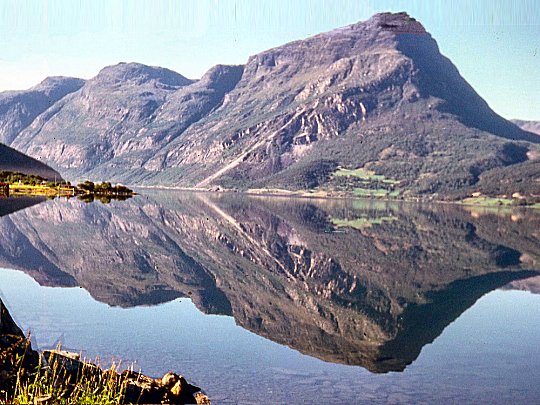
Troll Rally 1966 – A Norwegian mountain lake, its crystal-clear waters mirroring the surrounding peaks.
Sometimes portrayed as fearsome giants, sometimes as mischievous beings or guardians of nature, trolls occupy a special place in Norwegian culture and have become one of the country's most enduring and recognisable symbols.
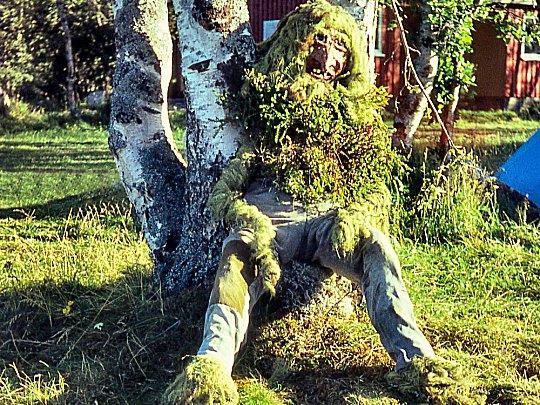
Troll Rally 1966 – Leaning against a birch tree, a troll fashioned from wood and foliage reminds participants that they are in the land of Norwegian legend.
Choosing the troll as the emblem of this rally was an obvious choice. An enduring symbol of Norway, it perfectly embodies the country's wild landscapes, majestic mountains and the spirit of adventure awaiting every motorcyclist who sets out to explore them.
The vision of Maarten "Gubben" Mager
The Troll Rally was the brainchild of Maarten "Gubben" Mager, one of the most remarkable figures in Norwegian motorcycling. Readers of this website may already recognise his name from our earlier feature on the Krystall Rally, where we explored his extraordinary contribution to motorcycle touring.
Troll Rally 1966 – Mjøsvang Kafe in Vang i Valdres served as the organisers' headquarters, where new arrivals registered for the rally.
A passionate traveller and gifted organiser, Mager understood long before most people that motorcyclists were looking for something more than competitions or sporting events. They wanted opportunities to travel, discover new countries and meet like-minded riders.
Troll Rally 1966 – A group of participants gathered to chat and admire the impressive variety of motorcycles on display.
His vision transformed Norwegian motorcycling. Besides founding the Troll Rally, he also launched the Norgestreffet and played a decisive role in creating Norway's rally tradition.
Today, the Troll Rally is rightly regarded as the pioneer of Norwegian motorcycle gatherings.
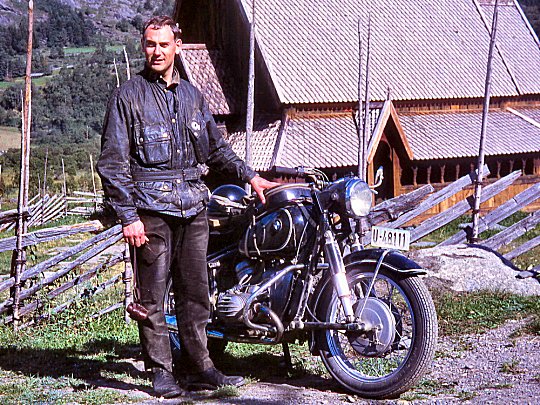
Troll Rally 1966 – A French participant whom Jean-Marie Debonneville met during the rally. Jean-Marie recalls that he was living and working in Norway at the time.
Together with the Krystall Rally, Norgestreffet, Midnattsoltreffet and Straand-Treffet, it forms the five great classics of Norwegian motorcycle touring.
Originally held during the last week of July, at the height of the Nordic summer, the rally gradually moved to the last weekend of August, where it continues to take place today.
A promising beginning
The inaugural Troll Rally was held in 1965 at Grindaheim, in the beautiful Valdres region of southern Norway. Participants established their campsite at Bøflaten Camping, beside the tranquil waters of Lake Vangsmjøsa.
Around 180 motorcyclists attended this first gathering—an impressive figure for a completely new event.
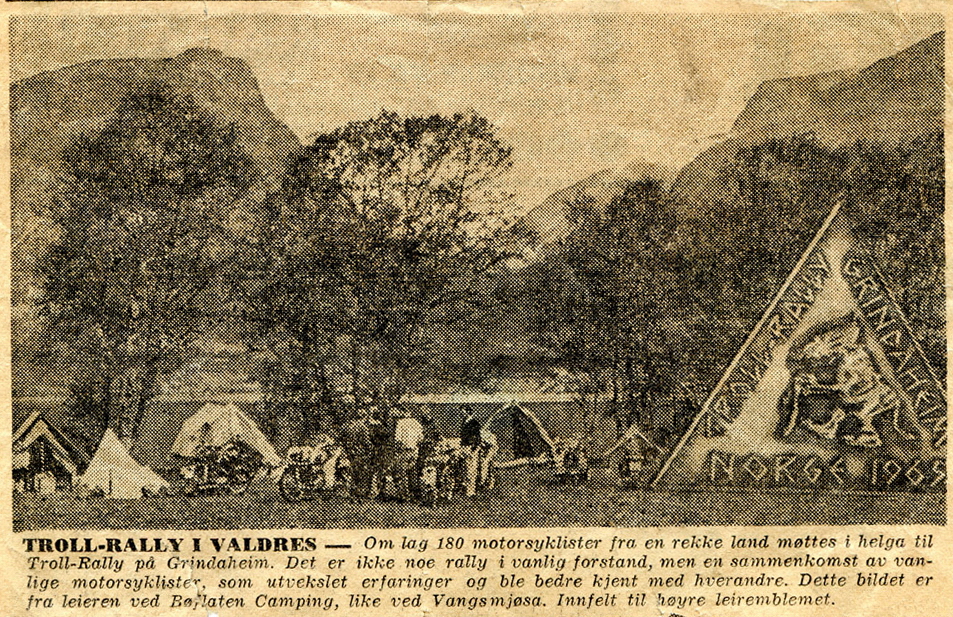 TROLL-RALLY I VALDRES - Om lag 180 motorsyklister fra en rekke land møttes i helga til Troll-Rally på Grindaheim. Det er ikke noe rally i vanlig forstand, men en sammenkomst av vanlige motorsyklister, som utvekslet erfaringer og ble bedre kjent med hverandre. Dette bildet er fra leieren ved Bøflaten Camping, like ved Vangsmjøsa. Innfelt til høyre leiremblemet.
Troll Rally 1965 – A clipping from a local newspaper reporting on the very first Troll Rally confirms that 180 motorcyclists gathered at Bøflaten Camping, on the shores of Lake Vangsmjøsa, for this inaugural event.
Although most participants naturally came from Norway, riders also arrived from the Netherlands, Germany and several other European countries, attracted by the prospect of discovering Norway's spectacular mountain scenery in the company of fellow enthusiasts.
Newspaper reports published at the time made it clear that this was not a rally in the competitive sense of the word. Instead, it was a meeting of ordinary motorcyclists brought together by a shared love of travel, friendship and adventure.
Troll Rally 1966 – The true spirit of the rally: magnificent scenery, good company and a shared love of motorcycle touring.
That philosophy has remained unchanged ever since.
One delightful anecdote has survived from this first edition. According to contemporary accounts, a French grandmother completed the entire journey to Norway as pillion passenger on a Norton Atlas—a wonderful reminder that the spirit of adventure knows no age.
When the journey was the adventure
For many riders, however, simply reaching the Troll Rally was an achievement in itself.
Troll Rally 1966 – German participants enjoying a well-earned break after hundreds of miles on Norway's challenging roads. The destination was the Troll Rally, but the real adventure was getting there.
The second rally, held in 1966, perfectly illustrates what travelling through Norway meant during that era.
Among the foreign participants was the well-known French rally enthusiast Jean-Marie Debonneville, who travelled to the rally aboard a BMW sidecar outfit, accompanied by three friends from his home region, all riding sidecar combinations.
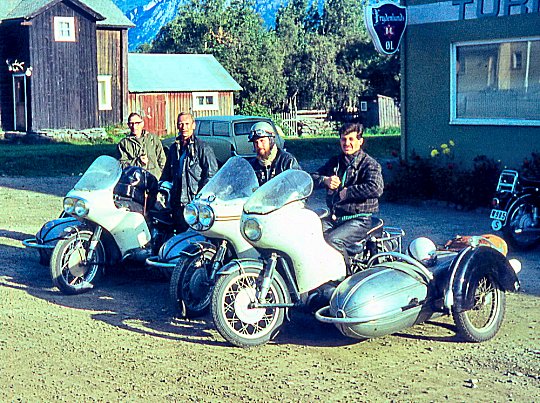
The Northern France contingent at the 1966 Troll Rally. From left to right: Mr Cuvelier Sr., his son Pierre, a school headmaster from Roubaix; Jean-Marie Debonneville; and a motorcyclist from Lille whose name, sixty years later, Le Druide may surely be forgiven for having forgotten.
When I recently spoke to Jean-Marie, he smiled at the memories and insisted that describing the journey as an adventure was no exaggeration.
"In those days," he recalled, "the tarmac ended barely sixty kilometres beyond Oslo."
Indeed, during the 1960s, Norway's road network was still far from being completely surfaced.
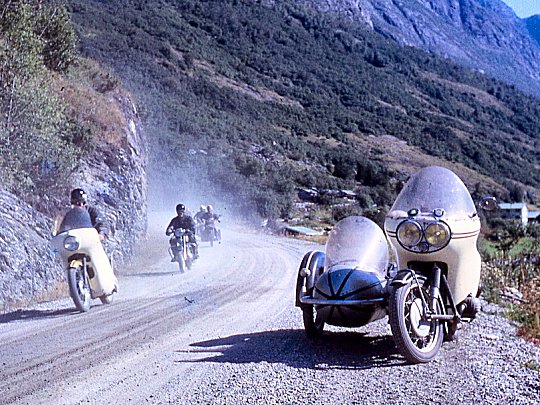
Troll Rally 1966 – Jean-Marie Debonneville's BMW sidecar outfit waits beside a dusty Norwegian gravel road as fellow riders disappear into the clouds of dust ahead.
Outside the major towns and principal highways, motorcyclists encountered long stretches of dirt roads, compacted gravel tracks and oil-treated surfaces—known at the time as oil gravel roads or bitumen-treated roads.
Dust, loose stones, mud and slippery roads after rain were all part of everyday riding.
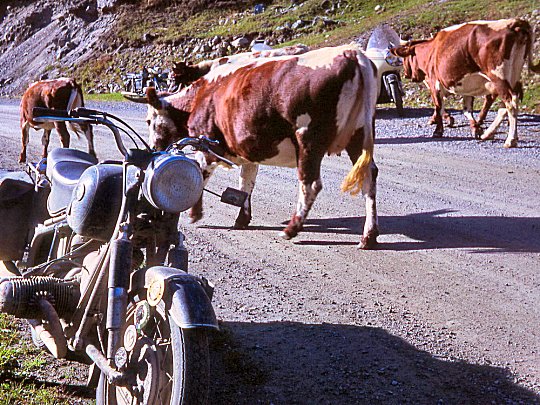
Troll Rally 1966 – Dust, gravel... and the occasional bovine roadblock. Just another day on the road to the Troll Rally.
For Troll Rally participants of the 1960s, these conditions were not considered hardships but an integral part of the adventure itself. Travelling through Norway demanded patience, skill and determination, qualities that gave these early rallies their unique character.
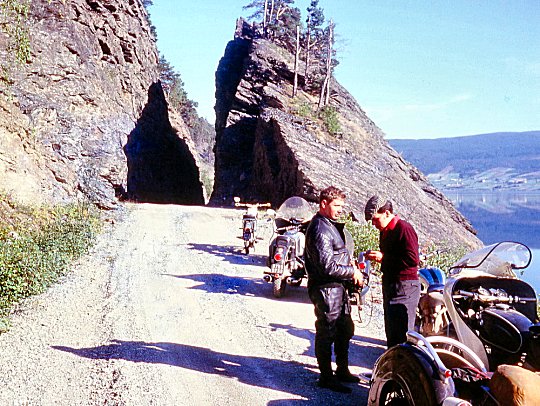
Troll Rally 1966 – Before tunnels became commonplace, Norwegian engineers simply persuaded the mountain to make a little room for the road.
Fortunately, Jean-Marie returned from the 1966 rally with a remarkable collection of photographs. More than half a century later, he has generously allowed me to reproduce them here, giving LPMCC readers an exclusive glimpse of one of Scandinavia's earliest international motorcycle gatherings.
An enduring philosophy
The immediate success of the first Troll Rally confirmed that Mager's vision had struck exactly the right chord.
The rally's objectives, written into its original regulations, remain just as relevant today:
The purpose of the Troll Rally is to increase interest in motorcycle touring and to promote camaraderie among motorcyclists.
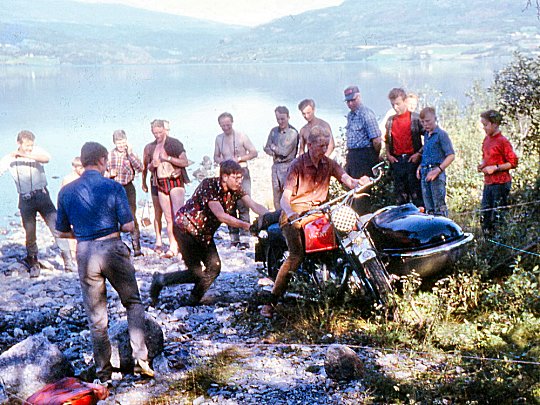
Troll Rally 1966 – Camaraderie in action beside Lake Vangsmjøsa, as fellow riders help push a British rider's Vincent sidecar outfit.
Few rally organisers have ever summarised their ambitions so simply—or so effectively.
There were no races to win, no special tests to complete and no prizes for speed.
The road itself was the reward.
A rally that became an institution
As the years passed, the Troll Rally grew into one of Norway's best-loved motorcycling traditions.
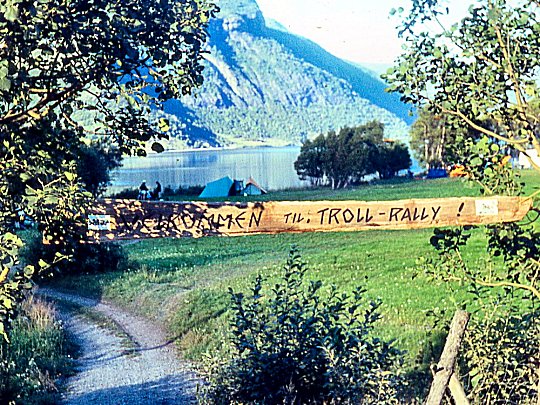
Troll Rally 1966 – "Welcome to the Troll Rally!" A hand-painted banner greeted riders as they arrived at the lakeside campsite beside Lake Vangsmjøsa.
Each summer, riders crossed mountains, valleys, forests and high plateaux to reach the rally site, discovering some of Europe's most spectacular scenery along the way. For many participants, the journey to the rally became every bit as memorable as the gathering itself.
Troll Rally 1966 – A view across the campsite at Bølstad Camping, where riders from across Europe pitched their tents beneath the mountains of Valdres.
Since its inauguration in 1965, the Troll Rally has been held at several locations across southern Norway.
The first eight editions (1965–1972) took place at Grindaheim in Vang, Valdres, before the rally moved to Tuddal in Telemark for three years (1973–1975).
It then visited Kviteseid (1976), Drevsjø in Engerdal (1977–1978), Flå in Hallingdal (1979), Golsfjellet (1980–1982), and Hølen in Akershus (1983).
In 1984, the rally found a new home at Stykjavika in Fyresdal, Telemark, although it temporarily relocated to Våler in Solør, Hedmark, between 1987 and 1989.
Returning to Stykjavika in 1990, the Troll Rally has remained there ever since, with the only interruption being the cancellation of the 2020 and 2021 editions due to the COVID-19 pandemic.
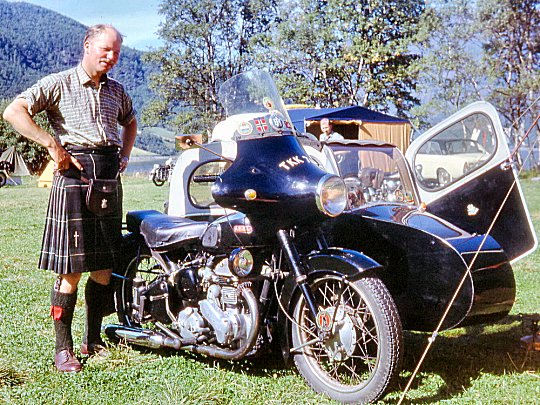
Troll Rally 1966 – Aanon Aanonssen, a Scotsman living in Norway, proudly poses in traditional Highland dress beside his Ariel sidecar outfit.
Today, Stykjavika is firmly established as the spiritual home of Norway's most famous motorcycle rally, having hosted almost four decades of Troll Rally history.
The atmosphere remains remarkably faithful to the founders' original ideals. Hundreds of motorcycles fill the campsite each year, conversations continue late into the evening and friendships are formed around campfires exactly as they were sixty years ago.
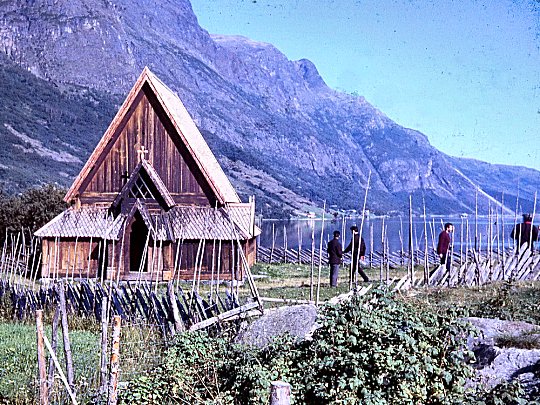
Troll Rally 1966 – Near the campsite, a traditional Norwegian wooden church overlooks the tranquil waters of Lake Vangsmjøsa.
One feature has always distinguished the Troll Rally from many other motorcycle events: the organisers have deliberately chosen not to sell alcohol on the rally site, reinforcing its reputation as a friendly, family-oriented gathering centred entirely on motorcycle touring.
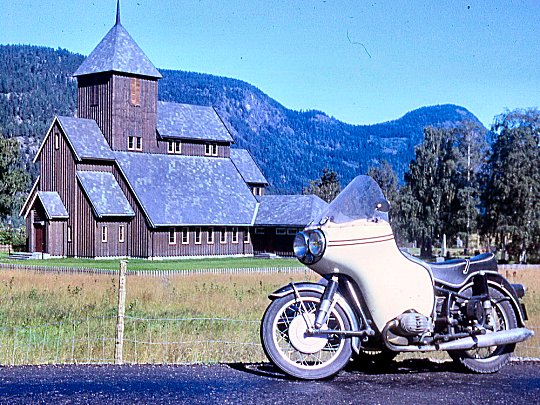
Troll Rally 1966 – A perfect postcard from 1960s Norway: Jean-Marie Debonneville's BMW sidecar outfit against the backdrop of a traditional Norwegian wooden church.
As with many traditional international rallies, awards are presented for achievements such as the longest distance travelled, the youngest participant, the oldest rider and several other honorary categories.
Sixty years on
Today, organised by the Motor Cykel Entusiastenes Klubb (MCEK), the Troll Rally remains true to the vision of its founder, Maarten "Gubben" Mager.
For six decades it has remained, above all, a gathering where the joy of motorcycle touring, the discovery of Norway's magnificent landscapes and the camaraderie between riders are the true driving forces behind the adventure.
Sixty years later, that simple philosophy continues to define the Troll Rally, making it not only the father of Norway's great motorcycle rallies, but also one of the true classics of European motorcycle touring.

Troll Rally 1967 – A BMW R60 paired with an MZ sidecar. An unusual combination for its time that undoubtedly attracted plenty of admiring glances.
The 60th annual Troll Rally will take place from 28–30 August 2026 at Stykkjevika, Fyresdal, Norway, where motorcyclists from across Europe will once again gather to celebrate a tradition that began in the mountains of Valdres back in 1965.
The 60th annual Troll Rally took place from 28–30 August 2026 at Stykkjevika, Fyresdal, Norway, where motorcyclists from across Europe once again gathered to celebrate a tradition that began in the mountains of Valdres back in 1965.
Text: Jean-Francois Helias
Images: J.M. Debonneville & J.F Helias
Addendum
Pierre Certain: A lifetime devoted to motorcycling
Among the many photographs brought back by Jean-Marie Debonneville from his Scandinavian expedition to the second Troll Rally in July 1966, one in particular gave me immense pleasure. It captures a legendary figure in the history of French motorcycle touring and who was also present at the rally: Pierre Certain.
Sadly, his name is little known among today's motorcycling public, and even less so to younger generations. Yet those of us who had the privilege of knowing him, or simply meeting him at rallies and major motorcycle gatherings over the years, remember Pierre Certain with the greatest respect.
A gifted mechanic, an indefatigable traveller, an accomplished rally rider and a true living encyclopaedia of French motorcycling, he devoted his entire life to his passion with extraordinary generosity.
My delight at discovering this photograph was all the greater because images of Pierre Certain are remarkably scarce. To the best of my knowledge, the only other photograph of him available on the internet shows him riding an off-road motorcycle. That is precious little for a man who contributed so much to the world of motorcycling and whose knowledge seemed virtually inexhaustible.
Thanks to Jean-Marie Debonneville, we are now able to present what is, in all likelihood, a previously unpublished historical photograph: Pierre Certain, captured in the campsite of the 1966 Troll Rally.
It is a rare image that undoubtedly deserves its place in the memory of French motorcycle touring.
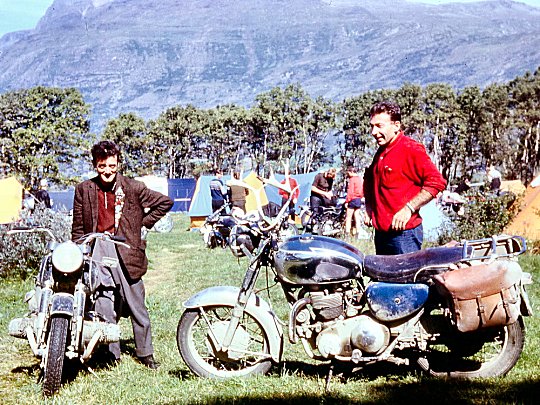
Troll Rally 1966 – On the far left of the photograph stands Pierre Certain. The rally badges covering the lapel of his jacket already tell the story of a great traveller and one of France's most indefatigable rally riders.
One of France's motorcycling legends
Few French motorcyclists have devoted their entire lives to the world of motorcycles as completely as Pierre Certain. Mechanic, restorer, collector, designer, long-distance traveller and rally enthusiast, he became one of the most respected figures in French motorcycling history through a lifetime of dedication to both the preservation and enjoyment of historic motorcycles.
Born in Verrines-sous-Celles, western France, after leaving school, he began an apprenticeship as a mechanic at the Octave Renaud garage in nearby Celles-sur-Belle. His career was interrupted by military service, first for eighteen months in 1952 and again in 1955 when he was recalled to serve in Algeria during the Algerian War. On returning to civilian life, he resumed work at the same garage, where he remained for a remarkable forty-five years.
An exceptionally gifted mechanic, Pierre rapidly acquired an encyclopaedic knowledge of motorcycles of every make and age. His technical expertise earned him an outstanding reputation throughout the French motorcycling community, where he became the person many enthusiasts turned to for advice on restoration, engineering and historical accuracy. His skills extended beyond restoration: he also designed and built his own competition motorcycles for road racing and motocross, demonstrating both ingenuity and remarkable craftsmanship.
Travel was another of Pierre Certain's lifelong passions. He covered tens of thousands of kilometres across Europe on his motorcycles, exloring virtually every European country, Albania being the only exception. At a time when international motorcycle travel remained a genuine adventure, Pierre became a familiar face at many of Europe's great touring rallies, combining his love of riding with an insatiable curiosity to discover new countries and cultures.
Alongside his travels, Pierre patiently assembled one of France's finest private collections of historic motorcycles. Over several decades he amassed 204 complete machines, ranging from common everyday models to exceptionally rare and technically significant examples dating from the earliest years of motorcycling.
Realising that his retirement income would never allow him to maintain such an important collection indefinitely—and determined to keep it together rather than see it dispersed—he arranged for the entire collection to be transferred to the town of Celles-sur-Belle. It now forms the basis of the Musée des Motos Anciennes Pierre Certain, preserving his life's work for future generations.
Pierre Certain passed away on 6 January 2016 at the age of 83. With his death, French motorcycling lost one of its greatest authorities and an inexhaustible source of knowledge, wisdom and inspiration. Few individuals have contributed so much to preserving and promoting France's motorcycling heritage.
He will be remembered as one of the country's foremost custodians of motorcycle history: a gifted mechanic, an indefatigable traveller, an accomplished rally rider, and a passionate guardian of more than a century of motorcycling heritage.