Vercingétorix Rally
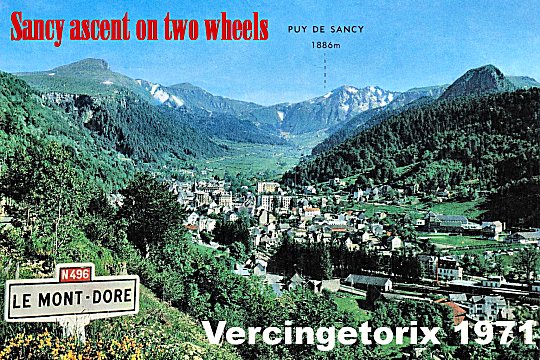
In July 1971 — on the 17th and 18th, to be precise — the MC Dragons organized the second edition of their Vercingétorix rally, this time at the foot of the Puy de Sancy, at an altitude of 1,886 metres, five kilometres from Mont-Dore.
The change of location was no coincidence: it immediately placed the event in a harsher, more isolated setting, one that better matched the organizers’ vision of what such a gathering should be.
On the road toward Mont-Dore, the tone was already set. The winding mountain route, with its succession of bends and curves, became part of the initiation.
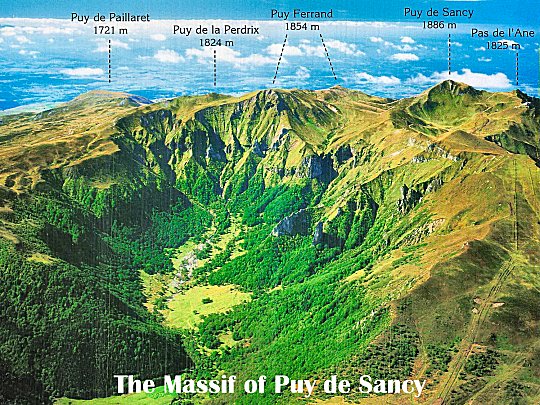
Had the rain not dampened the mood that weekend, in such a wild and majestic setting, the gathering would undoubtedly have stood as one of the finest successes in the club’s history.
Once at the foot of the Sancy, it became clear that tents were already rising in great numbers. At first, the weather was mild — almost ideal — but the calm did not last.
As is often the case in the mountains, especially in summer, conditions can shift rapidly and turn to storms. This particular weekend was indeed be marked by highly changeable weather.
Earning the badge
The program itself remained true to the spirit of rallies of the time: campfires, camping, music, and above all, camaraderie.
For a modest entry fee of 16 francs, participants were treated to an aperitif, coffee, merguez sausages, bread, cheese, and generous quantities of local wine — no less than 200 litres planned for the Saturday evening.
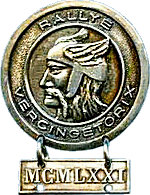
To this were added a dated commemorative medal and a sticker, though obtaining them was subject to a rather particular condition.
For this second gathering in 1971, the Dragons introduced a rule that perfectly captured their philosophy: the medals would only be awarded on Sunday morning, at the summit of the Puy de Sancy. The intention was clear —
to deter “show-offs, clowns, and posers.”
The symbolism was powerful, all the more so as the path leading to the summit was inaccessible to cars. It had to be tackled by motorcycle, often in conditions closer to trials riding than to a simple outing.
Rain, fatigue, and rocks: the reality of the rally
On Saturday evening, the weather deteriorated abruptly. Storms broke out, forcing participants to wait it out under their tents or take shelter however they could.
Music was played while waiting for a lull. When the rain finally eased, a pop band took over and tried to bring the night to life — but before long, with little audience left, the music stopped, and everyone returned to their sleeping bags.
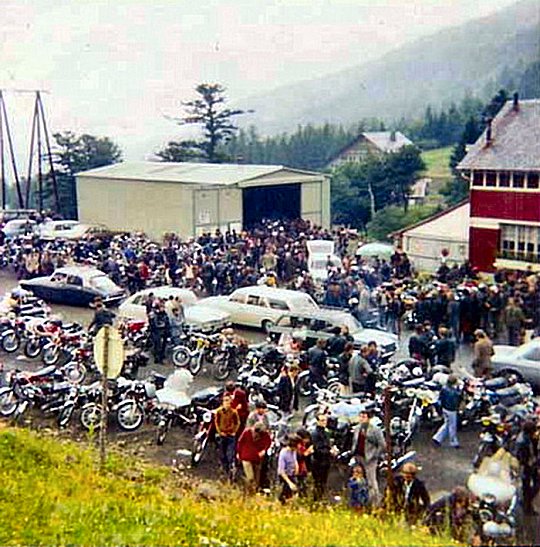
In the mist of the Sancy, Vercingetorix 1971 gathered free spirits — a vibrant crowd, lined-up machines, and the mountain as the setting for a moment outside of time.
On Sunday morning, around nine o’clock, the ascent of the Sancy began. It took place under difficult conditions. The rain had returned, and the track — already rough — became truly punishing: loose stones everywhere, a battered path, and uncertain progress.
Many experienced this climb more as an ordeal than a pleasure. The original intention — to filter participants — collided here with the harsh reality of the terrain. In fact, a large majority seemed not to enjoy the ascent, widely considered too demanding.
At half past twelve, the distribution of packed lunches offered a moment of respite. Merguez, bread, cheese, and an aperitif are handed out quickly, in an atmosphere that had once again become warm and convivial, despite the large number of participants.
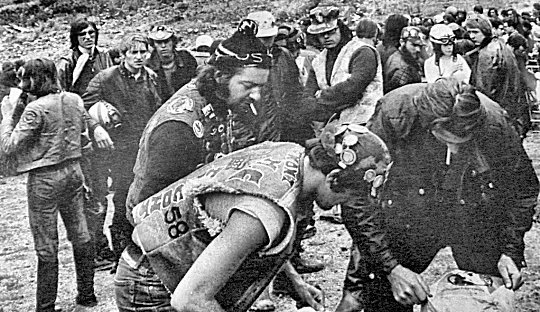
MC Dragons at work — President Kiki Blanchot (beanie on, cigarette in his mouth); leaning in front of him, cap on and cut-off vest on his back, Patrice Deslignière, known as ‘Pat de Nevers.’
Fires were lit here and there; everyone grilled their sausages, talked, and shared. It was one of the highlights of the gathering.
More numerous, less close: the downside of success
The entire organization of the event relied on extremely modest financial means: a budget of just 750 old francs.
That figure alone speaks volumes about the Dragons’ commitment and the spirit behind Vercingétorix — a no-frills gathering built on resourcefulness, solidarity, and a certain idea of freedom.
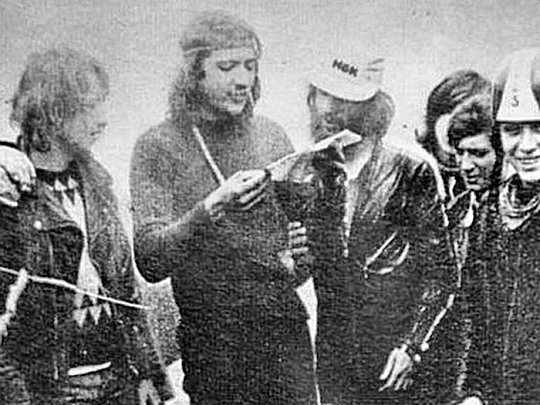
The two men in the center are well-known figures from that remarkable era of “piraterie”: Dominique “Mob Kid” Giraudet (holding a sheet of paper) and Bruno “Crapaud” Bérard of MC 95 (wearing the NGK cap).
Attendance at this second rally was clearly on the rise.
No official figures were recorded, but estimates suggest more than 600 participants and close to 1,000 motorcycles gathered at the foot of the Sancy.
Many foreign riders had made the trip.
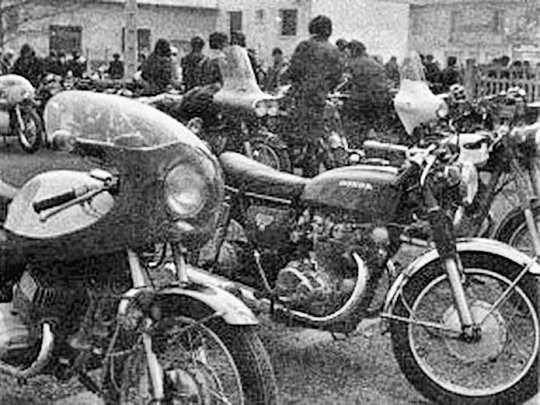
Machines of the era.
But this rise in popularity did not come without consequences. A certain sense of regret was already emerging: success draws crowds, but it also dilutes the sense of camaraderie. Like many such gatherings, Vercingétorix found itself facing an internal contradiction — how to grow without losing its soul.
Three years of silence, then a rebirth
At the time, no one suspected that there would be no Vercingétorix gatherings in 1972, 1973, or 1974.
During those three dormant years, within the Dragons MC, behind Kiki Blanchot, only a very small core of die-hard enthusiasts — true all-season riders — continued to represent the spirit of France’s greatest “pirate” across various gatherings.
It wasn’t until 1975 that Vercingétorix was revived. On his own initiative, Kiki, surrounded by close companions and loyal former members, brought the event back to life.
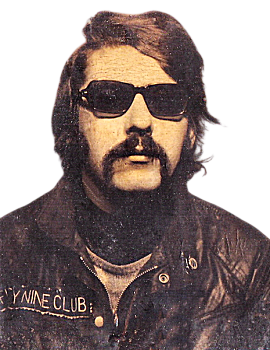

The late Kiki Blanchot, founder and leader of the MC Dragons, photographed here on April 1st, 1971 — just three months before this second Vercingétorix rally.
This time, it was no longer a gathering open to all or advertised in the motorcycle press: the event became invitation-only, bringing together the very best of French and international rally riders of the era.
A new era: exclusivity embraced
This shift was not an isolated case.
From the mid-1970s onward, most of the long-standing rallies organized by the most emblematic “pirate” clubs evolved in the same direction. Many gradually moved to an invitation-only format, marking a clear transition from large, open gatherings to more private meetings.
These new events, even the largest ones, rarely brought together more than 250 participants — most of whom already knew each other.
This evolution reflected a refocusing around a core group of insiders and a desire to preserve a spirit that had become increasingly difficult to maintain.
Thus, behind this transformation lay a deeper change in the rally world: less open, but more tightly knit, these strictly invitation-only gatherings favoured the quality of relationships over the quantity of participants.
Text: Jean-Francois Helias
Images: G. Gaudechoux & J.F Helias