Chamois 1972
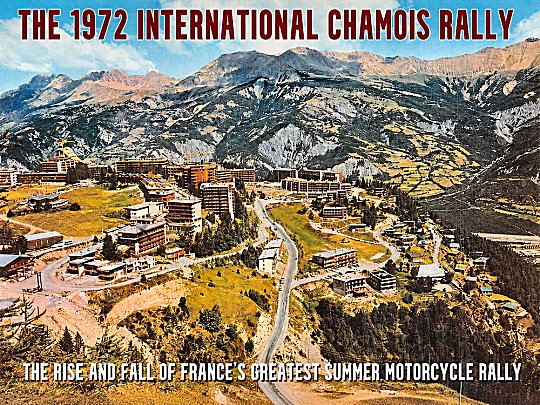
 Some adventures disappear because they fail. Others come to an end at the very height of their glory, brought down by the very success they achieved. The Chamois unquestionably belongs to the latter category.
For eight remarkable years, the Chamois embodied the very spirit of French long-distance motorcycle touring.
Far more than just another motorcycle rally, it had become a true summer pilgrimage. Every July, thousands of riders converged on the Alps, not in search of comfort or trophies, but to share a common passion, challenge the mountains, and rediscover that unique sense of brotherhood which defined the great motorcycle gatherings of the era.
The Forced Departure from Val d'Isère
When participants left Val d'Isère at the end of the 1971 edition, no one imagined they would never return.
Yet only a few months later, the Val d'Isère municipal council, concerned by the growing number of road accidents recorded during previous editions, decided that the rally would no longer be welcome.
This decision forced Jean Murit, the Chamois' principal founder, to find a new home for the event in the space of just a few months.
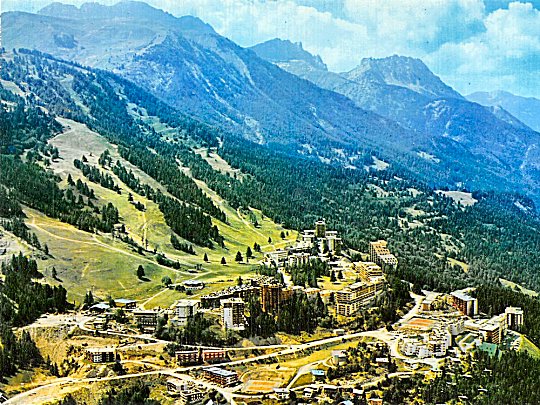
Pra‑Loup is a renowned Alpine ski resort nestled in the Ubaye Valley in southeastern France's Alpes-de-Haute-Provence department. Developed during the 1960s, its distinctive name literally means "Meadow of the Wolf."
Salvation came from Pra‑Loup, a young ski resort in the Alpes-de-Haute-Provence, just a few kilometres from Barcelonnette, under the leadership of an exceptional man: Honoré Bonnet.
Honoré Bonnet takes up the challenge
Honoré Bonnet (1919–2005) was no ordinary ski resort director.
A qualified mountain guide, former head coach of the French Alpine Ski Team, and one of the most influential figures in French skiing, Bonnet led Les Bleus through their golden era from 1959 to 1968.
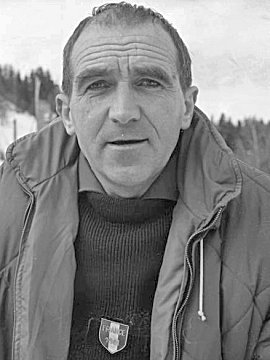
Honoré Bonnet (1919–2005)
Nicknamed "Napoleon" for his natural authority and outstanding organisational skills, he led the French team to an unprecedented period of international dominance, winning 17 Olympic medals and 21 World Championship medals under his leadership. A true visionary, he was also one of the driving forces behind the creation of the Alpine Ski World Cup.
By agreeing to host the Chamois at Pra‑Loup, Honoré Bonnet knew he was taking on a formidable challenge. Relocating France's largest summer motorcycle rally to a completely new venue in the space of just a few months was a tremendous undertaking.
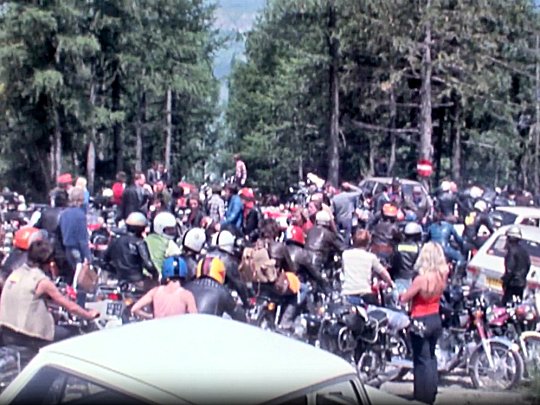
A view of the participants at the 1972 Chamois Rally. When preparations began, no one could have imagined that nearly 10,000 motorcyclists would ultimately make the journey.
Organising an event of this magnitude was almost venturing into the unknown. No one could predict with any certainty how many motorcyclists would make the journey. Everything therefore had to be planned on a grand scale, with every possible scenario anticipated and facilities capable of accommodating an exceptionally large turnout.
An organisation equal to the challenge
Working alongside Jean Murit, Honoré Bonnet devoted himself tirelessly to organising this extraordinary edition. The entire resort of Pra‑Loup, together with the surrounding villages, was mobilised to welcome thousands of rallyists on 15–16 July 1972 under the best possible conditions. Campsites, accommodation, water supplies and sanitary facilities were all meticulously prepared.
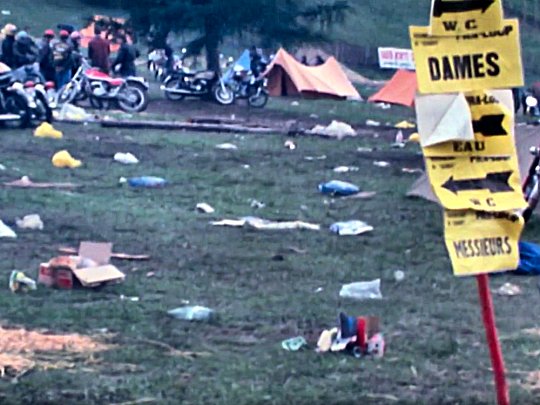
The signposts guided campers to the men's and women's toilets and the water points provided throughout one of the campsites.
The organisers even went so far as to supply the campsites free of charge with bales of straw to insulate tents from the damp ground, along with several cubic metres of firewood to keep the countless campfires burning.
Throughout Saturday, tipper trucks shuttled back and forth, delivering supplies to the campsites and ensuring that the campers' needs were met.
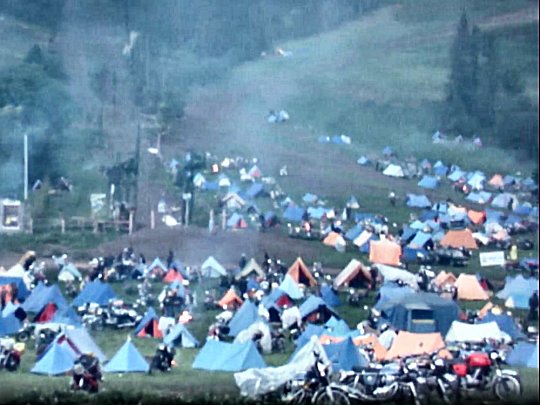
A view of one of the campsites at the 1972 Chamois Rally.
Jean Murit and Honoré Bonnet had truly done everything possible to ensure that every rider felt welcome.
Their commitment was all the more remarkable given that, at the time, part of the local population still viewed motorcyclists with a certain degree of suspicion, readily associating them with the "Blousons Noirs" — the French equivalent of the "rockers" or "motorcycle hooligans" portrayed by the media during that era.
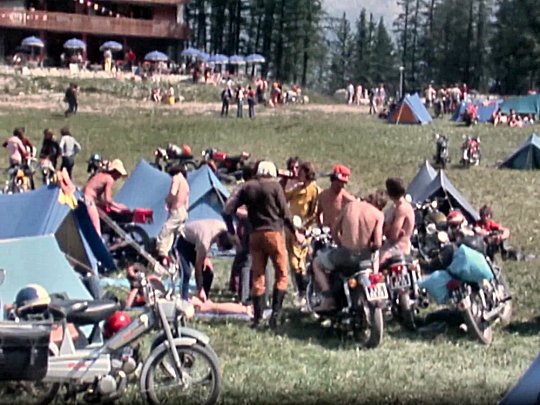
For a short while, life at the campsite was exactly what every Chamois participant had come for: motorcycles, friends and the shared spirit of adventure in the heart of the French Alps.
Everything seemed to be in place for the first Chamois at Pra‑Loup to be a resounding success. But when confronted with the weather and the unforgiving forces of the mountains, even the most meticulous planning was about to reach its limits.
The Chamois: A victim of its own success
The real lesson of the 1972 edition was not simply the appalling weather.
The Chamois had quite simply outgrown itself.
Nearly 6,500 participants registered officially, yet the actual attendance was estimated at almost 10,000 motorcycles. The Chamois had earned a reputation as the largest motorcycle gathering in Europe during the 1970s, alongside the famous winter Elefantentreffen in Germany.
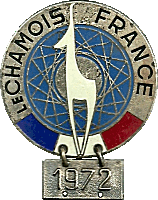
Following the rally's forced relocation to a new venue, its commemorative badge was redesigned.
This extraordinary popularity was both its greatest triumph... and ultimately its greatest weakness.
Beyond a certain point, a rally is no longer simply a motorcycle gathering; it becomes a temporary town, bringing with it all the challenges that entails: traffic management, accommodation, safety, supplies, emergency services, sanitation, and peaceful coexistence with the local community.
Jean Murit and Honoré Bonnet had prepared for a major rally. What they could not reasonably have anticipated was a human tidal wave of such magnitude.
When the mountains reassert their power
As if this unprecedented turnout were not enough, the forces of nature suddenly decided to intervene.
From Friday evening onwards, violent thunderstorms turned the vast camping meadows into seas of mud. Tents stood in water, while damp riding gear and clothing struggled to dry around the countless campfires, kept burning by the huge reserves of firewood generously provided by the local authorities..
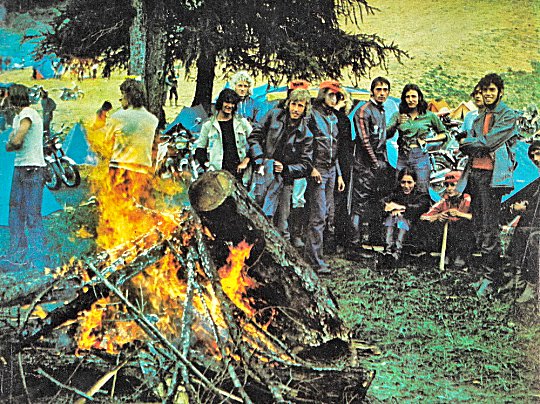

As the storms swept across Pra‑Loup, the campfires became a welcome refuge where soaked riders gathered to dry their clothes, warm themselves and share the enduring spirit of the Chamois.
The mountains were delivering a stark reminder that they alone remained the true masters of the landscape.
On Saturday, just as the traditional parade finally seemed set to take place under more favourable skies, another storm of exceptional violence suddenly swept across the mountains.
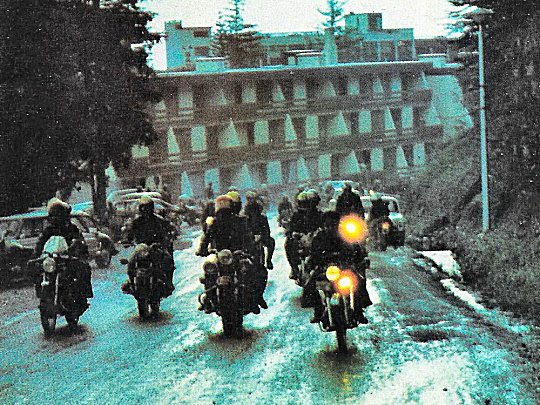
Participants setting off in the pouring rain for the traditional parade. Previously held every Sunday morning since 1965, it was exceptionally rescheduled to Saturday afternoon for the 1972 rally.
The storm reached an extraordinary level of violence.
Within minutes, the mountain slopes were transformed into raging torrents. Powerful floodwaters surged down the hillsides before forcing their way into several homes.
All around the valley, lightning ripped across the sky, striking the surrounding peaks with terrifying force.
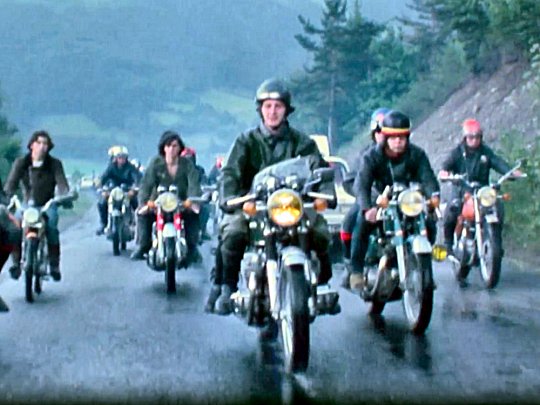
Behind Jean Murit, leading the procession aboard an Ossa Trial, thousands of motorcyclists completed the climb to Pra‑Loup under torrential rain.
The almost continuous roar of thunder, echoing from one mountainside to another, plunged the entire region into an atmosphere that was as spectacular as it was apocalyptic.
Pra‑Loup narrowly escaped a genuine disaster. Just a few kilometres from the resort, lightning struck the alpine pastures, killing seventy grazing sheep instantly. It was a dramatic reminder of the sheer ferocity of the unleashed elements.
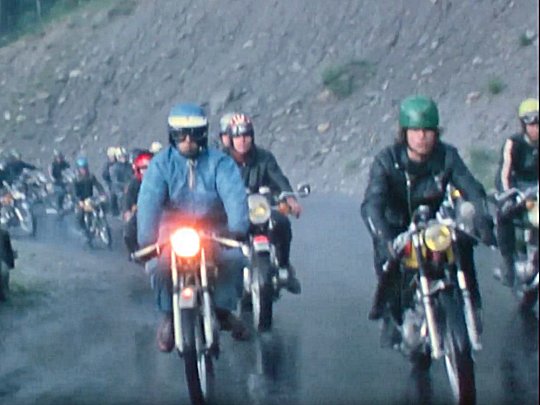
Despite the relentless rain, the traditional Chamois parade went ahead, with thousands of motorcyclists making the climb to Pra‑Loup.
In reality, this outburst of the elements was only the prelude to a chain of events that would dramatically alter the course of the rally and make this eighth edition one of the most eventful in its entire history.
Text: Jean-Francois Helias
Photos: Gilles Gaudechoux & J.F Helias
To be continued with Part 2