Rainbow Rally
A century of motorcycling in the Grand Duchy
The Motor-Union of the Grand Duchy of Luxembourg (MUL) was founded on 5 May 1922 under the name Club des Motocyclettes Luxembourgeoises (CML).
Just one year later, in 1923, the organisation adopted the name by which it is still known today: the Motor-Union of the Grand Duchy of Luxembourg (MUL).
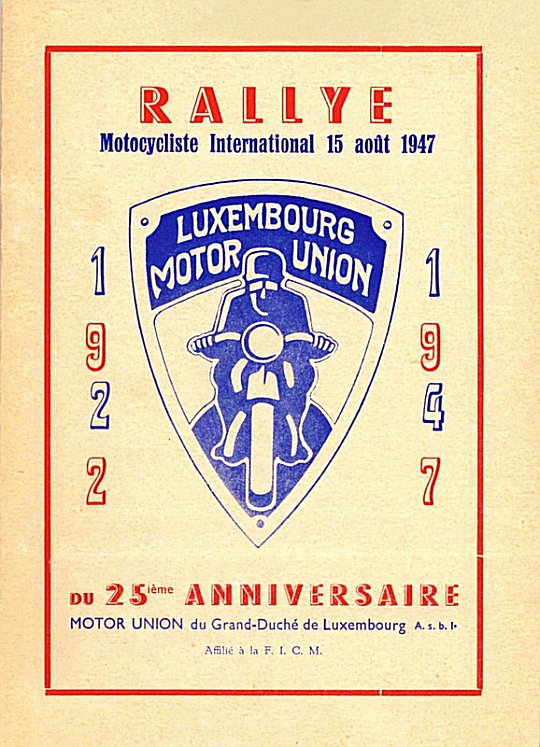
Left: Official MUL badge. Right: Commemorative card issued for the International Motorcycle Rally held on 15 August 1947 to celebrate the 25th anniversary of the Luxembourg Motor Union.
Since 1926, it has served as Luxembourg's official representative within the Fédération Internationale de Motocyclisme (FIM). Today, the MUL brings together twelve affiliated motorcycle clubs and governs every branch of motorcycling in the Grand Duchy, including touring, road racing, motocross, trials and enduro.
Alongside the national federation, a second organisation also plays an important role within Luxembourg's motorcycling community. Founded in 2021 with the support of the Automobile Club of Luxembourg (ACL), the Maison du Motard unites fourteen motorcycle clubs devoted primarily to touring and recreational riding. Several of these clubs are not affiliated with the MUL, illustrating both the diversity and vitality of motorcycling in this small but enthusiastic country.
The 1970s: Luxembourg's golden age of motorcycle rallies
As far as motorcycle touring was concerned, the golden age of Luxembourg's rallies came during the first half of the 1970s. At the time, no fewer than ten motorcycle gatherings were held each year across the Grand Duchy.
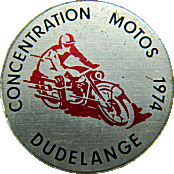

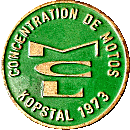
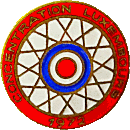
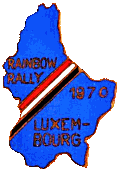
A selection of badges from Luxembourg's most prestigious motorcycle rallies of the 1970s, the Grand Duchy's golden age of motorcycle touring.
Among the best known were the Brouch Rally, Rallye des Copains, Dudelange Rally, Ehlange Rally, Kopstal Rally and the Vallée de l'Our Rally, all of which played a significant role in establishing Luxembourg's reputation on the European motorcycling scene.
As I have mentioned in previous articles, 1974 and 1975 marked the beginning of a genuine love affair with Belgium and its motorcycle rallies.
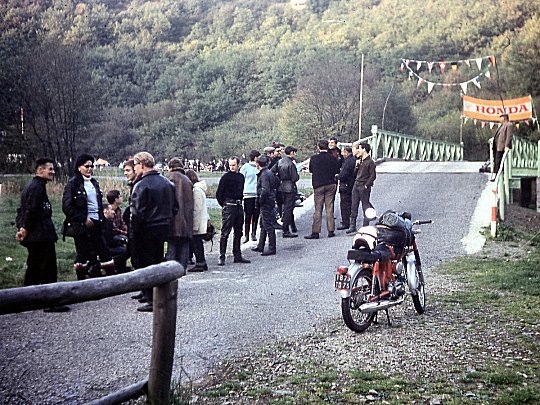
Rainbow rally 1967 - The entrance to the rally. Riders gather for a chat beneath a Honda banner, one of the sponsors supporting the 1967 Rainbow Rally in Brouch.
During those two years I forged many lasting friendships with Belgian motorcyclists, which only strengthened my desire to return time and again. I found myself crossing the Belgian border almost every month — sometimes even twice — to take part in the country's best-known gatherings.
The hundreds of kilometres that had to be covered in the saddle never seemed a hardship. The unique atmosphere of those rallies, the legendary warmth of Belgian hospitality and the pleasure of meeting up with friends were more than enough to justify a long round trip for nothing more than a single weekend of motorcycling fellowship.
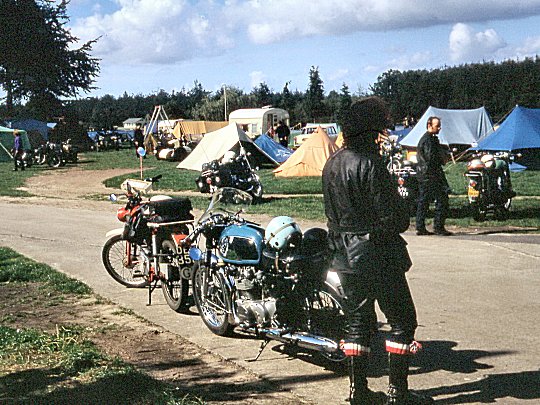
Rainbow rally 1967 - A peaceful corner campsite. Dozens of motorcycles and colourful tents reflect the international appeal of Luxembourg's most famous motorcycle rally.
With the Grand Duchy of Luxembourg lying on Belgium's doorstep, it was only a matter of time before I ventured across the border as well. During 1974, I attended two of the country's finest motorcycle rallies: Brouch and Dudelange, both regarded among Luxembourg's premier gatherings of the period.
The rally that drew Europe to Luxembourg
Long before my own visits, however, my friend and senior, Jean-Marie Debonneville, had already discovered the roads of Luxembourg. In 1967 and again in 1968, he attended what remains to this day the most famous motorcycle gathering ever organised in the Grand Duchy: the legendary Rainbow Rally.
Rainbow rally 1967 - A fascinating line-up of motorcycles outside the Hotel Huberty. The variety of British, Belgian, German, French and Luxembourg registration plates bears witness to the truly international character of the gathering.
Held in the village of Brouch, in the canton of Mersch in western Luxembourg, this internationally renowned event attracted motorcyclists from every corner of Europe.
From a historical perspective, very little is known about the organisation of the Rainbow Rally, which — judging by every commemorative badge I have had the privilege of examining over the years — appears to have been held from 1967 to 1970.
That said, this does not necessarily mean that no earlier editions took place before 1967.
Even less is known about the club behind the organisation of the event. Nearly sixty years later, our esteemed nonagenarian Jean-Marie Debonneville can no longer recall the name of the man who was the driving force behind the rally.
In fact, virtually nothing has survived about the organisers.
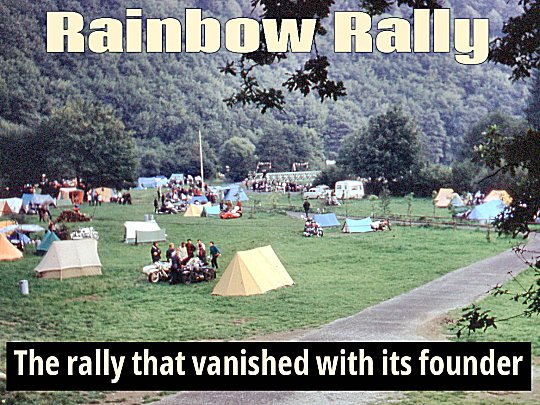
Rainbow rally 1968 - The Rainbow Rally campsite in 1968. For one weekend, this peaceful corner of Luxembourg was transformed into an international village of motorcyclists.
The only certainty is that there was a principal organiser whose vision and dedication made the Rainbow Rally possible. His story — and the tragic circumstances that brought both his life and the rally itself to an end — will be told in the concluding section of this article.
When fate crossed the road
One memory, however, has never faded. Jean-Marie still recalls the story behind the Rainbow Rally's unexpected disappearance. According to him, the event came to an end after the tragic and highly unusual death of its principal organiser.
A general view of the Rainbow Rally campsite in 1969
One evening, while riding home from work after dark, he was struck by a wild boar that suddenly burst out of the forest and ran across the road. Thrown from his motorcycle, he was killed instantly.
With his untimely death, the Rainbow Rally itself disappeared, bringing to a close one of the most remarkable chapters in Luxembourg's motorcycling history.
Beyond the miles
Looking back almost sixty years later, one cannot help but reflect on how strangely fate sometimes writes its own stories. The Rainbow Rally brought together several hundred motorcyclists in search of freedom, adventure and friendship, yet its own story ended because of a single, tragic moment on a quiet country road.
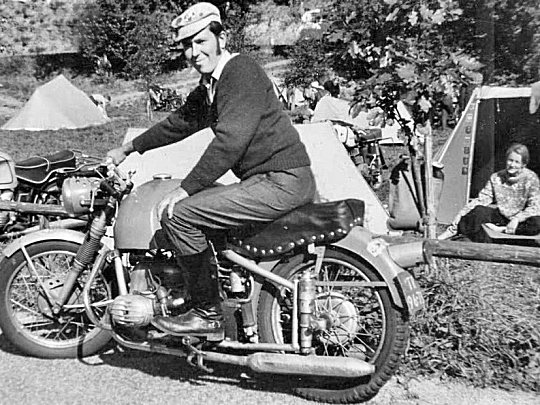
A smiling rallyman proudly poses on his faithful BMW at the 1969 Rainbow Rally.
It is a sobering reminder that our lives can change in the blink of an eye. We all make plans, dream of future journeys and imagine the miles still to come, never knowing which ride will be our last. Sometimes, destiny needs no more than a split second to alter everything.
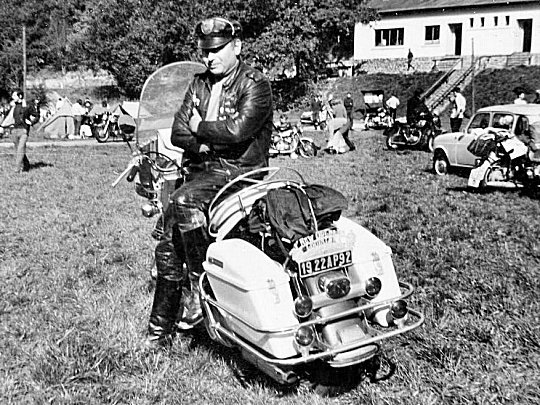
A French rallyman from the Hauts-de-Seine department and his imposing, fully equipped Harley-Davidson at the 1969 Rainbow Rally.
Perhaps that is why rallies have always meant so much to those who attend them.
Beyond the motorcycles, and the miles travelled, they celebrate something far more precious: the privilege of being alive, of sharing the road with friends and of creating memories that will outlive us all.
In the end, machines grow old, badges gather dust and campsites disappear, but the stories — and the people who inspired them — remain.
Text: Jean-Francois Helias
Photos: J.M. Debonneville & J.F Helias