Vercingétorix Rally
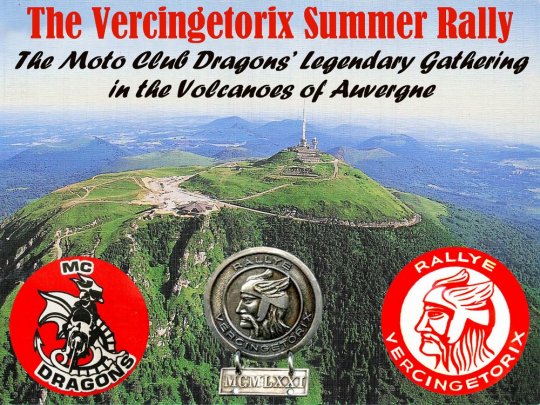
One cannot evoke the Vercingétorix Rally — this notorious summer gathering organized in the 1970s by the legendary MC Dragons — without first outlining the portrait of this emblematic club from Auvergne, as well as that of its charismatic founder and leader, Christian ‘Kiki’ Blanchot.
For behind this legendary gathering, there is a club, a group, a spirit… and above all, a man. The subject is therefore vast and, in itself, deserves thorough development.
This is why a dedicated page will soon be devoted on this site to the history of the MC Dragons of Clermont-Ferrand, now recognized, alongside its counterpart the MC 95 of Enghien-les-Bains, as the two greatest ‘pirate’ clubs in the history of French motorcycle touring.
The club’s early days in brief
Founded in Clermont-Ferrand in December 1968 by Christian “Kiki” Blanchot, a true leader of men, the MC Dragons was born around some thirty enthusiasts who would gather at the Estancia bar — a handful of bikers bound together by the road, friendship, and a shared desire for elsewhere.
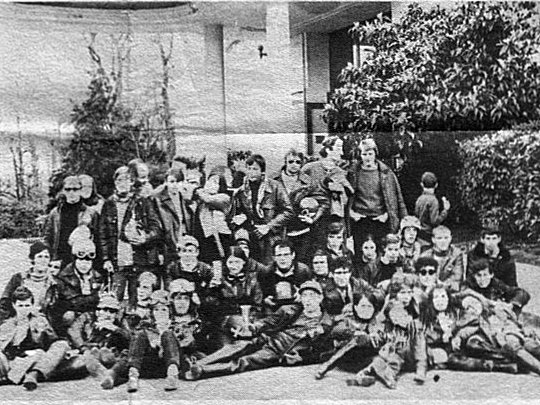
Posing for posterity, the MC Dragons is photographed here around 1969. President Kiki stands at the centre, in the background, wearing dark glasses.
But very quickly, things accelerate. As early as 1969, the club already had nearly 130 members. Driven by a spirit of freedom and a pronounced taste for adventure, the group grew before one’s eyes, eventually reaching nearly 200 members at its peak — a veritable tribe.
The MC Dragons distinguished itself above all by its strong taste for motorcycle touring, an orientation that owed much to the influence of Kiki Blanchot’s guiding figures, as he was then fascinated by the great travellers Robert Sexé and Jean-Marie Debonneville.
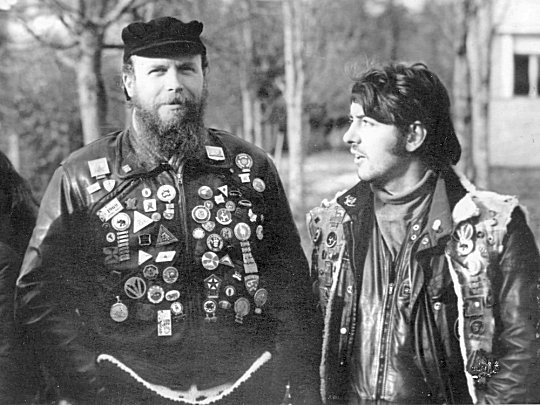
A young Kiki Blanchot (on the right) is photographed here alongside Debonneville (on the left).
In 1969, the young club joined the Moto Club d’Auvergne, affiliated with the FFM and then presided over by Marcel Cornet. It had no other choice: if it wanted to compete in the French Touring Championship, organized by the Fédération Française de Motocyclisme, affiliation was mandatory at the time, as the competition was not open to independent rally riders.
Every weekend, a solid core of its members took part in the major rallies of the era, competing under the colours of the Moto Club d’Auvergne.
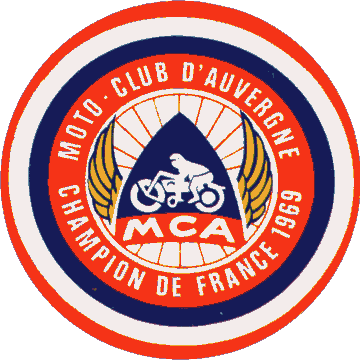
The sticker produced on this occasion by the MC Auvergne.
Their commitment and determination quickly paid off: as early as 1969, they made a significant contribution to winning the French motorcycle touring championship title for the MC Auvergne. A success largely attributable to the Dragons, given the limited involvement of the MCA in this venture.
However, as in many French clubs at the time — where motorcycle touring was often considered the poor relation of the discipline — the members of the MC Dragons felt they were not being recognized at their true worth. Frustration, misunderstanding, and a desire for independence gradually fueled an inevitable break.
In 1970, Kiki and his group struck out on their own and left the Moto Club d’Auvergne to found a free, independent club. The Dragons had chosen their side: that of freedom.
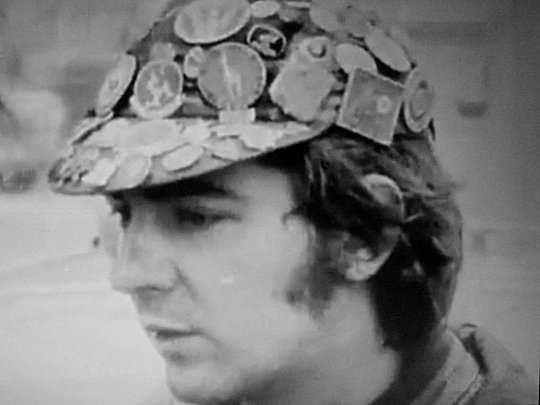
A young Kiki Blanchot is filmed here at the 1970 French Grand Prix in Le Mans for an INA documentary. His cap says a lot about his passion and enthusiasm for rallying.
The birth of the ‘piraterie’ spirit
A founding decision that marks the beginnings of the ‘piraterie’ movement in French motorcycle touring. This current, then emerging, would in the following years give rise to numerous ideological clashes with the governing bodies of the Fédération Française de Motocyclisme, then perceived as rigid and out of touch with reality.
A movement that would shape up the French motorcycling landscape, disrupt traditions, and provoke, in the years that followed, real ideological confrontations with a Fédération Française de Motocyclisme considered too rigid, too far removed from the field… and above all incapable of understanding this new generation of riders.
Why Vercingétorix became the rally’s name
When one is from Auvergne and has to name a motorcycle rally, the name Vercingétorix comes naturally. A powerful symbol of the region, it perfectly embodies the spirit of such a gathering.
A war leader of the Arverni, he distinguished himself by uniting the Gallic tribes against Julius Caesar. His name remains linked to the victory of Gergovia and the defeat at Alesia in 52 BC, which sealed the fate of Gaul.
Captured, imprisoned, and then executed in Rome, he became a legendary figure. Even today, he embodies resistance and pride — values that resonate perfectly with the free and indomitable spirit of the MC Dragons.
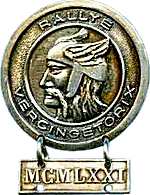
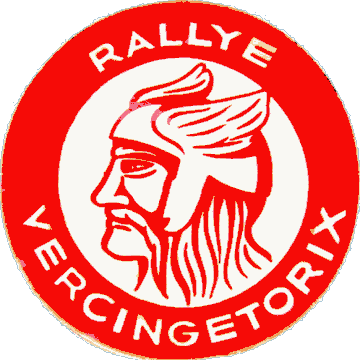
The 1971 badge, with its original year bar in Roman numerals, as well as the sticker from the 1976 gathering.
In this regard, like most MC Dragons memorabilia — with the exception of the sticker from the 1977 Rallye-Neiges, designed by Thibault Feuillade (PAVECK section) — these creations are the work of Kiki Blanchot.
For beyond being a motorcyclist, Kiki was also a skilled draftsman, trained at the École des Beaux-Arts in Clermont-Ferrand, where he associated with the renowned Auvergne painter André Corny.
1970 – First gathering atop the Puy-de-Dôme
The Dragons had made a name for themselves in record time. By consistently standing out at the rallies they attended, their very first event was highly anticipated. It was scheduled for 15 and 16 July 1970, the week following the Chamois Rally of the BMW Club de France.
Among certain affiliated clubs — and even within the ranks of the FFM — bets were running high: for many, such a gathering could only be disorganized, even chaotic, given the sulphurous reputation of the club.
(left) on the way to Place du 1er-Mai, the MC 95 delegation represented by Bruno Bérard, Francis Arondel, and Francis Maillard. (right) In the square, MC Dragons president Kiki Blanchot (wearing a cap) and vice-president Philippe Herbin (the tallest, behind him) welcoming the arrivals.
They were sorely mistaken. For although everything was far from perfect, this first edition was widely recognized by the majority of participants as a genuine success.
As was notably attested by the great Belgian rally rider, the late Jean Delain, in a report published in Moto-Revue:
“We emphasize the very good organization of this first Vercingétorix rally. All the Dragons worked tirelessly every day to try to create something worthwhile: signposts, dispatch riders at the entrances to the city (our friends Daniel and Amy, on BMWs from the Moto-Club Châtillonnais, had the pleasant experience of this).
“We are touched by all these young people whose passion for motorcycling is without limits, and we only left two days after this gathering, somewhat saddened to part from such good friends.”
Attempted sabotage
And yet, nothing had been spared the MC Dragons.
Some of their detractors — most likely close to the FFM — had tried until the very end to derail the event. Just a week before the scheduled date, a misleading statement even appeared in the press, bluntly announcing the cancellation of the rally • • •
A view of the arrivals at Place du 1er-Mai.
But fortunately, the attempt failed.
Despite this bogus statement, more than 600 participants — 560 of them officially registered — coming from all over France and even from abroad, converged that weekend on Clermont-Ferrand. More specifically, they gathered at Place du 1er-Mai, where Kiki and his team awaited them at the checkpoint and registration point.
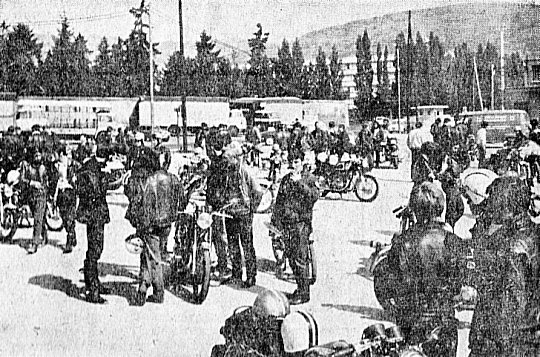
From dawn on Saturday, participants pour in. After registering, they head to the campsite near the Cliersou caves, overlooking the volcanoes of Auvergne.
The most distant among them? An Australian motorcyclist, visiting France on holiday, who did not miss the opportunity to take part in the event.
An epic climb to the Cliersou caves
For the campsite, the Dragons had obtained authorization from the authorities so that the rally riders could settle near the Cliersou caves.
It is hard to imagine a more remarkable setting, in the heart of nature, to pitch a tent: the surrounding panorama is exceptional and offers a breathtaking view over the volcanoes of Auvergne.
Carved by human hands during the Merovingian period, the Cliersou caves were used to extract stone and manufacture sarcophagi.
On the other hand, reaching the campsite proved to be a real challenge on two wheels, one that everyone had to face. Following the summer storms of the previous days, the waterlogged tracks made the climb considerably more difficult.
It was necessary to help one another push machines that were slipping and sliding sideways in the mud, all in a joyful and convivial chaos where no one was spared. More than one volunteer who came to lend a hand ended up splattered with mud.
The Sunday at the Puy-de-Dôme
If the Saturday evening at the campsite was among the most convivial — around campfires, set to the rhythm of the traditional bawdy and risqué songs sung by the bards of the time and taken up in chorus by everyone present — the highlight of the rally was without a doubt the picnic on the following Sunday.
The MC Dragons had in fact invited all participants to a picnic lunch in the majestic setting of the summit of the Puy-de-Dôme.
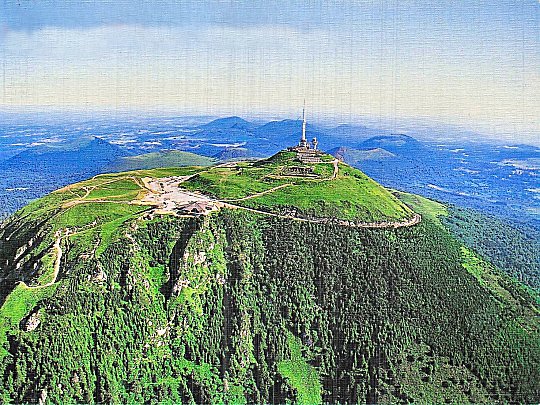
One must admit, it is hard to find a more beautiful place to organize a picnic among rally riders…
For readers who may never have heard of this magical place, it should be noted that this volcano, although one of the youngest in the range (around 11,000 years old), is both the most famous and the highest — rising to 1,465 meters in altitude — of the 80 dormant volcanoes aligned in the Chaîne des Puys, very close to Clermont-Ferrand.
From its summit, the rally riders could enjoy a spectacular 360° panoramic view over the Chaîne des Puys, the Limagne plain, and the fine city of Clermont-Ferrand.
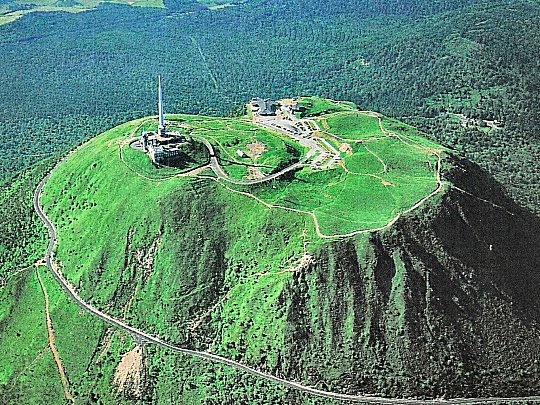
Excavations there have uncovered the remains of a Roman temple dedicated to Mercury (2nd century), attesting to an important ancient pilgrimage site. Today, the summit also hosts a meteorological station and telecommunications antennas.
For the countryside lunch, everyone enjoyed generous skewers of meat and grilled merguez cooked over coals, accompanied by a delicious local Auvergne wine, served freely from two impressive barrels.
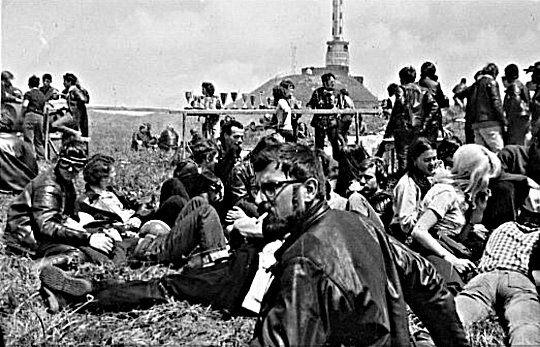
On the heights of the Puy-de-Dôme, a reflection of a time when gatherings blended a spirit of freedom, camaraderie, and simple pleasures.
The atmosphere was so convivial that, it is said, two motorcyclists from the national gendarmerie, tasked with escorting the participants to the Puy-de-Dôme, were invited to share a drink.
They reportedly then experienced the greatest difficulty getting back on their bikes to ride down toward Clermont-Ferrand.
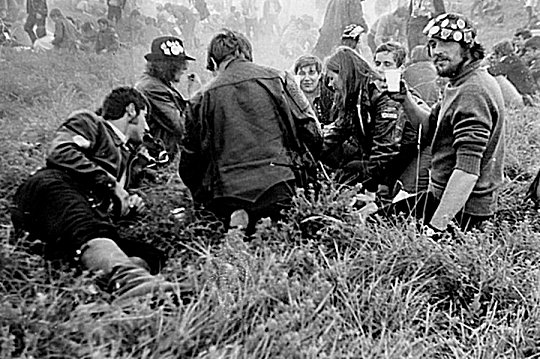
Official report: ascent successful... descent uncertain after intensive tasting of Auvergne wine.
When the Dragons empty the bakeries
Overwhelmed by the unexpected scale of the event, the Dragons quickly found themselves facing an event overwhelmed by the sheer number of attendees.
The provisions, though carefully planned, ran out far sooner than expected, swept away by the general enthusiasm. It was then necessary to improvise urgently: the surrounding bakeries were called upon — sometimes insistently — to make up for the shortage and provide enough to sustain the hungry crowd.
But these minor logistical inconveniences took a back seat. For the essential lay not in the organization, however strained it may have been, but in the collective momentum, the conviviality, and the spirit of sharing that animated all the participants.
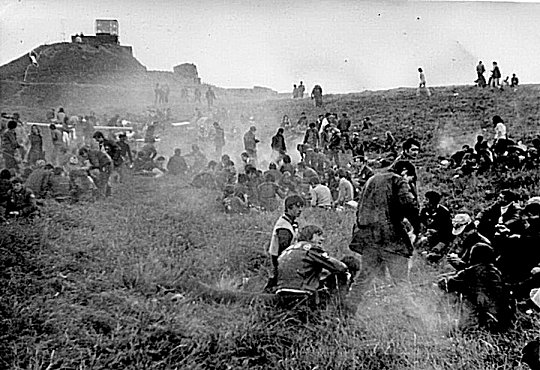
Impeccable organization: the chaos is perfectly under control.
Kiki Takes the Stage
Once the meal was over, and before the majority of participants began their journey home, came the much-anticipated moment of the traditional prize-giving ceremony, as was customary at the time.
Placed under Kiki’s direction, the ceremony quickly turned into a true spectacle.
Prize-giving, Dragons style: Kiki in full action, an improvised master of ceremonies and unquestioned guarantor of good spirits.
The numerous awards and trophies intended to honour the most deserving were none other than those accumulated over the years by the MC Dragons during the many rallies in which its members had taken part — a self-deprecating nod to their own history.
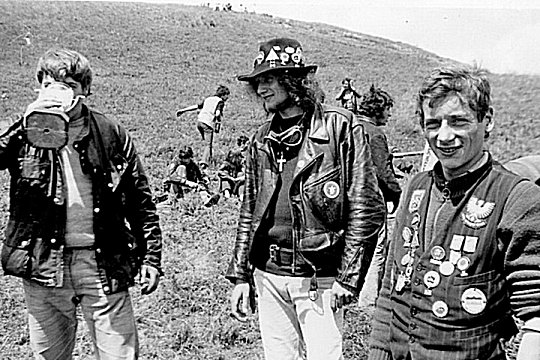
A symbol of an unpretentious atmosphere: here, trophies are also used for toasting.
Among the award recipients, one rider stood out in particular: an Australian motorcyclist who had travelled an astonishing and wholly unexpected distance. Passing through Auvergne on holiday, he took the opportunity to join the rally, riding a two-stroke scrambler piled high with luggage.
Unsurprisingly, his presence did not go unnoticed. He was awarded the trophy for the longest journey — a distinction he accepted with a broad smile and celebrated, in true Dragons spirit, by raising a drink… straight from the cup.
(left) His machine loaded like a pack mule; (right) the Australian, now wearing a beret, sets off again as a Frenchman by adoption — a sign of successful integration.
The birth of a myth on the volcanoes
At the end of this first edition, the detractors of the MC Dragons — foremost among them certain figures close to the Fédération Française de Motocyclisme — were forced to admit, not without reluctance, that they had been seriously mistaken about the organizational abilities of these young motorcyclists from Auvergne, in whom they had placed so little faith.
Admittedly, everything was not perfect: the Sunday picnic experienced a slight disruption, as the provisions were overwhelmed by a turnout far greater than expected. But beyond this setback, this first Vercingétorix Rally came close to excellence.
The journalist from the specialist press, Jean-Pierre “Zinzin” Frisquet — future co-founder of Moto Journal — was not mistaken when he wrote that it was “something halfway between a Woodstock and a Chamois of the great years.”
A particularly eloquent tribute to this first summer rally orchestrated by Blanchot’s crew.
The End of a Legend
Buoyed by this success, the club did it again in July 1971, with a new gathering, this time organized at the Puy de Sancy.
Then, as the initial momentum began to fade, it was not until 1975 that a third edition emerged — more confidential, by invitation only, reserved for the elite of long-distance riders — held in Montmorin.
The final two editions, in the same spirit, took place at the watchtower of the château of Montaigut-le-Blanc.
Text: Jean-Francois Helias
Images: G. Gaudechoux & J.F Helias

Un grand merci pour tous les efforts et le temps que tu consacres à rédiger ces articles sur les grands rallyes d’hier. Au fil de tes récits, tu deviens la mémoire vivante de cette époque que nous avons tant aimée.


- Hervé « Le Grec » Bully
Co-fondateur de la Confrérie Motocycliste des Gueux d’Route